Your mortgage is not going anywhere. Groceries cost more than they did two years ago. And the backyard behind your house? It is just sitting there. Collecting leaves. Maybe a stray soccer ball. Nothing else. Rent Backyard for Money is ideal.
Meanwhile, your neighbor three streets over quietly collects a check every month because someone is storing an RV on their side lot. Another person in your city just made $600 from a birthday party held in their garden. And someone else is getting paid every single time a dog owner shows up to let their pup run around a fenced yard.
You are not missing some complicated investment strategy. You are missing the obvious thing right outside your back door.
This guide covers everything you need to know about how to rent backyard for money in a real, practical way. No fluff. No vague advice. Just the actual platforms, real income ranges, and honest answers to the questions most people Google before they start.
Why Your Backyard Is Worth More Than You Think
Most homeowners think passive income means buying a rental property or dumping money into stocks. But there is a whole category of income sitting right outside your back door, and it requires zero capital to start.
The demand is real for Rent Backyard for Money. People in dense neighborhoods need storage for their RVs, boats, and extra cars. Families want private outdoor spaces to celebrate without paying for an event hall. Dog owners desperately want fenced yards where their pets can run freely. Photographers need natural backdrops for shoots. And engaged couples are increasingly looking for intimate, affordable alternatives to expensive wedding venues.
Your backyard does not need a pool or a professional landscape design to be worth renting. It needs to be safe, reasonably clean, and listed in the right place.
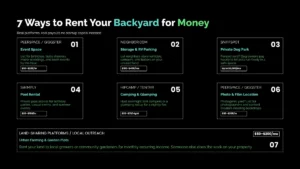
7 Real Ways to Rent Backyard for Money
1. Rent It as a Private Event Space
This is one of the most straightforward ways to generate unused land income. Platforms like Peerspace and Giggster let homeowners list outdoor spaces by the hour for events like birthday parties, baby showers, bridal showers, micro-weddings, and networking gatherings.
You set the hourly rate, define availability, and guests book directly through the platform. Depending on how large your yard is and what amenities you offer (a patio, string lights, seating), listings in suburban markets regularly earn between $50 and $200 per hour. Larger or more photogenic yards in metro areas can command significantly more.
What makes this model work is that event venues are expensive and impersonal. A private backyard feels intimate and affordable by comparison. That gap is where your income opportunity lives.
2. Rent Rent Backyard for Money as a Storage Space
This is one of the most genuinely passive options available. Platforms like Neighbor.com let you list your driveway, side yard, or any unused outdoor area as storage for vehicles, RVs, boats, campers, and trailers.
One Colorado homeowner named Mark listed his unused acreage on Neighbor and now earns over $1,300 a month spending only about 20 minutes of his time each month. The platform handles payments, matches renters, and even provides a $1 million host guarantee. Mark stores a mix of campers and vehicles on basic gravel ground. No prep required.
If you want to rent space for storage, Neighbor is the simplest starting point. Listing is free and the platform only takes a 4.9% processing fee plus 30 cents per payout. A single RV storage spot in many areas earns between $100 and $300 per month.
3. Let Dog Owners Use It as a Private Dog Park
Sniffspot is a platform specifically built for this. Dog owners pay to book private yards by the hour so their pets can run freely without the chaos and risk of public dog parks. Hosts list their yard, set house rules, specify whether other animals will be present, and earn per booking.
Hourly rates run from $4 to $30 depending on yard size and location, with most listings sitting under $15 per hour. Top earners on the platform reportedly bring in over $3,000 a month. Sniffspot also provides $2 million in liability insurance for hosts, which removes a major concern for homeowners worried about injuries.
If you have a fenced yard of any size, this is one of the easiest ways to start earning from it immediately.
4. Rent Your Pool (If You Have One)
Swimply is the platform that made private pool rentals mainstream. Homeowners with pools list them by the hour, and guests book for birthdays, summer celebrations, or just a relaxing afternoon swim. Optional add-ons like towels, pool toys, or hot tub access let you increase your rate.
Pool rentals typically start around $35 to $50 per hour, though well-equipped listings in warm markets can charge considerably more. Swimply has since expanded beyond pools to include tennis courts, home gyms, and studios. If you have a pool and it sits unused most of the week, this is one of the higher-earning backyard income options available.
5. List It for Photo Shoots and Film Projects
Photographers, videographers, content creators, and even small film crews regularly need outdoor locations that look good on camera. If your backyard has character (think mature trees, a garden, a patio, an interesting fence, good natural light) it could be exactly what someone is searching for.
Peerspace is again the go-to platform for this. Outdoor shoot locations in major cities commonly list for $75 to $250 per hour. Even in smaller markets, a photogenic yard can earn meaningfully from just a few bookings a month.
6. Host Camping or Glamping Guests
Yes, people pay to camp in private backyards. Platforms like Hipcamp, Tentrr, and even Airbnb allow homeowners to list outdoor space for overnight stays. Whether you let guests pitch a tent, park a camper, or glamp in a decorated setup you provide, this model taps into a growing desire for private, nature-adjacent experiences.
Pricing varies widely based on amenities, but a basic tent spot with fire pit access can earn $25 to $75 a night. Add a comfortable glamping setup and that number climbs quickly.
7. Grow and Sell From the Space
This is less passive but worth mentioning for those with larger yards. Renting out a plot to a community gardener, a small urban farmer, or a composting service turns unused land into recurring income. Some platforms match landowners with local growers who pay monthly to use the space for cultivation.
Even if you never see the land yourself, the income shows up each month while someone else does the work on your property.
How Much Can You Actually Earn Renting Your Backyard?
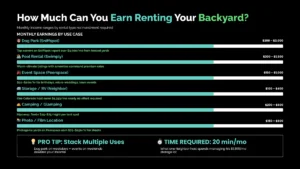
The honest answer is: it depends on your location, your yard, and how many uses you stack. But here is a realistic breakdown to give you a baseline:
- Storage on Neighbor: $100 to $400 per month per spot
- Sniffspot dog park rentals: $200 to $800 per month depending on bookings
- Event space on Peerspace or Giggster: $150 to $1,000 per month depending on frequency
- Pool rentals on Swimply: $300 to $1,500 per month in warm seasons
- Camping or glamping: $200 to $600 per month with consistent bookings
- Photo shoot location: $150 to $600 per month based on local demand
Many hosts stack multiple income streams from the same space. The backyard that hosts a dog during weekday mornings can be available for events on weekends. The yard listed on Peerspace for photo shoots can also bring in Sniffspot revenue on off days. This stacking is where the real numbers start to add up.
What You Need to Do Before You List
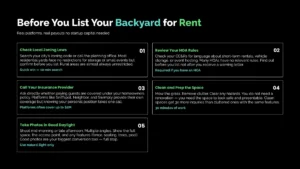
Before you post your first listing, there are a few things worth sorting out so you do not run into problems later.
Check Local Zoning Rules
Some municipalities limit how often you can rent your property or require permits for events above a certain number of guests. A quick call to your local planning office or a search on your city’s website will answer this in minutes. Most residential backyards used for occasional storage or small events face no restrictions at all.
Review Your HOA Rules
If you live in a neighborhood with a homeowners association, check your CC&Rs before listing anything. Some HOAs restrict short-term rentals or storage of vehicles. Others have no relevant rules at all. Find out before you get a letter.
Look at Your Insurance Policy
Your standard homeowners policy may or may not cover paying guests on your property. Call your insurance company and ask directly. Most platforms like Sniffspot, Neighbor, and Swimply provide their own liability coverage, but knowing where your personal policy stands is worth the 10-minute call.
Set Up Your Space and Take Good Photos
You do not need a renovation. You need the space to look clean, safe, and honest in photos. Mow the grass. Remove any junk or clutter. Take photos in good daylight from multiple angles. Good photos consistently outperform identical listings with bad photos. This is the most direct thing you can do to increase your bookings.
Best Platforms to Rent Backyard for Money
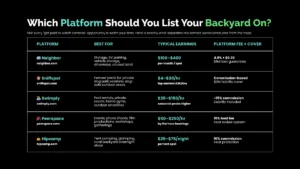
Here is a quick reference for where to list based on what you want to rent your backyard for:
- Neighbor.com: Best for storage, RV parking, vehicle storage, and driveway rentals
- Sniffspot: Best for fenced yards available for private dog park sessions
- Swimply: Best for pool rentals and private outdoor amenities
- Peerspace: Best for event space, photo shoots, video productions, and gatherings
- Giggster: Best for film and photography location rentals
- Hipcamp or Tentrr: Best for camping, glamping, and overnight outdoor stays
- Airbnb Experiences: Best for hosting outdoor workshops, tours, or unique local activities
Most of these platforms are free to join. They take a commission (usually between 5% and 25%) only when a booking is confirmed. That means no upfront cost and no risk if you do not get bookings right away.
The Bottom Line
Your backyard is an asset. It sits on land you already pay for, maintain, and insure. The only question is whether it works for you or just sits there.
Renting your backyard for money does not require a business plan or startup capital. It requires a listing on the right platform, a few photos taken in decent light, and a price that reflects what others nearby are charging.
Whether you want a few hundred dollars a month covering a utility bill or you want to build a stacked system of backyard income streams, the opportunity is real. The people earning it are not special. They just started.
Ready to explore more odd but legitimate side hustles like this one? Head over to weirdwealth.io/category/odd-side-hustles/ for more.
Frequently Asked Questions
Can I rent my backyard for parties and events?
Yes. Platforms like Peerspace and Giggster are specifically built for this. You list your outdoor space, set an hourly rate, and guests book for events like birthdays, bridal showers, baby showers, micro-weddings, and team gatherings. Some hosts earn several hundred dollars from a single weekend booking.
How do I rent my backyard for dog use?
Sniffspot is the leading platform for this. You create a host profile, describe your yard (size, fencing, whether other animals are present), and set an hourly rate. Dog owners in your area search and book your space directly through the app. Sniffspot provides $2 million in liability coverage for hosts at no charge.
What is the best app to rent your backyard for money?
It depends on the use case. For storage, Neighbor.com is the most established and hands-off option. For events and photo shoots, Peerspace leads the market. For dog parks, Sniffspot is the dedicated choice. For pools, Swimply is the original. Many hosts list across multiple platforms to maximize occupancy.
How much can I make renting out my backyard?
Earnings vary by location, yard size, and how many income streams you activate. Storage hosts on Neighbor commonly earn $100 to $400 per month per spot. Event space hosts on Peerspace can earn several hundred dollars from a single booking. Dog park hosts on Sniffspot report top earners bringing in over $3,000 per month. Stacking multiple uses across the same space is where the highest earners operate.
Is renting your backyard for money legal?
Generally yes, but it depends on your local zoning laws, HOA rules, and the type of rental. Storage and private event rentals are permitted in most residential areas. Check your city’s zoning code and your HOA guidelines before listing. Most platforms also offer guidance on local compliance.