
Key Takeways
- $28/hour equals about $58,240 gross annual income (full-time 40 hrs/week).
- Average monthly income ≈ $4,853 before taxes and deductions.
- Biweekly earnings come to about $2,240 per paycheck (26 pay periods/year).
- Estimated take-home pay is ~$3,800–$4,100 per month after taxes.
- Budgeting matters: income supports savings, essentials, and lifestyle balance using structured planning (like 50/30/20 rule).
Earning a consistent hourly wage is one of the best ways to build predictable financial security. If you have recently secured a job paying this rate, or if you are aiming for a raise, you are likely wondering: 28 an hour is how much a year?
When working a traditional full-time schedule, an hourly rate of $28 translates to an estimated gross 28 dollars an hour annual salary of $58,240.
While that baseline number gives you a solid starting point, your actual take-home pay depends heavily on variables like taxes, your state of residence, and your specific workplace benefits. At Weird Wealth, we believe that understanding your base number is only the first step.
True financial clarity requires breaking down your earnings into monthly, biweekly, and daily intervals so you can build a lifestyle that prioritizes saving and smart investing. This complete guide provides the exact breakdown of a $28 hourly wage for the 2026 calendar year.
AI Overview
$28/hour equals about $58,240/year (40 hrs/week), ~$4,853 monthly, and ~$2,240 biweekly before taxes. After deductions, take-home is roughly $3,800–$4,100 monthly. Budgeting (50/30/20) helps manage essentials, lifestyle, and savings. Overtime, taxes, and benefits affect final pay. Overall, $28/hour provides stable income and strong foundation for financial planning and savings. (≈395 chars)
The Standard Full-Time Calculation
To convert a 28/hr to yearly income figure, financial planners rely on the standard work year baseline. Assuming a traditional full-time schedule, you will work 40 hours per week across 52 weeks. This brings your total to 2,080 working hours over the course of the year.
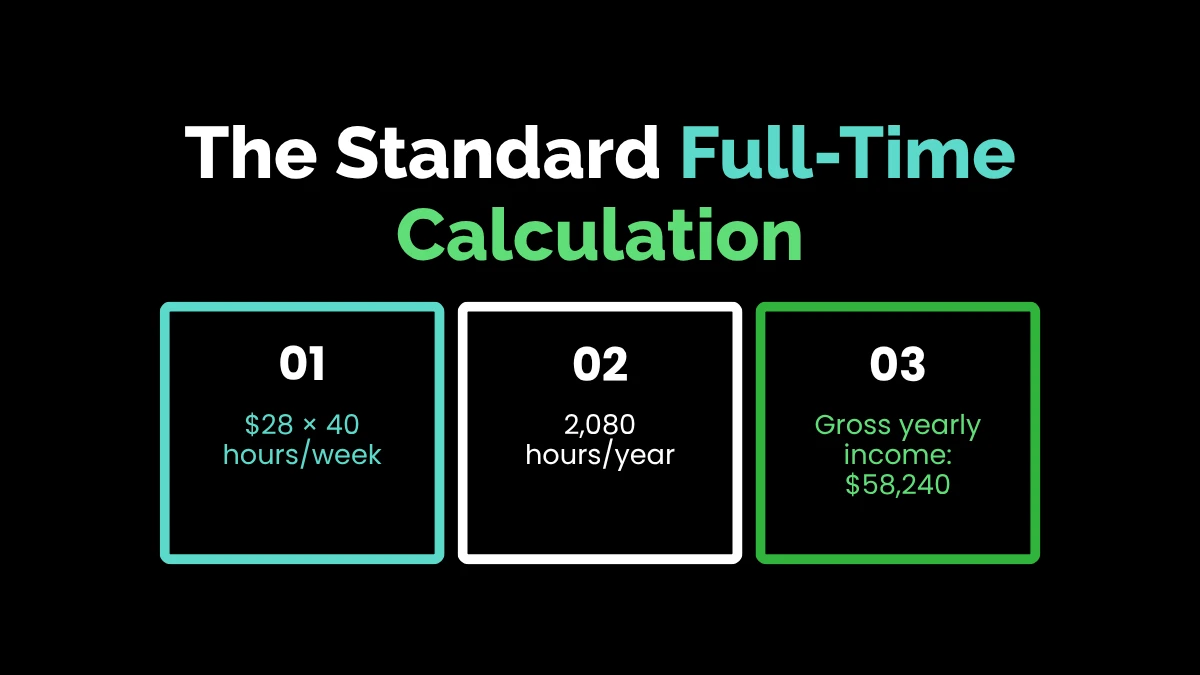
This $58,240 baseline serves as your total compensation before any automatic paycheck deductions are applied. If your position includes paid time off (PTO) for vacations and standard federal holidays, your yearly earnings will match this total exactly.
However, if your employer does not provide paid leave, your annual figure will drop during the weeks you take time off from regular shifts.
28 an Hour Paycheck Breakdown
Reviewing a raw annual figure can make everyday budgeting difficult. To gain a clearer perspective on your money, it helps to view your compensation through the exact pay intervals used by most corporate payroll systems.
28 an Hour Monthly Income
Your gross 28 an hour monthly income sits at an average of $4,853. It is a common mistake to calculate monthly pay by simply dividing the yearly salary by 4, Using that incorrect method would imply that every month contains exactly four weeks, which misses several days over the year.
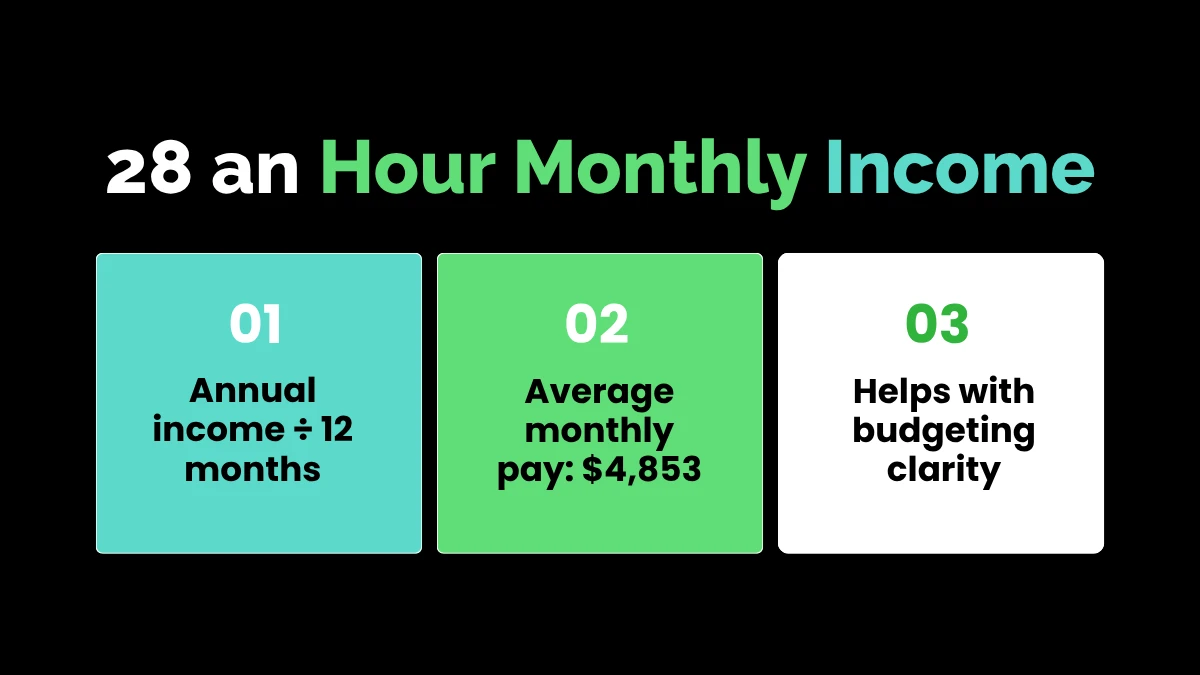
To find the true, accurate average, divide the gross annual income of $58,240 by 12 months. This approach ensures your budget accounts for the longer months that contain a fifth weekly paycheck.
28 an Hour Biweekly Pay
A significant portion of employers distribute checks every other Friday. On this schedule, your gross 28 an hour biweekly pay equals $2,240. Because a calendar year contains 52 weeks, a biweekly distribution schedule results in exactly 26 pay periods over twelve months.
During two separate months of the year, you will receive three biweekly paychecks instead of two. Savvy budgeters often treat these extra check cycles as bonus savings injections to fund automated investments or pay down outstanding debts.
Weekly and Daily Breakdown
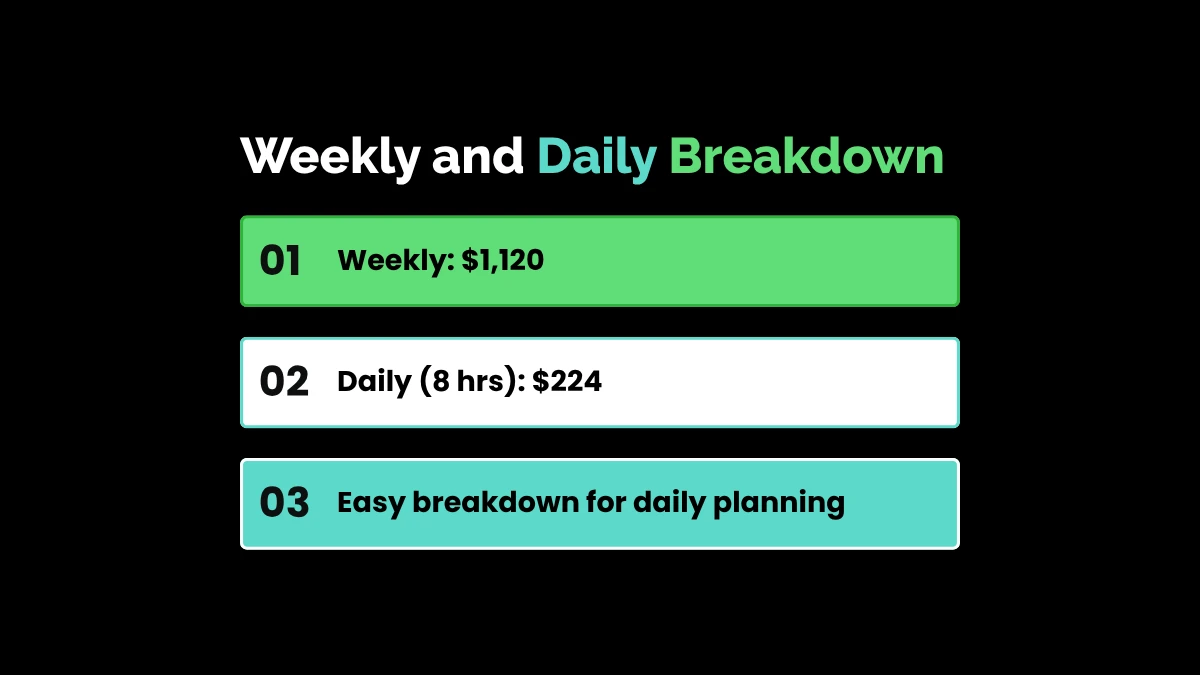
On a strict weekly timeline, your gross earnings equal $1,120. If you break that down into standard eight-hour daily shifts, you are earning a gross total of $224 per day.
| Pay Period | Gross Income Calculation | Total Earnings |
| Hourly | Base Rate | $28.00 |
| Daily (8 Hours) | $28.00 × 8 Hours | $224.00 |
| Weekly (40 Hours) | $224.00 × 5 Days | $1,120.00 |
| Biweekly | $1,120.00 × 2 Weeks | $2,240.00 |
| Monthly | $58,240.00 ÷ 12 Months | $4,853.33 |
| Annual Salary | $1,120.00 × 52 Weeks | $58,240.00 |
What Is 28 an Hour After Tax?
The gross totals listed above represent your earnings before federal, state, and local governments take their respective cuts. To set a practical budget, you must calculate your estimated 28 an hour after tax income.
When you receive a paycheck in the United States, your employer is legally required to withhold mandatory taxes right away. For a single filer utilizing the basic standard deduction for the 2026 tax year, the primary withholdings include:
- FICA Tax (7.65%): This is a fixed percentage that goes directly toward funding Social Security (6.2%) and Medicare (1.45%).
- Federal Income Tax: The IRS taxes your income using a progressive bracket system. For an individual earning a full time 28 hour salary of $58,240, a large portion of your initial earnings is protected by the $16,100 standard deduction for 2026. The remaining taxable income falls into the 10% and 12% federal tax brackets.
- State and Local Income Taxes: This amount varies entirely based on where you live. Residents of states like Texas, Florida, or Washington pay 0% in state income tax, while workers in California or New York will see an additional portion of their checks withheld.
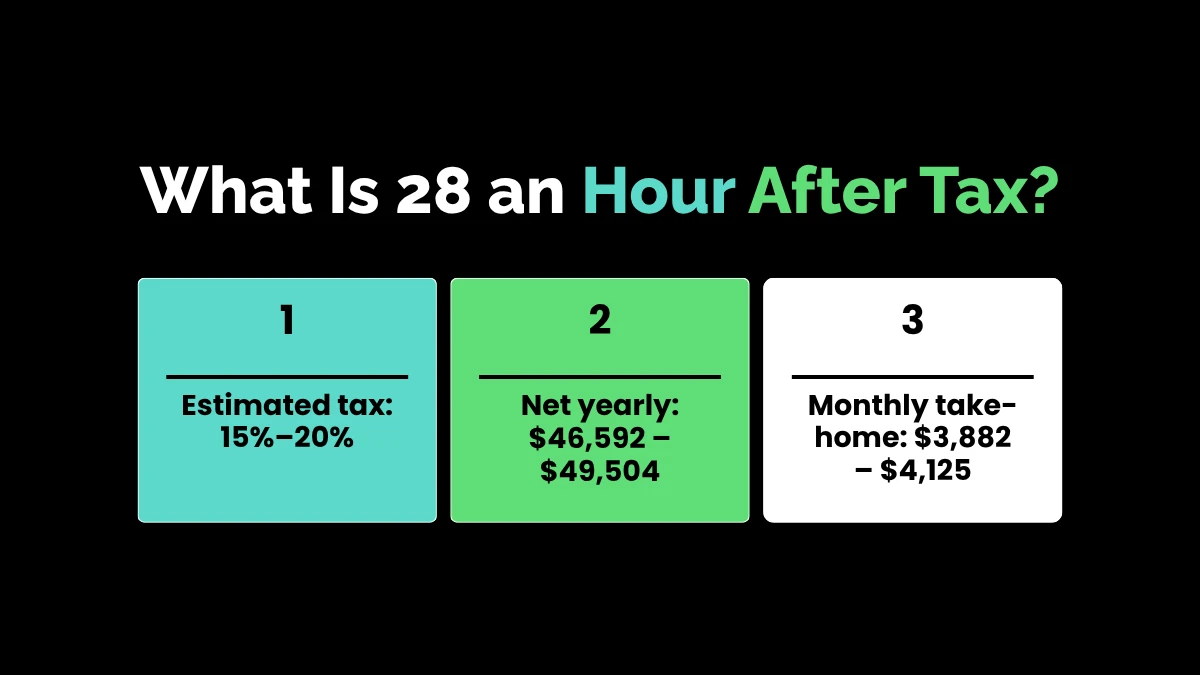
Assuming an estimated average total tax burden of 15% to 20% for a single filer with no major adjustments, your net take-home pay drops to these realistic ranges:
- Estimated Net Annual Income: $46,592 – $49,504
- Estimated Net Monthly Income: $3,882 – $4,125
- Estimated Net Biweekly Pay: $1,792 – $1,904
Important Budgeting Note: If you enroll in employer-sponsored benefits, such as health insurance premiums or traditional 401(k) retirement contributions, those payments are deducted directly from your check alongside your taxes. Make sure to account for these items when setting up your personal cash flow tracker.
Real-World Factors Influencing Your Pay
A standard 28 per hour salary calculator provides an ideal baseline, but your day-to-day work reality rarely follows a perfectly static equation. Several workplace variables can shift your annual numbers up or down.
- Overtime Hours: Under federal law, non-exempt hourly employees earn an overtime rate of “time-and-a-half” (or $42.00 per hour) for any hours worked beyond the standard 40-hour weekly limit. Picking up just five hours of overtime each week can boost your gross annual salary by more than $10,000 over a year.
- Unpaid Closures and Seasonal Lulls: If your industry experiences slow seasons or closes down during major federal holidays without providing holiday pay, your total working hours might fall below the standard 2,080 baseline. Losing two weeks of work to unpaid closures reduces your annual gross earnings by $2,240.
- Part-Time Shifts: If you work a partial schedule rather than a full time 28 hour salary, your annual math adjusts entirely based on your average weekly commitment. For instance, a steady part-time schedule of 25 hours per week results in a gross annual income of $36,400.
Budgeting Effectively on $28 an Hour
Earning roughly $58,240 gross places you ahead of the median individual income in many regions, providing an excellent foundation for building long-term momentum. To turn this hourly wage into real net worth, you need a proactive deployment strategy.
We recommend utilizing a balanced budgeting framework, such as the 50/30/20 rule, which splits your estimated post-tax monthly take-home pay (approximately $4,000) into three clear categories.
1. Essential Obligations (50%)
Allocate roughly $2,000 per month toward your non-negotiable living expenses.
This category covers your rent or mortgage payments, basic utilities, groceries, insurance premiums, and dependable transportation. Keeping your fixed living costs at or below this threshold ensures you maintain a comfortable buffer against inflation.
2. Discretionary Choices (30%)
Dedicate up to $1,200 per month to your lifestyle and personal enjoyment. This bucket covers dining out, weekend entertainment, hobby supplies, and travel plans.
Managing this category carefully lets you enjoy your daily life without sacrificing your financial future.
3. Future Wealth Building (20%)
Direct at least $800 every single month toward your long-term goals. Use these funds to establish a three-to-six-month emergency fund, capture your employer’s full 401(k) match, or build up an independent investment account.
Consistently automating this portion of your income is the fastest way to turn a modest hourly wage into lasting capital.
Conclusion
Answering 28 an hour is how much a year reveals a gross annual salary baseline of $58,240 for full-time workers. When broken down further, this rate delivers a steady gross 28 an hour monthly income of $4,853 and a gross 28 an hour biweekly pay of $2,240.
While taxes and workplace benefits will inevitably lower your final take-home pay, earning $28 an hour provides a secure foundation for comfortable daily living, consistent saving, and strategic wealth building.
By tracking your exact income intervals and managing your fixed expenses carefully, you can maximize every dollar on your paycheck and take complete control of your financial trajectory.
Frequently Asked Questions (FAQs)
What is the gross annual income for $28 an hour working full-time?
Working a traditional full-time schedule of 40 hours per week for 52 weeks results in a total of 2,080 working hours. Multiplying these hours by a $28 hourly wage yields a total gross 28 dollars an hour annual salary of $58,240 before taxes and benefit deductions.
How much is $28 an hour on a monthly basis?
A $28 hourly wage yields an average gross monthly income of $4,853.33. This value is calculated by dividing your total gross annual earnings ($58,240) by the 12 months in a year, which accurately accounts for months that contain an extra payroll week.
What is my net take-home pay if I make $28 an hour?
Your exact 28 an hour after tax income depends heavily on your state of residence and personal pre-tax payroll deductions. For a single filer utilizing the standard deduction in 2026, an estimated total tax burden of 15% to 20% leaves you with a net annual take-home salary ranging between $46,592 and $49,504.
How many paychecks do I receive in a year on a biweekly schedule?
If your company utilizes a biweekly pay cycle, you will receive exactly 26 paychecks over the course of a calendar year. This means that during two separate months of the year, you will receive three paychecks instead of the usual two.
Can you live comfortably earning $28 an hour?
Yes, a gross salary of $58,240 allows for a highly comfortable lifestyle in many areas across the country. By practicing smart cash management, keeping your fixed housing costs low, and minimizing high-interest consumer debt, this wage provides more than enough room to cover your daily necessities while consistently funding your long-term savings goals.