
A riser desk won’t make you rich. But if it recovers even 30 minutes of lost productivity per day, the afternoon hours you currently waste feeling sluggish, that’s 125 hours per year. At $50/hour, that’s $6,250 in recovered output from a $150 purchase.
If you spend your working life evaluating investments, here’s one with an absurd return profile.
A riser desk, the platform that sits on top of your existing desk and lets you switch between sitting and standing, costs $130–$500. It requires no installation, no renovation, and no commitment beyond placing it on the desk you already own.
The return: you feel noticeably better during the second half of every workday.
That sounds like a soft benefit. It isn’t. The afternoon energy crash that hits most desk workers between 2 and 4 PM is not a discipline problem. It is a physiological consequence of sitting in the same position for 5–6 hours. Blood flow decreases. Circulation to the brain slows.
Muscles disengage. The result is measurable, slower cognitive processing, reduced focus, and lower decision quality during the hours when many professionals are making their most important calls.
Standing for 15–30 minutes per hour interrupts that cycle. Not because standing burns significantly more calories, it doesn’t, the difference is roughly 8–10 extra calories per hour.
But because changing posture restores circulation, re-engages core muscles, and resets the attention cycle that degrades during prolonged static sitting.
The question for anyone who thinks about money professionally is straightforward: what is the value of your most productive afternoon hours, multiplied by 250 workdays per year?
What a Riser Desk Actually Is
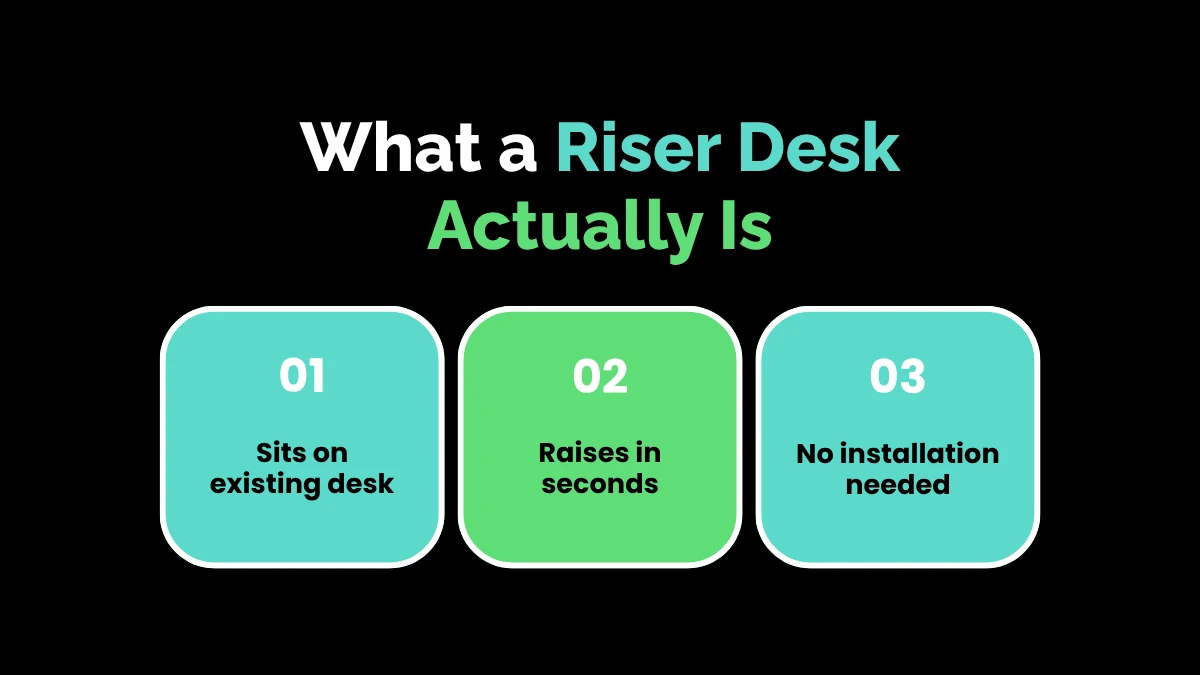
A riser desk is an adjustable platform that sits on top of your existing desk. You place your monitor, keyboard, and mouse on it. When you want to stand, you raise the platform. When you want to sit, you lower it. The switch takes 3–5 seconds.
Most models use one of three mechanisms:
Gas spring (pneumatic) — squeeze a handle, the platform lifts via pneumatic assist. Release to lock. No power needed. Most common. $130–$350.
Electric motor — press a button, the motor adjusts the height. Some models store memory presets for your exact sitting and standing positions. $350–$600.
Manual lock — physically lift and lock into preset height positions. Cheapest option. Also the most friction-heavy, which means you’ll use it less. Under $130.
The two-tier design is standard: an upper platform for your monitor and a lower shelf for your keyboard and mouse. This matters because ergonomic standing requires your screen at eye level and your keyboard at elbow height, two different positions that a single flat platform can’t accommodate simultaneously.
The Financial Case for a Riser Desk
Let’s run the numbers the way you’d evaluate any business investment.
The Cost
| Category | Range |
| Budget riser desk | $100–$150 |
| Mid-range gas spring | $150–$300 |
| Premium electric | $350–$600 |
| Anti-fatigue mat (recommended) | $25–$40 |
| Total investment (mid-range) | ~$200–$340 |
Compare this to a full motorized standing desk: $400–$1,200 plus the cost of removing your existing desk. The riser desk is 30–50% of the price and requires zero furniture changes.
The Return
The return on a riser desk is not calorie burn. It is recovered productivity in the afternoon hours.
Conservative assumption: You recover 30 minutes of productive capacity per workday by eliminating or reducing the afternoon energy crash through sit-stand alternation.
Annual recovered time: 30 minutes × 250 workdays = 125 hours/year
Value at different hourly rates:
| Your Effective Hourly Rate | Annual Value of Recovered Time |
| $25/hr | $3,125 |
| $50/hr | $6,250 |
| $75/hr | $9,375 |
| $100/hr | $12,500 |
A $200 riser desk that recovers $6,250 in productivity over a year has a 3,025% ROI. Even if you cut the assumption in half, 15 minutes recovered per day, the ROI is still 1,462%.
These are not hard measurements. You can’t prove that standing for 15 minutes at 2 PM directly produced a specific dollar outcome. But the directional math is so overwhelmingly favorable that the precision of the estimate doesn’t matter.
If you’re the kind of person who bills by the hour, tracks deep work time, or measures output per day, the riser desk pays for itself within the first two weeks of use.
The Comparison
| Investment | Cost | Annual Value | Payback Period |
| Riser desk (mid-range) | $200 | $3,125–$6,250 recovered productivity | 1–2 weeks |
| Gym membership | $600/year | Health benefits (harder to quantify) | Ongoing |
| Ergonomic chair | $800–$1,500 | Reduced back pain, better posture | 2–6 months |
| Full standing desk | $600–$1,200 | Same as riser desk | 1–2 months |
| Second monitor | $200–$400 | 20–30% productivity gain (Microsoft research) | 2–4 weeks |
The riser desk is one of the fastest-payback productivity investments available, comparable to a second monitor and significantly cheaper than an ergonomic chair, while addressing a different dimension of the same problem (energy management vs. pain reduction).
How to Choose One Without Overthinking It
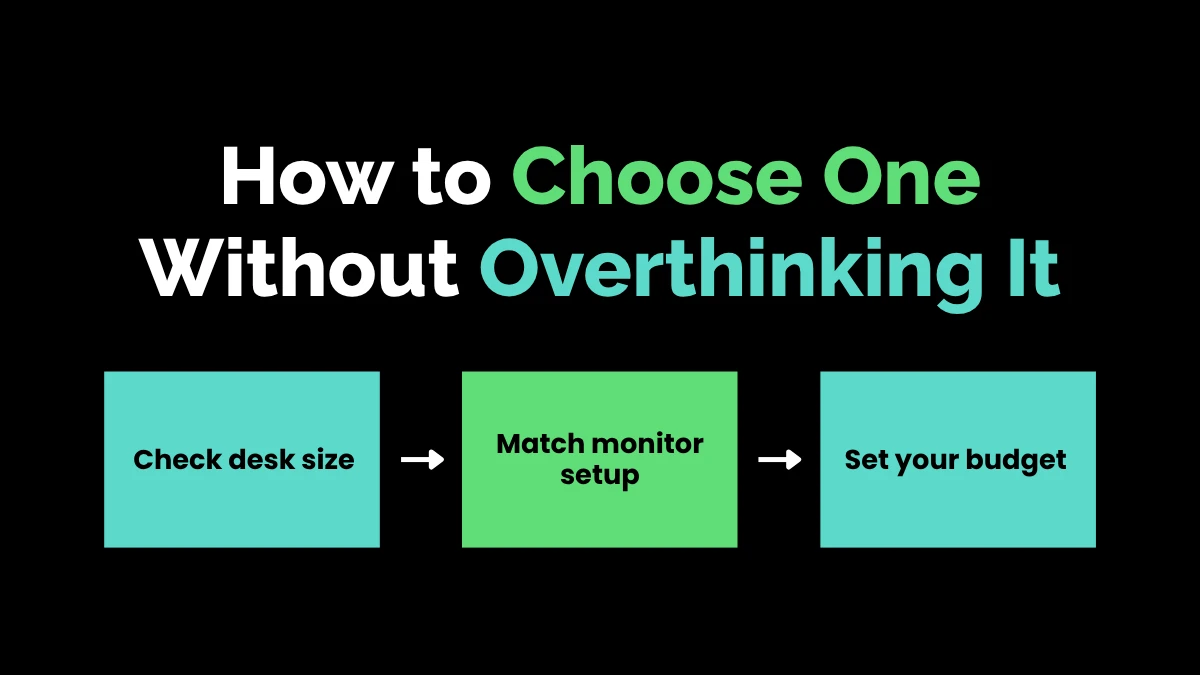
The riser desk market has dozens of options. You don’t need to evaluate all of them. You need to answer four questions:
- How much desk space do you have? Measure your desk width. If it’s under 40 inches, go compact. If it’s over 48 inches, a full-size 36-inch riser desk will fit comfortably.
- How many monitors? One monitor: 26-inch riser is sufficient. Dual monitors: 32–36 inches. Ultrawide: 36 inches minimum.
- How tall are you? 5’4″–5’8″: look for 12–16 inches max height. 5’9″–6’0″: 15–18 inches. Over 6’0″: 18–22 inches. The most common mistake is buying a riser that doesn’t go high enough.
- What’s your budget? Under $150: Vivo K-Series 32″. $200–$350: FlexiSpot M2. $400+: VariDesk Pro Plus 36 Electric.
That’s it. Those four questions eliminate 90% of the options and point you to the right product.
The Four Products Worth Your Money
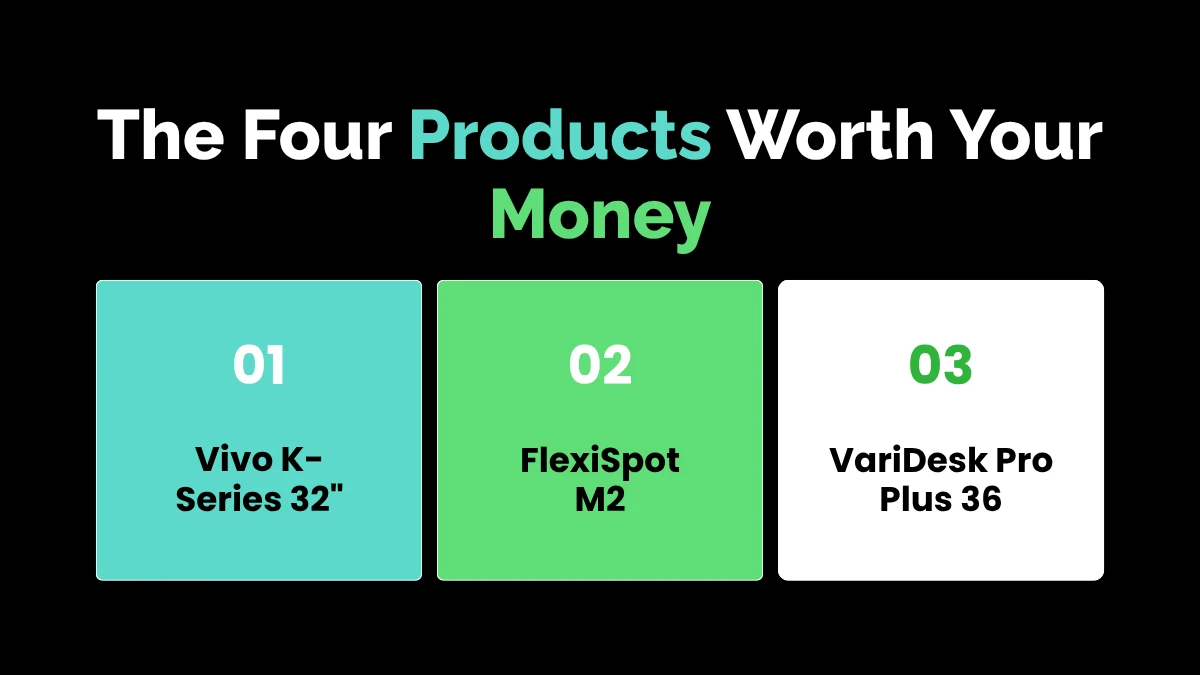
Best Value: Vivo K-Series 32″, ~$140
Pneumatic gas spring. Steel X-frame. 32-inch platform with keyboard tray. Stable. Durable. Comes in 6 sizes and 10 colors. The best riser desk under $200 by a significant margin.
ROI math: At $140 and 30 min/day recovered productivity at $50/hr, payback period is 1.1 days.
Best Overall: FlexiSpot M2, ~$270
Gas spring. 35-inch platform. Two-tier with keyboard tray. Adjusts 4.7–19.7 inches. 33-pound capacity. The most recommended riser desk across independent reviews for a reason, no significant weakness.
ROI math: At $270 and 30 min/day at $50/hr, payback period is 2.2 days.
Best for Tall People: VariDesk Pro Plus 36, ~$400
Wider platform. Higher maximum height (17.5 inches). Heavier construction means better stability. Designed for larger setups and taller users. Spring-loaded, no motor.
Best Premium: VariDesk Pro Plus 36 Electric, ~$550
Electric motor. Memory presets. 110-pound capacity. The effortless option, one button press instead of squeezing a handle. If you switch positions 8+ times per day, the electric motor removes enough friction to justify the premium.
The Ergonomic Setup That Prevents You From Abandoning It
The #1 reason people stop using riser desks is not that standing doesn’t help. It’s that they set it up wrong, developed neck or shoulder pain, and blamed the product instead of the ergonomics.
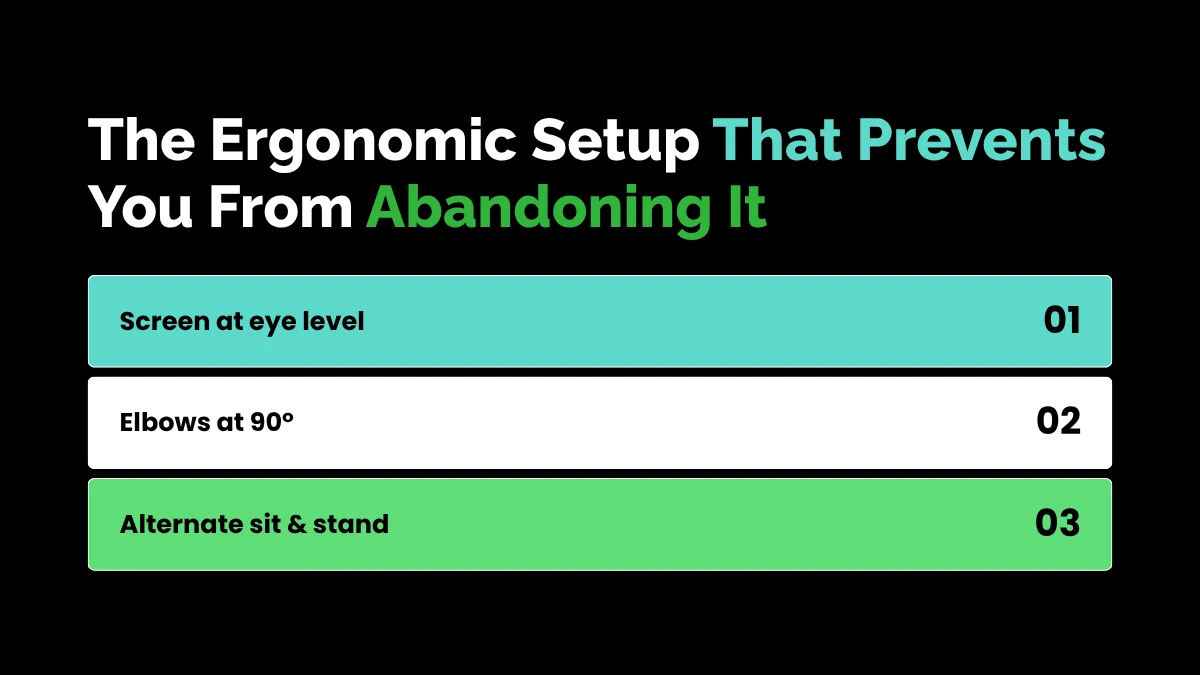
Monitor: Top of screen at or slightly below eye level. Look straight ahead, not up.
Keyboard: Elbows at 90–100 degrees. Forearms parallel to the floor. Wrists straight.
Posture: Weight distributed evenly. Knees not locked. Shift weight periodically.
Floor: An anti-fatigue mat ($25–$40) makes standing sessions 3x more comfortable on hard floors.
The rhythm: Stand 15–30 minutes for every 45–60 minutes of sitting. This is research-supported. Standing for 8 hours straight is as bad as sitting for 8 hours straight. The value is in the alternation.
The Side Hustle Angle: Can You Resell Riser Desks?
For the WeirdWealth readers who evaluate everything through a side income lens, there is actually a micro-opportunity here.
The riser desk market has significant pricing inefficiency. VariDesks and FlexiSpots appear on Facebook Marketplace, Craigslist, and corporate surplus sales at 40–60% below retail because offices upgrading to full standing desks dispose of perfectly functional converters.
A refurbished VariDesk Pro Plus 36 that retails for $400+ can be acquired for $80–$120 at corporate liquidation sales and resold for $200–$250. The margins exist because buyers trust the VariDesk brand and the product is built to last 10+ years, a used one at half price is a rational purchase for the buyer.
This is not a scalable business. It is a category where awareness of pricing inefficiency produces occasional high-margin transactions for people who are already looking.
Frequently Asked Questions
What is a riser desk?
An adjustable platform that sits on top of your existing desk and lets you switch between sitting and standing. Place your monitor and keyboard on it, raise it to stand, lower it to sit. No installation required.
How much does a riser desk cost?
$100–$600. Gas-spring models (most popular) run $130–$350. Electric models with presets run $400–$600. Budget models under $100 exist but often lack the stability needed for daily use.
Is a riser desk worth it financially?
If it recovers even 15–30 minutes of productive afternoon time daily, the payback period is 1–5 days depending on the model and your hourly rate. It is one of the fastest-ROI productivity investments available alongside a second monitor.
Does standing at a desk actually improve productivity?
The primary mechanism is energy management, not fitness. Alternating between sitting and standing prevents the circulation decline that causes the afternoon energy crash. The productivity benefit is indirect, you feel better, think more clearly, and maintain focus longer.
How long should I stand per hour?
15–30 minutes per hour is the research-supported rhythm. Start with 10 minutes if you’re new to standing at a desk and increase gradually over a week.
Do riser desks wobble?
Cheap ones do. Quality gas-spring and electric models from FlexiSpot, VariDesk, and Vivo are stable enough for comfortable typing. Check user reviews specifically for stability at maximum standing height before buying.
Bottom Line
A riser desk is not a health product. It is not a fitness tool. It is not a weight-loss device.
It is a productivity investment with a measurable return, the recovery of your afternoon working hours from the physiological tax that prolonged sitting imposes on cognitive function, energy, and focus.
The math: $150–$300 invested, 125+ hours of productive time recovered annually, payback period measured in days.
Whether you’re a trader, a consultant, a founder, a freelancer, or anyone who bills their time or measures their output, the riser desk belongs in the same category as a second monitor, a good chair, and a fast internet connection. It is infrastructure that makes every working hour more valuable.
Buy one. Set it up correctly. Try it for a week. The afternoon will tell you everything you need to know.
WeirdWealth.io covers money, productivity, side income, and the unconventional investments that compound when nobody else is paying attention.