
Key Takeaways
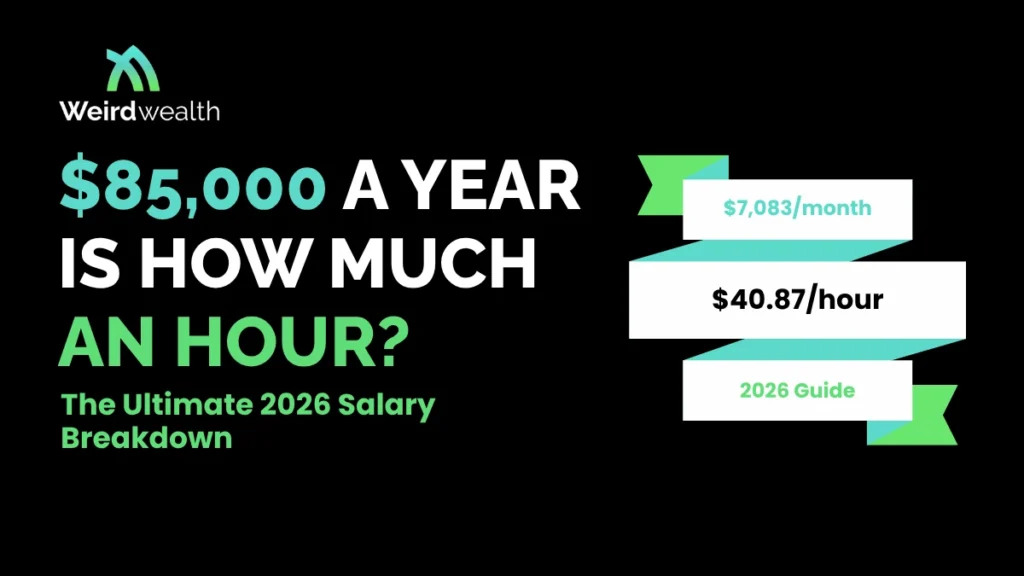
- Standard hourly rate: $40.87
- Based on 2,080 annual work hours
- Taxes significantly impact actual take-home pay
- Monthly budgeting requires viewing net, not gross, income
Introduction: Decoding Your Salary
Have you ever stared at a job offer letter, a promotion notice, or even your own steady paycheck and wondered, “Actually, $85,000 a year is how much an hour?”
It’s a super common question. Whether you are prepping for a high-stakes salary negotiation, planning your next career move, or just trying to get a better grip on your personal monthly budget, knowing your true hourly worth is a total game-changer.
If you work a standard 40-hour workweek, your $85,000 annual salary per hour comes out to approximately $40.87. It’s a solid, respectable number that places many professionals well into the middle-class bracket in most parts of the country.
But let’s be real, the “per hour” number is just the starting point of your financial picture. To truly understand your wealth, we need to dive deeper into the reality of taxes, deductions, and how your salary translates to your actual day-to-day life.
AI Overview
If you earn $85,000 annually, your hourly wage is approximately $40.87. This assumes a standard 2,080-hour work year (40 hours per week for 52 weeks). While this provides a clear baseline, your actual $85k take home pay will be lower due to taxes, benefits, and retirement contributions. Understanding this breakdown is key to effective personal finance management and smarter long-term budgeting.
The Math Behind the Salary
To find your rate, we usually divide the annual total by the total number of hours worked in a year. In most professional cases, we use the standard 2,080-hour calculation (40 hours × 52 weeks).
When you look at $85,000 a year is how much an hour, it feels straightforward. However, remember that your specific employment contract might involve different hours.
If you work 37.5 hours or if your role includes mandatory overtime, your actual hourly rate changes slightly. It’s all about the denominator, the more hours you put in, the lower your effective hourly rate becomes.
Why the “Hourly” View Matters
Knowing your hourly rate helps you value your time in a way that an annual salary figure just can’t. If you’re a freelancer, a contractor, or someone considering an ambitious side gig, this number gives you a vital benchmark.
At Weird wealth, we always suggest looking beyond the surface level. Your time is your most valuable asset, and knowing exactly what it’s worth is the first step toward building true financial confidence.
Breaking Down the Numbers
Seeing the big picture is helpful, but seeing the smaller, digestible chunks makes it feel “real.” Below is a quick table to help you visualize how your $85,000 salary distributes across different timeframes.
| Period | Estimated Gross Pay |
| Yearly | $85,000 |
| Monthly | $7,083 |
| Weekly | $1,635 |
| Daily | $327 |
| Hourly | $40.87 |
Taxes and Your Real Take-Home Pay
Here is the part everyone dislikes: taxes. Your gross income is unfortunately not what hits your bank account. Your $85k take home pay depends heavily on your location, filing status, and benefit elections.
After federal taxes, FICA (Social Security and Medicare), and state taxes, your actual paycheck will be noticeably lower than the gross monthly figure of $7,083.
Always factor in your health insurance premiums and 401(k) contributions, too. These are important investments in yourself, but they do reduce the immediate cash flow you see on payday.
Planning Your Monthly Budget
When you look at an $85k monthly breakdown, don’t just use the $7,083 number. Aim to budget based on what actually hits your account.
- Subtract roughly 20-30% for federal/state taxes and mandatory payroll deductions.
- Consider your fixed, non-negotiable costs like rent, mortgage, or student loans.
- Allocate funds for savings and “wants” using the time-tested 50/30/20 rule.
Is $85,000 a Good Salary?
In 2026, earning $85,000 annually is generally considered a strong, competitive salary. It sits comfortably above the U.S. median household income, providing room for both necessary living expenses and significant discretionary growth.
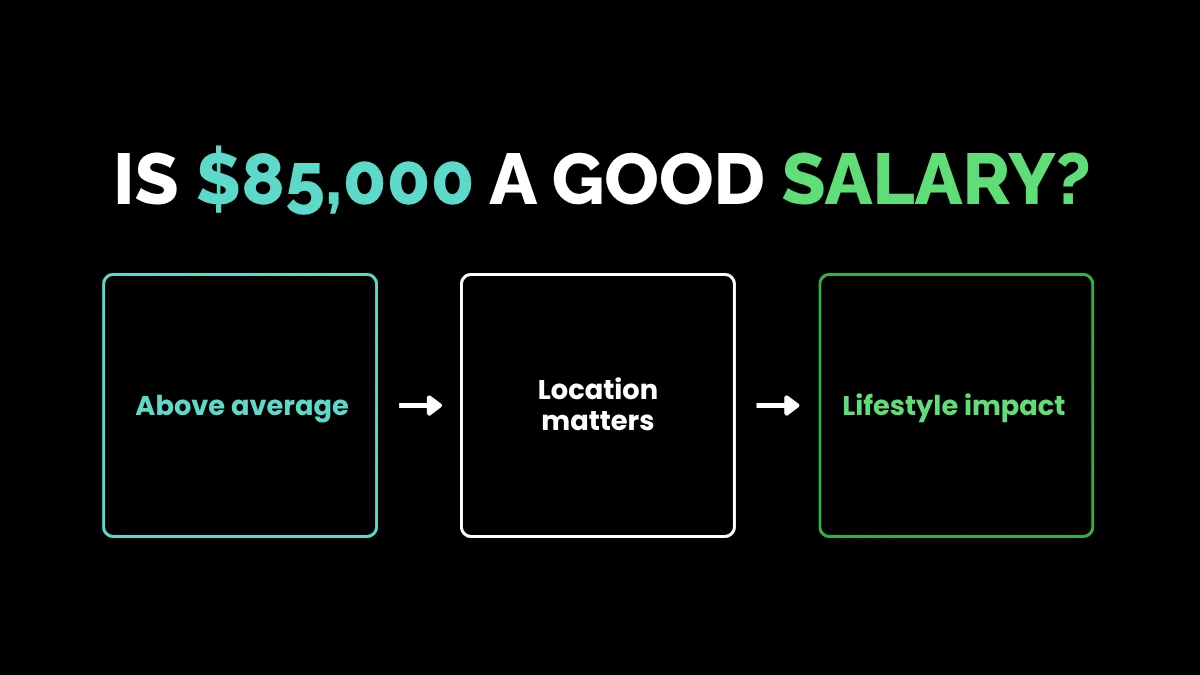
Whether this salary feels “rich” or just “comfortable” really depends on where you live. If you are in a high-cost metropolitan area, your $40.87 hourly rate might feel modest once rent and commuting are paid. If you live in a lower-cost area, you might find yourself with plenty of room to save, invest, or travel the world.
Maximizing Your Wealth
At Weirdwealth, we know that income is only half the equation. It doesn’t matter if your $85,000 annual salary per hour is $40 or $400 if you don’t have a plan for it.
- Audit your subscriptions: Small, recurring costs often eat into your monthly take-home pay unnoticed.
- Automate your savings: Treat your retirement account like a “must-pay” bill; pay yourself first before the money hits your “disposable” spending pile.
- Negotiate your raises: Your hourly value should increase as your skills grow. If you aren’t getting annual cost-of-living adjustments, your “real” hourly rate is effectively shrinking.
Understanding the Factors of Your Pay
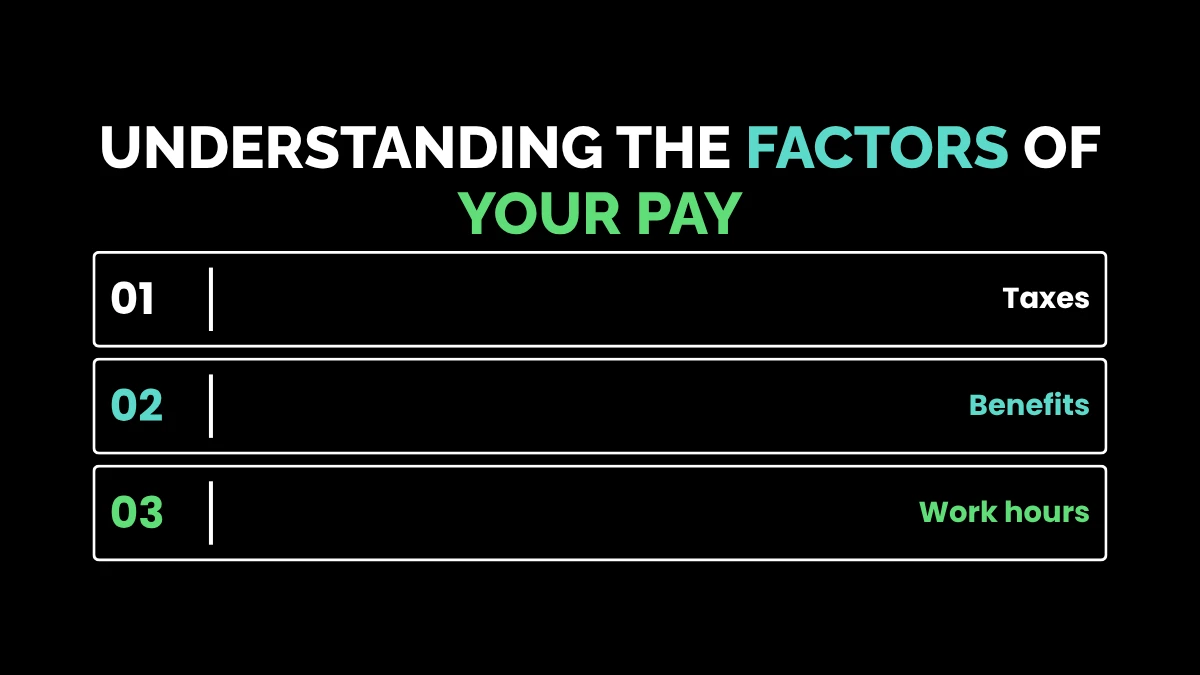
While we’ve established that $85,000 a year is how much an hour based on standard math, real life often throws in variables. Understanding these can help you better forecast your finances throughout the year.
Variables that Impact Your Hourly Rate
- Overtime: If you consistently work more than 40 hours, your effective hourly rate actually drops because your base salary is spread over more hours.
- Bonuses: Annual performance bonuses are part of your “total compensation” but aren’t included in your base hourly rate. View these as a bonus for the savings bucket, not the rent bucket.
- Benefits: Employer-paid health insurance or matching 401(k) contributions are “invisible” income that adds significant value to your base $85k salary. Always calculate your “total rewards” package when comparing jobs.
Using Your Salary Data for Growth
Knowing that $85,000 a year is how much an hour is a powerful tool for self-reflection. When you know you earn roughly $40.87 per hour, you start making different choices about how you spend your free time.

Is a two-hour commute worth your time? Is an expensive luxury purchase worth “X” hours of your labor? These aren’t just budget questions, they are lifestyle questions. When you quantify purchases in terms of “hours worked,” the value of your time becomes much clearer.
The Psychology of Earning
Money management isn’t just math; it’s psychology. When you start thinking in terms of hourly rates, your relationship with work changes.
You begin to identify “leaks” in your productivity and your spending. Every hour spent doing something that doesn’t align with your long-term goals becomes a calculated cost.
This is the foundation of building lasting wealth, not just earning a salary, but managing it with deep intent.
The 2026 Economic Context
As we move through 2026, cost-of-living adjustments have become a central theme for employees everywhere.
If your salary hasn’t kept pace with inflation, your “real” hourly wage in terms of purchasing power may be lower than it was a few years ago. It is vital to consider this when evaluating if $85,000 is still serving your specific needs.
If your essential expenses have risen faster than your salary, even a “good” income can start to feel surprisingly tight.
Strategic Career Moves
If you find that $85,000 is no longer sufficient, you have a few levers you can pull. You can look for a promotion within your current company, pivot to a new industry with higher margins, or develop a side stream of income.
The hourly rate calculation remains your benchmark. If a new job opportunity offers $95,000 but requires 50 hours of work instead of 40, you might actually be taking a pay cut on an hourly basis. Don’t fall for the “bigger salary, more stress” trap without doing the math first.
Lifestyle Choices and Financial Goals
Your hourly rate is the bridge between your career and your lifestyle. If you decide to pursue early retirement or a sabbatical, knowing your hourly rate helps you calculate exactly how much “time” you need to trade to reach those milestones.

It turns abstract concepts like “retirement savings” into concrete, achievable targets. Every extra dollar you save is essentially “buying back” future hours of your own life.
Conclusion
At the end of the day, understanding that $85,000 a year is how much an hour gives you clarity and control. By breaking down your $85k monthly breakdown and looking realistically at your $85k take home pay, you can make smarter decisions about your future.
Whether you are just starting out or leveling up your career, remember that your income is a tool. With the right planning and a bit of discipline, that $40.87 an hour can build a foundation that lasts a lifetime. Keep focusing on your goals, stay consistent with your budget, and you’ll be in great shape.
At Weirdwealth, we hope this guide empowers you to take command of your financial journey and make every single hour count toward your long-term success. Your wealth is built on the choices you make every single day.
Frequently Asked Questions
How do I calculate my hourly rate from my annual salary?
Simply divide your annual gross salary by 2,080, which represents the standard 40-hour workweek over 52 weeks in a year. This provides your gross hourly baseline before any taxes or deductions are removed from your paycheck.
Is 85k a good salary for a single person in 2026?
Yes, it is generally considered a comfortable salary that allows for basic needs, savings, and discretionary spending in most U.S. locations. However, the true value depends on your specific city’s cost of living, housing market, and personal debt obligations.
Why is my take-home pay lower than my hourly rate?
Your take-home pay is significantly lower because of federal and state taxes, Social Security, Medicare, health insurance premiums, and voluntary retirement account contributions. These deductions vary by individual, so always check your personal pay stub for the exact numbers.
Should I include bonuses in my hourly rate calculation?
Generally, no. Your hourly rate calculation should focus on your base salary to provide an accurate, reliable picture of your guaranteed income. Bonuses are variable and should be treated as “extra” rather than part of your baseline budget.