

Key Takeaways
-
Gross annual salary: $37,440 for full-time hours
-
Net take-home pay: $30,000 to $32,000 estimated
-
Monthly gross pay: $3,120 before taxes and insurance
-
Weekly gross pay: $720 for standard 40-hour weeks
Have you ever wondered what your hourly wage actually adds up to over an entire year?
Working full-time at $18 per hour gives you a gross annual salary of $37,440.
That total represents your gross income before taxes, healthcare contributions, or retirement contributions come out of your paycheck.
Understanding $18 an hour is how much a year helps you plan expenses, build budgets, and evaluate new job opportunities effectively.
At Weird Wealth, we believe in breaking down real money numbers so you can make confident personal finance choices.
Let’s dive into the full math, including taxes, monthly take-home pay, local living costs, and budget strategies.
AI Overview
A hourly wage of $18 working full-time generates $37,440 per year in gross income. After deducting federal taxes, state taxes, and FICA contributions, your net take-home salary typically ranges between $30,000 and $32,000 annually. To figure out if $18 an hour is how much a year you need, review your local rent, commuting costs, and debt. Living on 18 an hour is realistic in lower-cost areas with disciplined budgeting.
Calculating Your $18 an Hour Gross Income
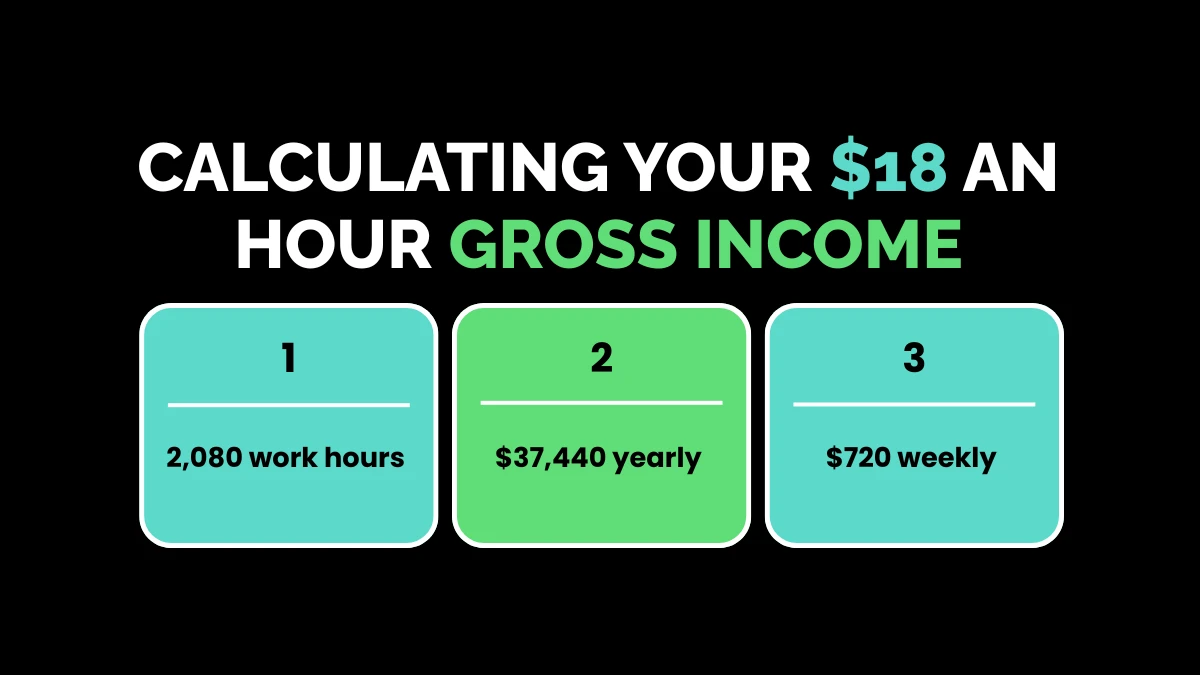
Gross income is the total money you earn before any payroll deductions disappear from your paycheck.
Assuming a standard 40-hour workweek for 52 weeks, you work 2,080 hours per year.
Multiplying 2,080 hours by $18 yields $37,440 in total gross annual compensation.
If you work part-time hours, your annual gross pay changes proportionately.
Working 30 hours per week earns $28,080 gross per year.
Working 20 hours per week brings in $18,720 gross per year.
Here is how your 18 dollars an hour yearly income breaks down across different pay periods:
| Pay Period | Calculated Hours | Gross Pay Amount |
| Hourly | 1 hour | $18.00 |
| Daily | 8 hours | $144.00 |
| Weekly | 40 hours | $720.00 |
| Bi-Weekly | 80 hours | $1,440.00 |
| Semi-Monthly | 86.67 hours | $1,560.00 |
| Monthly | 173.33 hours | $3,120.00 |
| Quarterly | 520 hours | $9,360.00 |
| Annually | 2,080 hours | $37,440.00 |
Knowing these figures makes tracking your gross paycheck amounts much simpler throughout the calendar year.
$18 an Hour After Taxes: What Is Your Take-Home Pay?
Gross salary looks great on paper, but net pay is what actually lands in your bank account.
Taxes reduce your overall earnings depending on your tax filing status, state of residence, and personal withholdings.
Every standard employee pays FICA taxes, which fund Social Security and Medicare programs across the country.
FICA taxes take a flat 7.65% cut from your gross earnings automatically.
For a gross income of $37,440, FICA taxes subtract approximately $2,864 per year.
Federal income taxes take another portion based on current IRS tax brackets and standard deductions.
State income taxes depend on where you live and range from 0% up to over 6%.
States like Texas, Florida, Nevada, and Washington charge zero state income tax on wage earnings.
States like California, New York, and Oregon take higher state income tax cuts from each paycheck.
Here is an estimated breakdown of your net take-home earnings on an 18 dollars an hour yearly income:
| Tax Category | Estimated Percentage | Annual Amount Subtracted |
| Gross Salary | 100% | $37,440 |
| FICA Taxes | 7.65% | -$2,864 |
| Federal Income Tax | ~7.5% – 9% | -$2,800 |
| State Income Tax | ~0% – 4% | -$1,100 |
| Estimated Net Pay | ~80% – 83% | ~$30,676 |
Your estimated net take-home pay equals roughly $30,000 to $31,500 per year.
That translates to a net monthly budget of about $2,500 to $2,625 in real spendable cash.
How Paid Time Off and Unpaid Leave Impact Your Pay
Does your job provide paid time off or paid holidays?
PTO significantly affects how much cash you actually bring home each year.
If your employer offers two weeks of paid vacation, your annual pay remains at the full $37,440 figure.
If your time off is completely unpaid, taking days off directly reduces your annual income total.
Taking two weeks of unpaid time off means working 2,000 hours instead of 2,080 hours.
That two-week break lowers your gross annual salary down to $36,000 flat.
Taking four weeks of unpaid time off drops your gross pay down to $33,120 per year.
When assessing any job offer, always factor benefits and paid leave into your compensation calculations.
Is 18 an Hour Enough to Live On Today?
Many job seekers ask: is 18 an hour enough to live on in current economic conditions?
The realistic answer depends almost entirely on your geographic location and household structure.
In low-cost rural areas or small towns, $18 per hour can support a single adult comfortably.
In major cities with high housing costs, living on 18 an hour requires strict financial discipline and careful planning.
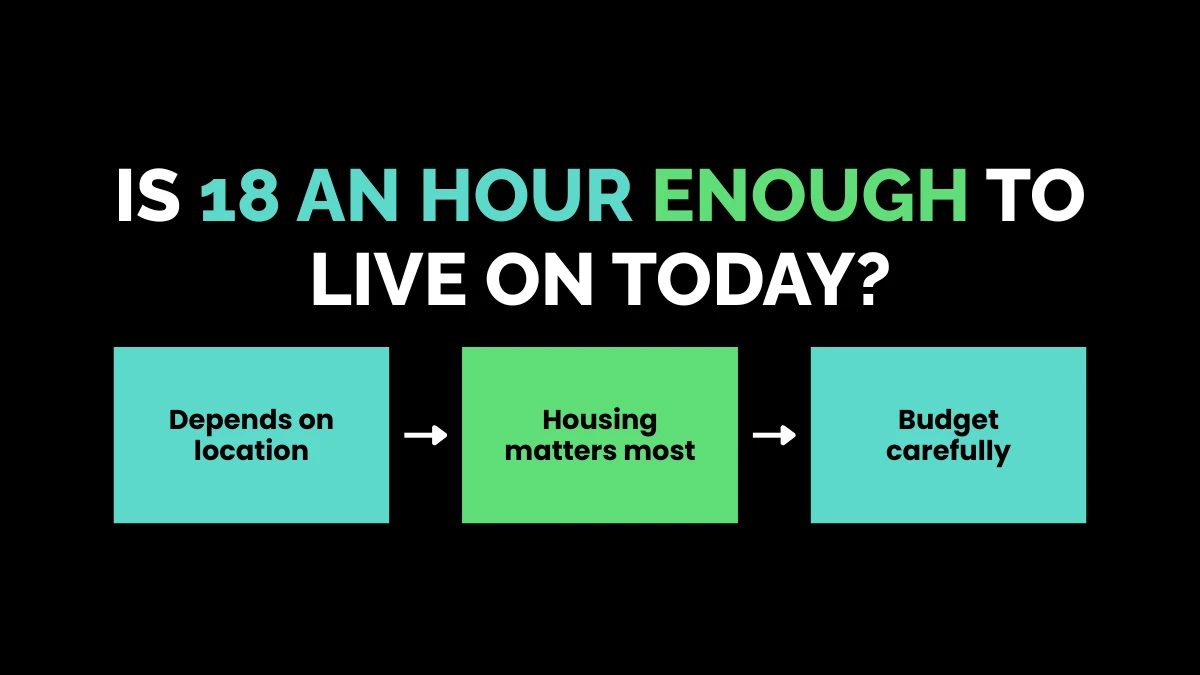
Shared housing arrangements make a massive difference in whether this hourly rate covers essential needs.
Single parents or sole income earners face tighter financial conditions on this wage level.
Evaluating your local cost of living helps determine if is 18 an hour enough to live on where you live.
Sample Monthly Budget for Living on 18 an Hour
Creating a functional budget helps you stretch every dollar effectively each month.
Assuming an estimated net monthly take-home pay of $2,550, here is a balanced spending framework.
This budget follows the 50/30/20 personal finance guideline adjusted for modern living costs.
| Budget Category | Targeted Percentage | Estimated Monthly Allocation |
| Rent & Housing | 35% | $892.50 |
| Utilities & Internet | 8% | $204.00 |
| Groceries & Food | 15% | $382.50 |
| Transportation & Gas | 12% | $306.00 |
| Healthcare & Insurance | 8% | $204.00 |
| Debt & Emergency Savings | 12% | $306.00 |
| Personal & Entertainment | 10% | $255.00 |
Keeping your housing expenses under $900 per month is crucial for maintaining overall financial balance.
If rent in your area exceeds this target, adjusting transportation or discretionary spending becomes necessary.
Understanding how $18 an hour is how much a year translates to monthly budgets keeps you ahead of bills.
At Weird Wealth, we suggest testing different budget templates until you find one that fits your life.
Geographic Breakdown: Living Costs Across Different Regions
Housing costs vary dramatically depending on your state and municipality.
Understanding local cost indexes shows where living on 18 an hour works best.
In Midwestern states like Ohio, Indiana, or Kansas, average single-bedroom rents remain relatively affordable.
In Southern states like Alabama, Mississippi, or Oklahoma, everyday groceries and transportation costs stay moderate.
In Coastal states like New York, Massachusetts, or Washington, housing costs digest a larger income percentage.
| City / Region Type | Average 1-Bed Rent | Financial Feasibility at $18/hr |
| Small Midwest Town | $650 – $800 | Highly manageable for single adults |
| Mid-Sized Southern City | $850 – $1,050 | Manageable with basic budgeting |
| Suburban East Coast | $1,200 – $1,500 | Tight; likely requires roommates |
| Major Metro Area | $1,700 – $2,200+ | Very difficult without shared expenses |
Location plays the biggest role in deciding whether is 18 an hour enough to live on long term.
Practical Action Steps for Living on 18 an Hour
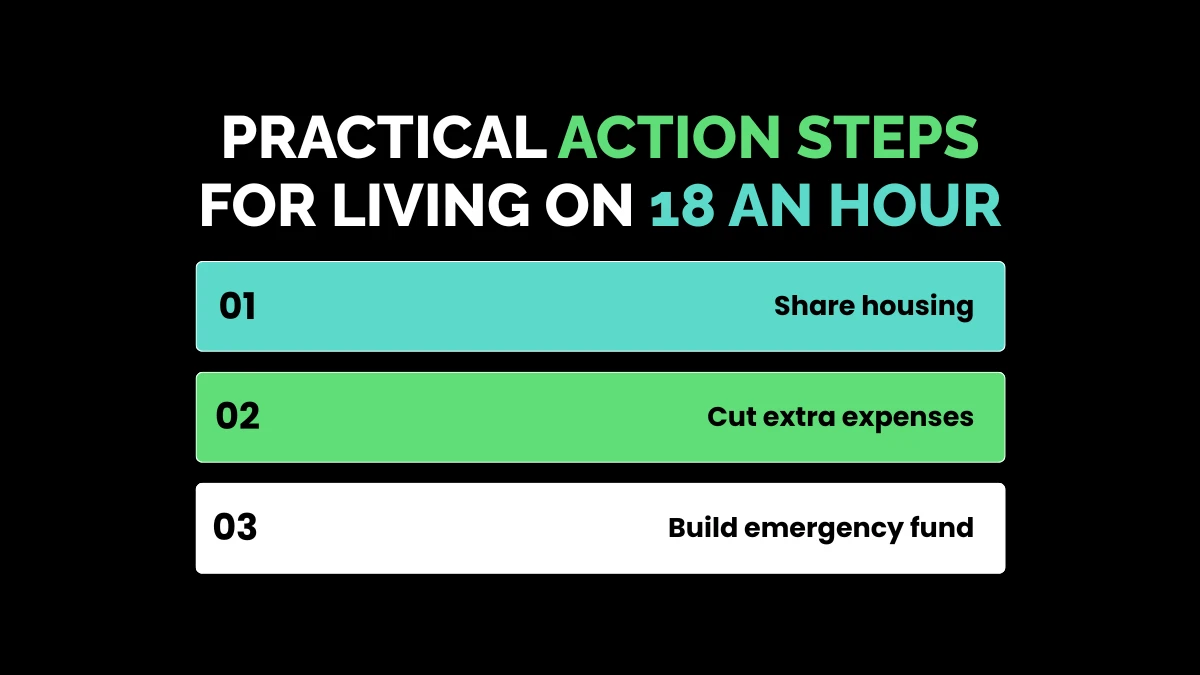
Managing your money wisely makes daily living smoother and far less stressful.
Here are proven, practical strategies to maximize your monthly cash flow:
-
Get a roommate or co-tenant: Splitting rent and utility charges instantly halves your largest monthly expense category.
-
Meal plan around weekly sales: Planning grocery lists around store discounts prevents high food delivery fees and impulse buys.
-
Audit monthly recurring subscriptions: Cancel unused streaming services, app memberships, or gym subscriptions to free up extra cash.
-
Build a starter emergency fund: Set aside $1,000 quickly in a high-yield savings account for unexpected car repairs or medical bills.
-
Use fee-free banking tools: Avoid checking account maintenance fees, overdraft penalties, or high ATM charges whenever possible.
Implementing even two or three of these habits builds a stronger financial safety cushion.
Comparing $18 an Hour to Other Common Wage Levels
Seeing how $18 per hour compares to other standard hourly rates provides helpful wage perspective.
It helps you evaluate potential promotions, career changes, or job offers accurately.
Here is how an 18 dollars an hour yearly income compares across standard full-time schedules:
| Hourly Wage Rate | Weekly Gross Pay | Monthly Gross Pay | Annual Gross Pay |
| $15.00 per hour | $600.00 | $2,600.00 | $31,200.00 |
| $16.50 per hour | $660.00 | $2,860.00 | $34,320.00 |
| $18.00 per hour | $720.00 | $3,120.00 | $37,440.00 |
| $20.00 per hour | $800.00 | $3,466.67 | $41,600.00 |
| $22.50 per hour | $900.00 | $3,900.00 | $46,800.00 |
| $25.00 per hour | $1,000.00 | $4,333.33 | $52,000.00 |
Moving from $18 to $20 per hour increases your annual gross earnings by $4,160.
That wage bump adds approximately $346 in extra gross pay to your monthly budget.
Smart Strategies to Boost Your Annual Income

If you want to move beyond an 18 dollars an hour yearly income, proactive career steps can accelerate your progress.
Here are actionable methods to increase your hourly wage rate over time:
-
Earn industry certifications: Pursuing short professional certificates in IT, project management, or healthcare opens higher-paying roles.
-
Negotiate a merit raise: Highlight your accomplishments, reliability, and expanded work duties during annual performance reviews.
-
Develop specialized technical skills: Learning trade skills, equipment operations, or software tools increases your market value to employers.
-
Start a targeted side hustle: Spending a few hours weekly on freelance work, tutoring, or service gigs adds extra monthly revenue.
-
Apply for internal leadership roles: Moving up to shift supervisor or team coordinator usually comes with immediate hourly wage increases.
Small hourly improvements aggregate into significant annual income gains over time.
Overtime Pay Potential at $18 an Hour
Overtime work provides a powerful opportunity to expand your annual gross pay significantly.
Under federal labor standards, overtime hours earned beyond 40 per week pay time-and-a-half.
At an hourly rate of $18, your overtime pay rate equals $27 per hour.
Working just five overtime hours per week adds $135 in gross weekly income.
Over 52 weeks, those five extra hours per week add $7,020 to your annual earnings.
That pushes your total gross annual salary from $37,440 up to $44,460.
Here is how consistent overtime hours impact your overall yearly compensation:
| Weekly Overtime Hours | Overtime Rate | Additional Weekly Pay | Total Annual Gross Salary |
| 0 Overtime Hours | $27.00 / hr | $0.00 | $37,440.00 |
| 2 Overtime Hours | $27.00 / hr | $54.00 | $40,248.00 |
| 5 Overtime Hours | $27.00 / hr | $135.00 | $44,460.00 |
| 10 Overtime Hours | $27.00 / hr | $270.00 | $51,480.00 |
If your employer offers overtime opportunities, taking advantage of them rapidly strengthens your savings.
Evaluating Healthcare and Employee Benefits
Cash wages are only one component of your total overall employment package.
Employer-sponsored benefits can add thousands of dollars in real monetary value to your salary.
A job paying $18 per hour with excellent health insurance can outperform a $20 job with no benefits.
Health insurance premiums paid by employers keep your out-of-pocket medical bills manageable.
Matching 401(k) contributions provide free retirement money that builds long-term wealth automatically.
Transportation stipends, tuition assistance, and health savings account matches also increase total compensation.
When reviewing job opportunities, calculate total benefits value alongside hourly pay rates.
Managing Debt and Building Savings on $18 an Hour
Paying down existing debt while saving money requires intentional organization on a $37,440 income.
High-interest debt like credit card balances should take immediate priority in your repayment plan.
Using the debt avalanche method pays off highest-interest balances first, saving money on interest charges.
Using the debt snowball method clears smallest balances first, building psychological momentum quickly.
Automating small weekly transfers into savings ensures consistent progress without constant decision-making.
Even saving $25 per week adds up to $1,300 in emergency savings across one year.
Financial stability comes from consistency rather than the size of each individual deposit.
Conclusion
Understanding exactly $18 an hour is how much a year gives you the clarity needed to handle your money wisely. Earning $37,440 gross translates to about $30,000–$32,000 in net take-home pay annually.
With solid budgeting, low debt, and controlled housing costs, living on 18 an hour offers a stable baseline as you work toward your long-term financial goals.
Frequently Asked Questions
What is $18 an hour annually after taxes?
Working full-time, $18 an hour generates roughly $30,000 to $32,000 per year in net take-home pay after standard federal, state, and payroll tax deductions.
How much is $18 an hour per month?
At 40 hours per week, $18 per hour equals $3,120 gross per month before taxes. Your net monthly take-home pay sits around $2,500 to $2,600.
Is $18 an hour considered a good living wage?
In low to moderate cost areas, $18 per hour covers standard living expenses well. In major cities, shared living arrangements make it much more manageable.
How much is $18 an hour weekly before taxes?
Working a standard 40-hour workweek, $18 per hour yields $720 in gross weekly income before any tax deductions or benefit withholdings are applied.