Key Takeaways
- Peer-to-peer lending via established protocols offers the safest entry point.
- Stablecoin strategies insulate your principal investment from market crashes.
- Auto-compounding vaults maximize returns without manual transaction fees.
- Liquid staking lets you earn baseline blockchain rewards while keeping assets liquid.
Let’s sit down and talk about your idle crypto assets. If you are simply leaving your digital tokens sitting inside a cold storage wallet or on a centralized exchange, you are missing out on one of the most powerful wealth-building tools.
Think of it like letting cash sit under your mattress instead of putting it into a high-yield savings account.
To fix this, you should look into DeFi yield farming beginners strategies to safely generate passive income. Based on available data, the decentralized finance space has evolved to offer several low-risk, highly accessible methods for everyday users to grow their portfolios.
In most cases, people assume you need an advanced degree in computer programming to navigate decentralized liquidity.
However, starting out is actually incredibly simple once you break the core options down into everyday terms. Let’s look at 10 beginner-friendly tactics you can deploy right now.
AI Overview
Using DeFi yield farming beginners frameworks is an excellent way to earn passive interest on your cryptocurrency. These straightforward strategies range from low-risk stablecoin lending and liquid staking to automated yield vaulting and liquidity provisioning. By deploying capital into time-tested decentralized protocols, beginners can accumulate consistent fees and governance tokens while avoiding the steep learning curves of advanced trading.
The Basics of Crypto “Rent”
Before we look at the specific strategies, let’s establish exactly what yield farming actually is. In the traditional financial world, you deposit money into a bank, and the bank lends it to corporations, giving you a tiny fraction of a percent in interest.
Decentralized finance completely cuts out that corporate middleman. Instead, you deploy your funds directly into automated smart contracts. These open-source programs handle the lending, borrowing, or asset swapping automatically.
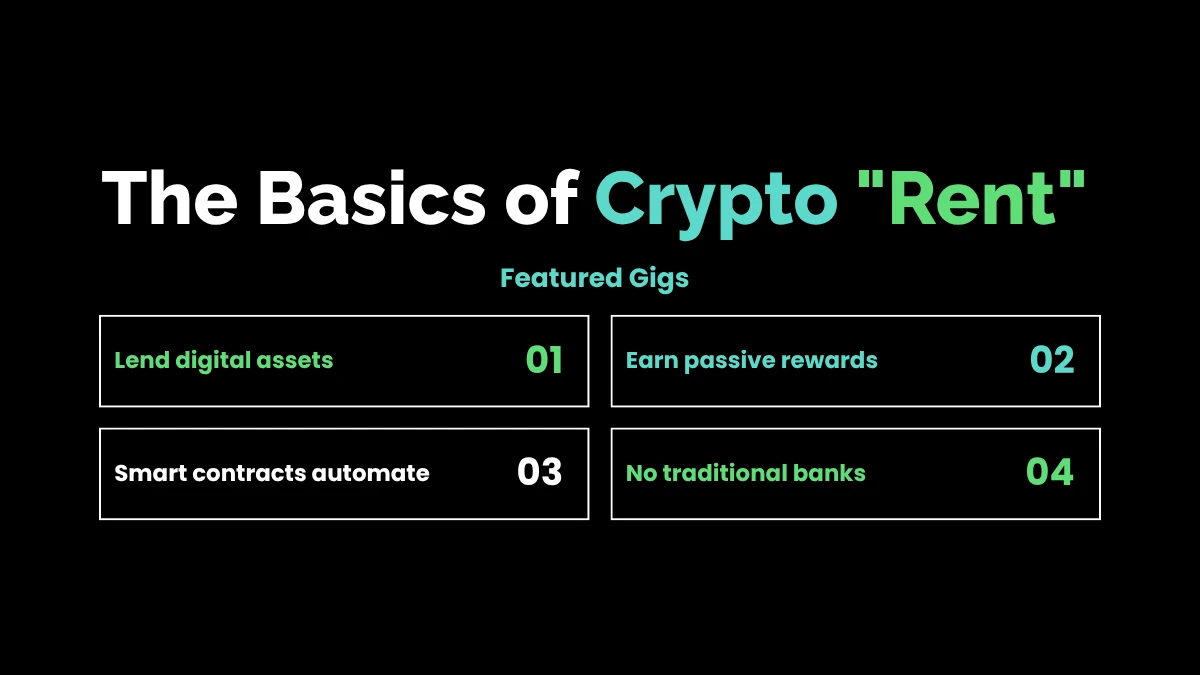
Because there is no massive bank taking a giant cut of the profits, the interest rates returned to everyday users are significantly more rewarding.
When you participate in these protocols, your digital assets are acting as foundational infrastructure. You are essentially renting out your property to global traders, and in return, you receive continuous micro-payments.
At Weirdwealth, we focus heavily on these precise styles of automated income generation because they require zero active daily labor.
10 Beginner-Friendly DeFi Farming Strategies
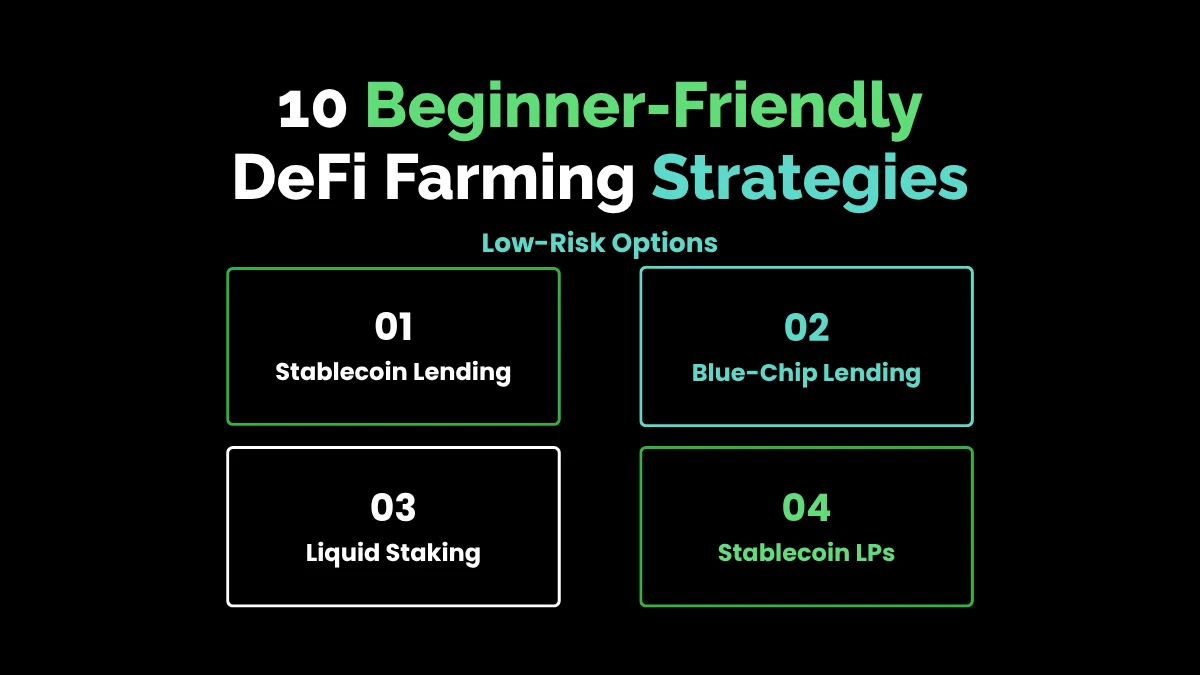
If you are ready to put your digital portfolio to work, these ten strategic paths provide a clear spectrum of risk, complexity, and potential return.
1. Simple Stablecoin Lending
If you hate watching your portfolio value bounce up and down during market volatility, stablecoin lending is the absolute safest place to start.
You simply deposit dollar-pegged assets like USDC or USDT into top-tier money market protocols. Borrowers post over-collateralized crypto assets to secure their loans, ensuring your underlying principal remains protected against default.
2. Blue-Chip Crypto Lending
If you prefer holding foundational assets like Ethereum or Bitcoin rather than fiat-pegged tokens, you can use those exact same money markets. Depositing your native coins allows you to accumulate a variable floating interest rate paid in the exact same asset.
It is a fantastic way to passively stack more satoshis or fractions of ether while patiently waiting for long-term market appreciation.
3. Liquid Staking Token (LST) Holding
Staking natively on blockchains like Ethereum traditionally requires locking your funds up for extended periods, rendering them completely unusable. Liquid staking protocols solve this friction completely.
When you deposit assets through services like Lido Finance, you receive a liquid voucher token back, such as stETH.
This voucher automatically accrues daily blockchain validation rewards while remaining entirely fluid. You can hold it, trade it, or use it as collateral elsewhere across the wider ecosystem.
4. Stablecoin Liquidity Provision (LP)
Decentralized exchanges do not use order books; instead, they rely on massive crowdsourced pools of tokens to facilitate swaps.
As a beginner, you can add equal parts of two different stablecoins like USDC and USDT into a specialized stable pool.
Because both assets are pegged to the same value, your risk of impermanent loss is negligible, while you pocket a clean cut of every single trading fee flowing through that pair.
5. Automated Yield Aggregator Vaults
Managing your positions manually can quickly become tedious and highly expensive due to network gas fees. Auto-compounding platforms like Beefy Finance or Yearn automate the entire process for you.
You deposit your assets into a unified vault, and their smart contracts automatically harvest earned rewards, swap them back for your underlying principal, and reinvest them multiple times a day to dramatically compound your overall returns.
6. Blue-Chip Volatile Liquidity Provision
For those comfortable with a slightly higher risk tolerance, providing liquidity for major asset pairs like ETH/USDC can yield excellent returns. You supply equal dollar amounts of both tokens to a decentralized exchange.
While you will experience some structural portfolio rebalancing as the price of ETH shifts, the massive trading volume on these core pairs generally translates into significant daily fee revenue.
7. Tokenized Real-World Asset (RWA) Vaults
One of the most exciting shifts is the migration of traditional financial products directly on-chain. Beginners can now access institutional-grade yield strategies, such as tokenized U.S. Treasury bills and short-term money market funds.
These structures generally provide a stable, risk-free base rate backed by real-world assets, completely independent of native crypto market volatility.
8. Single-Sided Asset Staking
If providing two different tokens to a pool feels too complicated, many decentralized platforms offer single-sided staking options.
You take a single native utility token and lock it directly into a specific protocol dashboard. This strategy eliminates any structural conversion steps, making it an incredibly clean, one-click layout for users who just want straightforward rewards.
9. Multi-Layer Incentive Pools
When new protocols launch, they often look for ways to pull in deep liquidity quickly. They do this by offering “stacked” rewards.
When you deposit into these specific pools, you earn the standard baseline trading fees, plus bonus governance tokens distributed by the platform. Stacking these multiple incentive layers together is an excellent way to supercharge your aggregate returns.
10. Low-Fee Layer-2 Ecosystem Farming
One major trap that ruins DeFi yield farming beginners setups is executing transactions on expensive networks where a single click can cost substantial cash.
| Network Type | Average Transaction Cost | Best Suited For |
| Ethereum Mainnet | $2.00 – $10.00+ | Large institutional capital allocations |
| Arbitrum L2 | Less than $0.05 | Regular, mid-sized portfolio farming |
| Base L2 | Less than $0.01 | Small accounts and micro-compounding |
Moving your activity to these highly efficient ecosystems ensures that your earned interest actually stays in your wallet, rather than being eaten alive by underlying network gas fees.
Evaluating Platform Safety and Trust
While the returns are incredibly attractive, you must always treat risk management as your absolute top priority. The decentralized ecosystem operates without a corporate help desk, meaning the security of your capital rests entirely on your own operational discipline.
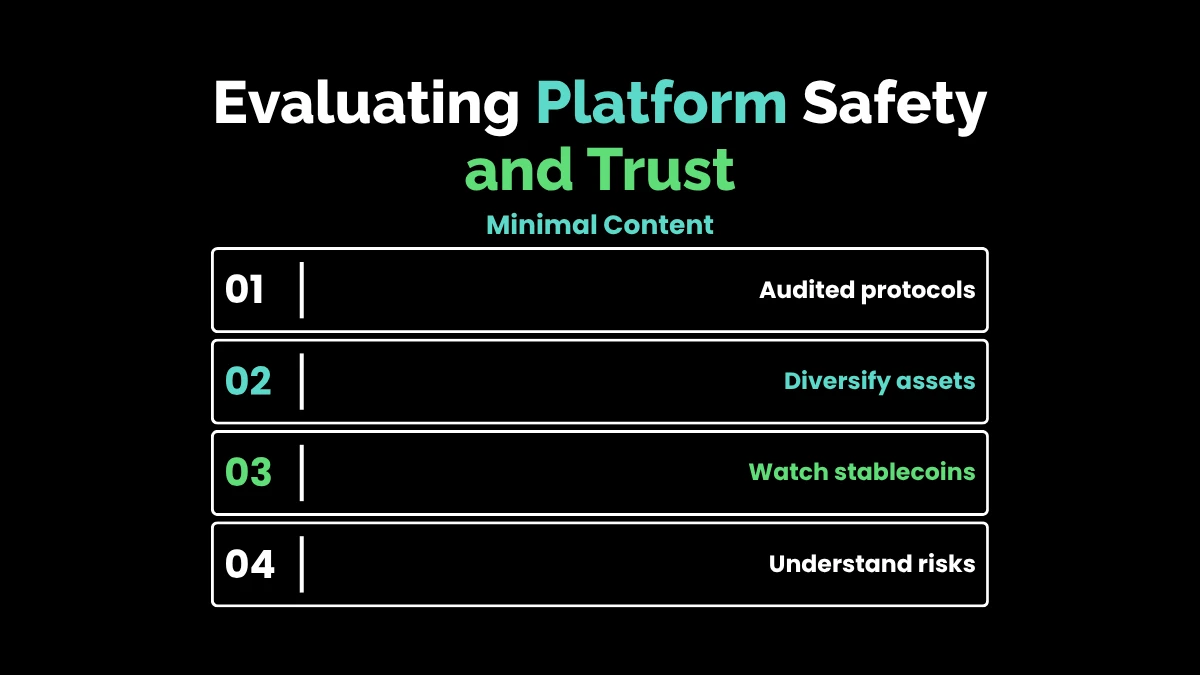
Core Risk Categories to Monitor
- Smart Contract Vulnerabilities: Even the most popular platforms can possess underlying code bugs. Stick to protocols that have been live for over three years and manage over $1 billion in total volume.
- Stablecoin De-Pegging: In rare market conditions, an algorithmic or poorly backed stablecoin can lose its dollar parity, damaging the value of your pool.
- Impermanent Loss: This occurs when the price ratio of two tokens in a liquidity pool diverges significantly compared to when you deposited them.
By keeping your positions diversified across multiple asset types and networks, you can easily mitigate the impact of any single isolated protocol issue.
Building Your First DeFi Income Portfolio
At Weird Wealth, we highly recommend taking a slow, tiered approach when constructing your initial yield engine. Never throw your entire net worth into an experimental pool simply because it advertises an eye-popping three-digit return profile.
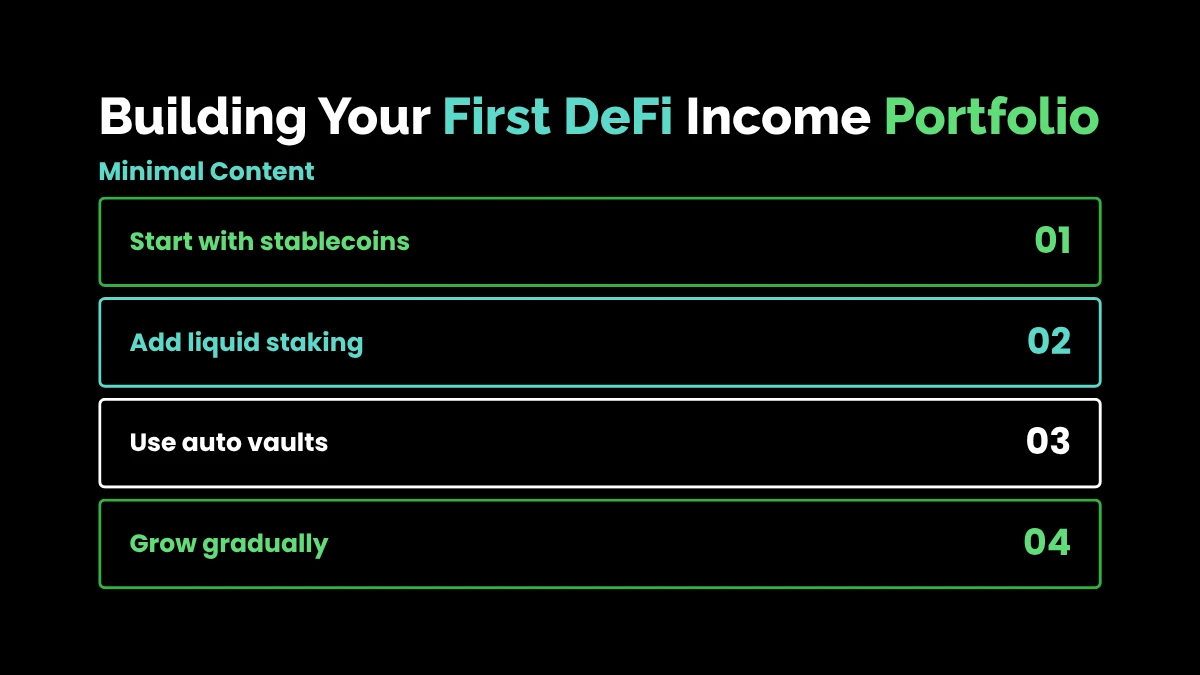
Instead, start by placing a large chunk of your available capital into stablecoin lending or tokenized Treasuries to secure a bulletproof foundation. From there, you can slowly allocate smaller portions into liquid staking and automated vaults.
This methodical architecture keeps your principal incredibly secure while giving you a front-row seat to learn how the exciting world of decentralized interest operates.
Conclusion
Stepping into the world of DeFi yield farming beginners strategies doesn’t have to be intimidating.
By focusing on simple lending protocols, utilizing dollar-backed stablecoins, and sticking to highly efficient Layer-2 networks, you can easily outpace traditional banking returns.
Treat your digital assets like productive real estate, stay safe by sticking to deeply liquid, audited protocols, and enjoy watching your crypto balances grow automatically every single block.
Frequently Asked Questions
What is the actual difference between APR and APY in yield farming?
The primary difference comes down to compounding. APR stands for Annual Percentage Rate, which represents the simple interest you earn over a year without reinvesting your rewards. APY stands for Annual Percentage Yield, which factors in the compounding effect of continuously adding your earned rewards back into the principal balance.
Is my capital locked up forever when I start yield farming?
In most cases, beginner strategies like variable rate lending on Aave or flexible liquidity provisioning allow you to withdraw your assets whenever you want. However, some specific fixed-term vaults or native blockchain staking options do require a defined lock-up period, so always review the protocol rules before confirming a deposit.
How do network gas fees impact my overall farming profitability?
Gas fees are the transaction costs paid to network validators to process your smart contract interactions. On networks like Ethereum mainnet, high gas fees can quickly wipe out the returns of smaller accounts. This is why beginners should generally focus their farming activities on ultra-low-cost Layer-2 networks like Base or Arbitrum.
What happens if a DeFi platform I am using gets exploited by hackers?
If a protocol suffers a smart contract exploit, there is a realistic risk that deposited funds could be drained from the contract. Because DeFi is entirely non-custodial and lacks centralized insurance, these losses are often permanent. To minimize this risk, always stick to mature, extensively audited platforms with long operational histories.