
If you’ve been paying attention to side hustle trends lately, you’ve probably noticed one idea showing up again and again: ATM passive income. It’s everywhere, on YouTube, LinkedIn, and even in casual conversations about “easy” money. Pair that with the growing interest in the vending machine business, and suddenly machines are being pitched as the ultimate hands-off income stream.
But here’s the honest version most people skip.
This model works but it’s not magic. It’s not instant. And it’s definitely not fully passive.
What it is, though, is one of the few real-world ways to build consistent, asset-based income without depending on clients, algorithms, or constant online effort. In 2026, that’s exactly why more people are quietly getting into ATM passive income and treating machines like small, income-producing assets.
Let’s break down how it actually works.
Why This Model Is Growing So Fast
There’s something appealing about owning a machine that makes money while you’re not around. That idea alone is enough to pull people in. But the real reason behind the rise of ATM passive income and the vending machine business is much more practical.
People are tired of unstable income streams.
Freelancers deal with inconsistent clients. Content creators rely on unpredictable algorithms. Even eCommerce sellers face rising ad costs and shrinking margins. Compared to that, passive income machines offer something different—predictability.
Cash still circulates in everyday life. Snacks and drinks still sell in high-traffic locations. And machines don’t call in sick or demand salaries.
That combination is what’s turning this into a serious cash flow side hustle rather than just another online trend.
What “Passive” Really Means Here
Before going further, it’s important to clear up a common misconception.
ATM passive income is not completely passive.
You don’t just buy a machine, place it somewhere, and forget about it forever. There’s setup involved. There’s maintenance. There’s monitoring.
But compared to most businesses, the workload is minimal once everything is running smoothly.
Think of it this way: you’re putting in effort upfront to build a system that continues to pay you over time. That’s why these are better described as passive income machines rather than fully passive ventures.
The difference matters, especially if you’re planning to scale.
How ATM Passive Income Actually Works
At its core, ATM passive income is a simple business model.
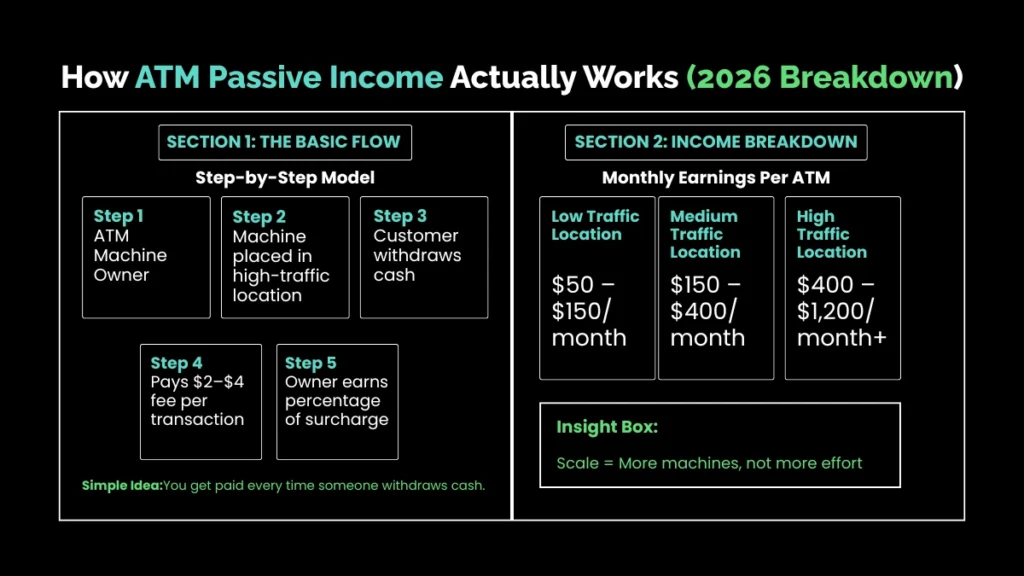
You own the ATM. You place it in a location with steady foot traffic. Every time someone withdraws cash, they pay a small fee. That fee becomes your revenue.
It sounds straightforward and it is but the details are where the real money is made.
Each transaction typically includes a surcharge, often between $2 and $4. A portion of that goes to you as the machine owner. If your ATM is placed in a busy location, those transactions add up quickly.
This is why location matters more than anything else. A quiet store might generate almost nothing, while a busy gas station or nightclub can bring in steady daily usage.
On average, a single ATM can generate a few hundred dollars per month. That might not sound impressive at first, but the real power of ATM passive income shows up when you scale. Five machines, ten machines, or more—and suddenly you’re looking at a consistent monthly income stream that doesn’t require daily attention.
That’s when it starts to feel like a true cash flow side hustle.
The Vending Machine Business Model
The vending machine business works differently, but the principle is similar.
Instead of earning from transaction fees, you earn by selling products. You stock snacks, drinks, or other items at wholesale prices and sell them at a markup through the machine.
Every sale generates a small profit, and over time, those profits stack up.
In 2026, vending machines have evolved beyond basic snack dispensers. You’ll find machines selling everything from protein shakes to electronics, depending on the location. This flexibility is what makes the vending machine business appealing to many beginners.
However, it does require more hands-on involvement than ATM passive income. You need to manage inventory, restock products, and occasionally deal with expired or unsold items.
That’s why many people start with vending machines and eventually expand into passive income machines like ATMs for a more hands-off experience.
Comparing ATMs and Vending Machines
A lot of people ask the same question: which one is better?
The answer depends on what you’re looking for.
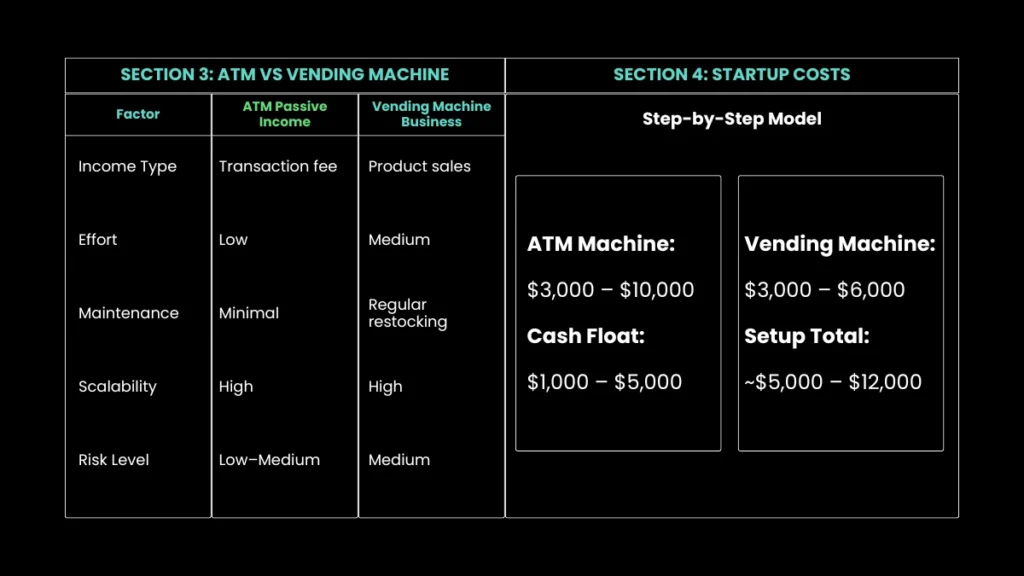
ATM passive income tends to be more predictable. Once the machine is placed in a good location, revenue stays relatively stable. There’s no inventory to manage, and maintenance is usually minimal.
The vending machine business, on the other hand, offers more flexibility but requires more effort. Your income depends on what you sell, how often you restock, and how well your product selection matches the location.
In simple terms, ATMs lean more toward passive income, while vending machines lean more toward active management.
That’s why many experienced operators eventually combine both, turning a single location into multiple income streams.
Startup Costs and What to Expect
One of the biggest barriers for beginners is the upfront cost.
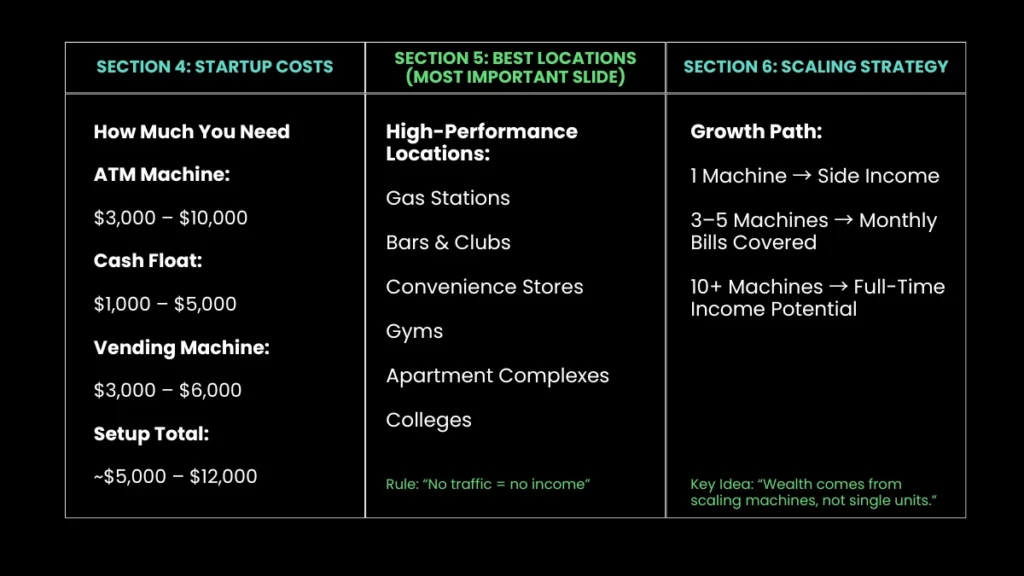
Starting with ATM passive income usually requires a few thousand dollars. The machine itself can cost anywhere from $3,000 to $10,000, depending on the model and features. On top of that, you’ll need cash to load into the machine so customers can withdraw money.
Altogether, most people spend around $5,000 to get started with one ATM.
The vending machine business falls into a similar range. Machines can cost between $3,000 and $6,000, and you’ll also need to budget for initial inventory.
Compared to other businesses, these costs are relatively low. You’re not renting a storefront or hiring employees. Instead, you’re investing in an asset that generates income over time.
That’s what makes both options attractive as a long-term cash flow side hustle.
The Role of Location in Success
If there’s one factor that determines whether you succeed or fail in this space, it’s location.
It doesn’t matter how new your machine is or how good it looks. If it’s placed somewhere with low traffic, it won’t make money.
On the flip side, even an average machine in a high-traffic area can generate consistent income.
For ATM passive income, ideal locations include gas stations, bars, clubs, and convenience stores—places where people frequently need cash.
For the vending machine business, offices, gyms, schools, and apartment complexes tend to perform well.
Choosing the right location isn’t just important it’s everything. It’s the difference between a machine that barely breaks even and one that becomes a reliable source of income.
Scaling Into Real Income
Most people don’t stop at one machine.
They start small, learn the process, and then reinvest their profits into more machines. Over time, this creates a network of income-producing assets.
This is where ATM passive income really shines.
One machine might cover a bill. Five machines might cover your rent. Ten or more can start replacing a full-time income.
The same applies to the vending machine business, although scaling requires more logistical effort due to restocking and inventory management.
Eventually, many operators build routes clusters of machines in nearby locations—so they can manage everything efficiently. Some even hire help to handle maintenance and restocking, making the business even more passive.
At that point, you’re no longer just running a side hustle. You’re managing a system of passive income machines.
Technology Is Making It Easier
In 2026, technology has made this model more accessible than ever.
Modern ATMs and vending machines come with remote monitoring systems. You can track transactions, check inventory levels, and receive alerts all from your phone.
This reduces the need for constant physical checks and makes managing multiple machines much easier.
It’s one of the reasons ATM passive income is becoming more popular. The more automated the system becomes, the closer it gets to true passivity.
The Risks You Should Know
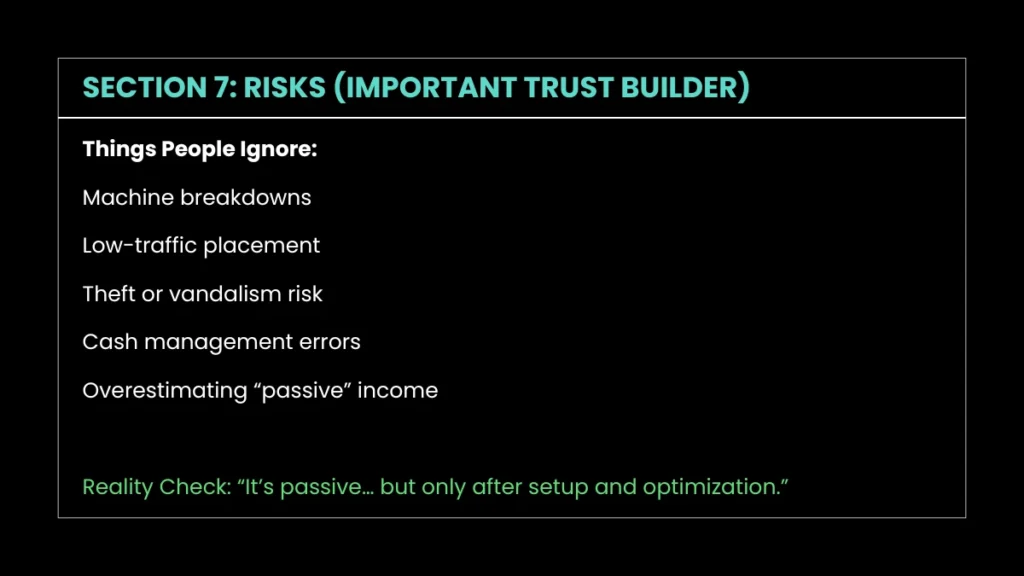
No business is risk-free, and this one is no exception.
Machines can break. Locations can underperform. In some cases, theft or vandalism can become an issue, especially for ATMs.
There’s also the risk of overestimating how “passive” this really is. If you go in expecting zero effort, you’ll likely be disappointed.
But if you approach it as a business one that requires smart decisions and occasional involvement—the risks become manageable.
That’s the mindset successful operators adopt.
Who This Model Is Best For
Not everyone is a good fit for this type of business.
It works best for people who have some capital to invest and are willing to think long-term. If you’re looking for instant results, this probably isn’t the right path.
But if you’re interested in building steady income over time, ATM passive income and the vending machine business offer a practical way to do it.
They’re especially appealing to people who want to diversify their income without relying entirely on online platforms.
Why Many People Combine Both
Some of the smartest operators don’t choose between ATMs and vending machines—they use both.
Placing an ATM and a vending machine in the same location allows you to maximize revenue from a single spot. One generates transaction fees, while the other generates product sales.
This layered approach turns a simple setup into a more powerful cash flow side hustle, creating multiple income streams from the same foot traffic.
The Future of ATM Passive Income
Despite the rise of digital payments, cash isn’t disappearing anytime soon. Many industries still rely heavily on it, and that keeps ATMs relevant.
At the same time, vending machines are becoming more advanced, offering cashless payments and a wider range of products.
Together, these trends suggest that ATM passive income and other passive income machines will continue to evolve rather than fade away.
For those willing to learn the system and play the long game, the opportunity is still very much alive.
Final Thoughts
There’s a reason more people are exploring ATM passive income in 2026.
It’s not because it’s easy or effortless. It’s because it’s simple, scalable, and grounded in real-world demand.
The vending machine business follows a similar path, offering a slightly more hands-on way to build consistent income.
Neither option will make you rich overnight. But both can help you build something far more valuable—steady, reliable cash flow that grows over time.
And in a world where income is becoming increasingly unpredictable, that kind of stability matters.
If you’re interested in exploring more unconventional income ideas like this, you can check out:
It’s a solid resource for discovering unique ways people are building income beyond the usual advice.
In the end, the appeal of ATM passive income isn’t just about making money while you sleep.
It’s about owning something that works for you even when you’re not working for it.
Frequently Asked Questions
Is owning an ATM still profitable in 2026?
Absolutely. While digital payments are huge, cash-heavy spots like bars, laundromats, and nightclubs haven’t slowed down. Most operators see a full return on investment (ROI) within 12–18 months if the location is right.
How much cash do I need to start an ATM side hustle?
Expect to spend roughly $5,000 to $7,000. This isn’t just for the machine; it includes the “vault cash” you load inside so customers can actually withdraw money. It’s an asset-heavy start, but it pays off in steady surcharges.
What are the best locations for vending machines right now?
Forget empty malls. In 2026, the real money is in apartment complexes, 24-hour gyms, and warehouses. Niche machines selling protein shakes or tech accessories are currently outperforming traditional soda machines in high-traffic areas.
How much time does it actually take to manage these machines?
It’s “semi-passive.” You’ll likely spend 2–4 hours a week on restocking or cash loading. Thankfully, 2026 tech lets you monitor everything from your phone, so you only visit the machine when it actually needs attention.
Do I need a business license or LLC?
Yes. To be taken seriously by property owners and to protect your personal assets, forming an LLC is a smart move. You’ll also need a business bank account to handle the electronic transfers from your transactions.