
Key Takeaways
- Automate savings before you spend.
- Follow the “pay yourself first” principle.
- Use payroll deductions to build wealth consistently.
- Capture employer retirement matches whenever available.
- Start small and increase savings gradually over time.
Staring at your bank account a few days before payday, wondering where your hard-earned money went, is a frustratingly common cycle. If you are tired of living paycheck to paycheck, implementing a structured salary saving scheme is the ultimate way to reclaim control of your financial future.
A salary saving scheme is a systematic method, often automated through your employer or bank that channels a portion of your income into savings before you have the chance to spend it. By prioritizing your financial future the moment your paycheck hits, you can easily build a nest egg using a salary saving scheme.
Here at Weird Wealth, we believe that building wealth shouldn’t feel like a chore. In this comprehensive guide, we will break down exactly how a salary saving scheme works, explore the best options available in 2026, and share practical strategies on how to save from salary without feeling deprived.
AI Overview
A salary saving scheme is a structured, automated approach to building financial security by setting aside a portion of your income before spending. Through payroll deductions, retirement contributions, or savings plans, it helps reduce impulse spending and encourages consistent wealth growth. By automating savings and following a “pay yourself first” strategy, individuals can achieve short- and long-term financial goals more effectively.
What is a Salary Saving Scheme and How Does It Work?
At its core, a salary saving scheme is a structured framework designed to make saving money completely hands-off. Instead of waiting until the end of the month to save whatever pocket change is left over, a salary saving scheme flips the script.
It relies heavily on the classic pay yourself first strategy, ensuring your future goals are funded before you pay your utility bills, buy groceries, or spend money on weekend entertainment. When you execute a pay yourself first strategy, you remove the temptation to spend money you should be saving.
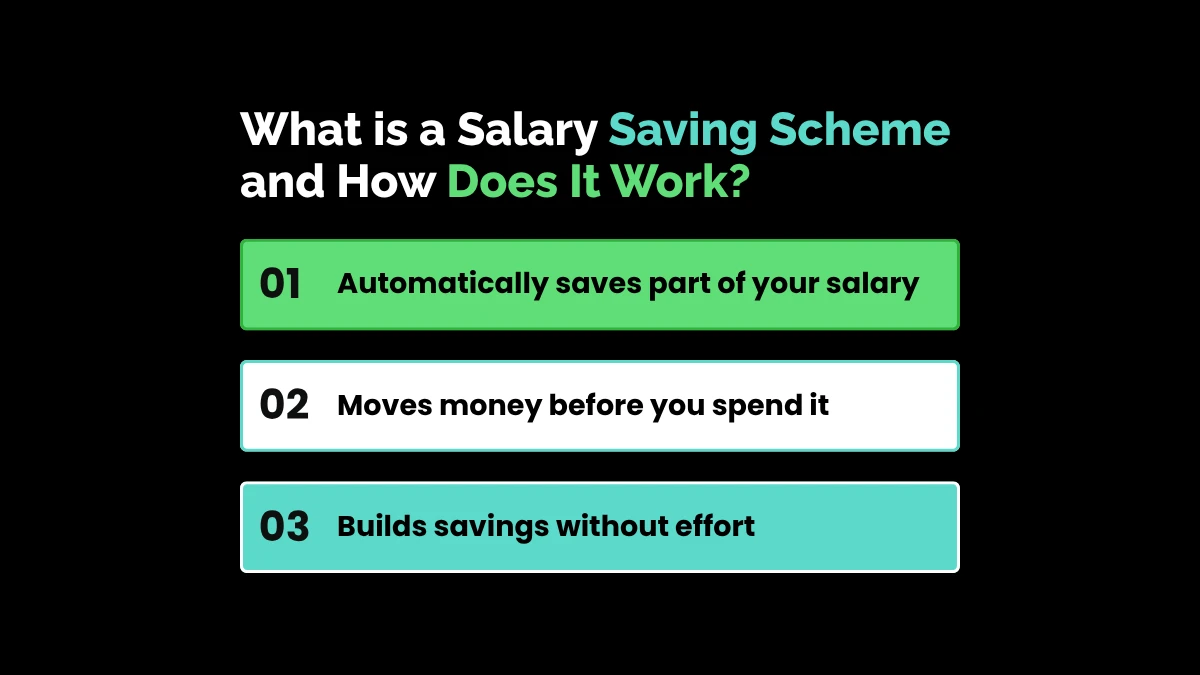
When you enroll in an official employee savings scheme through your workplace, or set up a dedicated arrangement with your financial institution, you are putting your financial goals on autopilot. The magic of an employee savings scheme lies in automation.
When you don’t physically see the money sitting in your main checking account, you mentally adapt to living on less. This simple psychological shift, driven by an automated employee savings scheme, eliminates the daily friction of deciding whether to save or spend, effectively curing impulse spending at the root.
The Best Salary Saving Schemes to Maximize Your Paycheck
There is no one-size-fits-all approach to building a financial safety net. Depending on your employer, your country, and your long-term objectives, you can choose from several highly effective frameworks to save money from paycheck deposits every month.
Learning how to save money from paycheck amounts consistently is the fastest way to build security, especially when you learn how to save from salary allocations automatically.
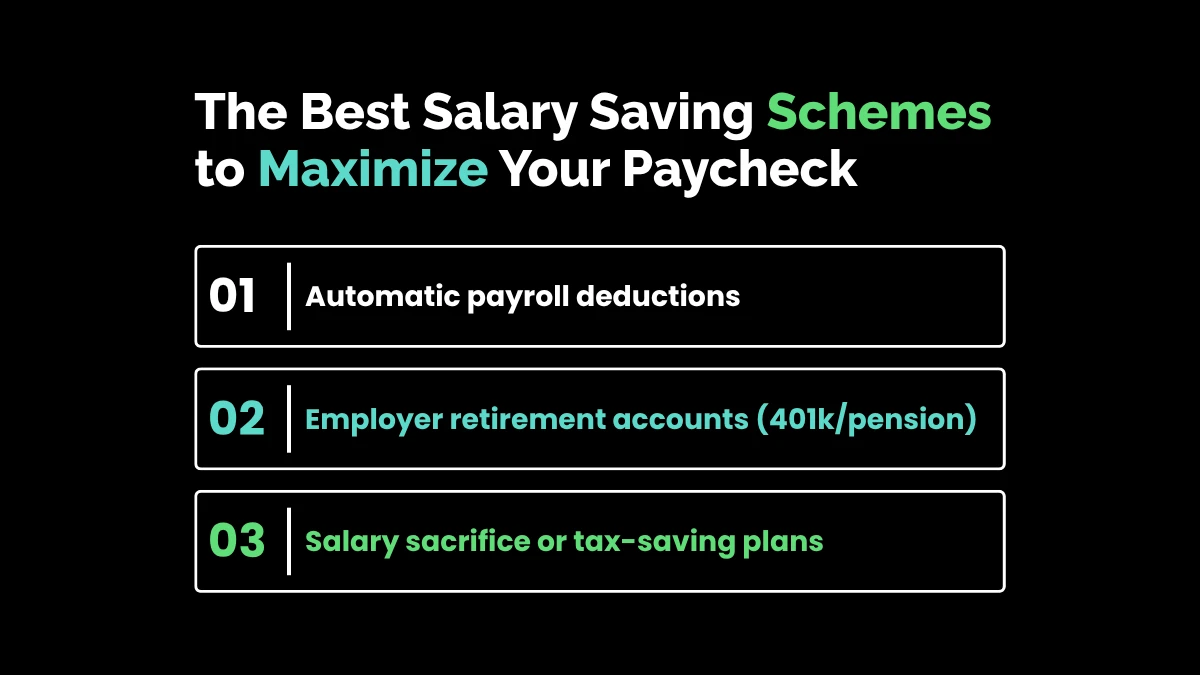
1. Automatic Payroll Deductions
The easiest entry point to a structured savings routine is an automatic salary deduction. With an automatic salary deduction setup, your employer’s payroll department splits your direct deposit.
A predetermined percentage or fixed dollar amount goes straight into a high-yield savings account or an investment portal through this automatic salary deduction, while the remainder lands in your everyday checking account.
Utilizing an automatic salary deduction ensures you save money from paycheck totals before you even see them.
2. Employer-Sponsored Retirement Accounts
For long-term financial security, utilizing a 401k salary deduction (or your country’s equivalent, like a workplace pension or superannuation) is arguably the most powerful payroll savings plan available.
Because a 401k salary deduction is often managed on a pre-tax basis, it lowers your overall taxable income for the year while quietly compounding in the background.
Enrolling in a workplace payroll savings plan that features a 401k salary deduction is an essential step for long-term wealth building.
3. Salary Sacrifice Programs
Another advanced strategy is a salary sacrifice savings arrangement. Under a salary sacrifice savings agreement, you legally agree to receive a lower cash salary in exchange for your employer directing that sacrificed amount into non-cash benefits, extra pension contributions, or company stock programs.
This salary sacrifice savings structure can significantly optimize your tax efficiency. Utilizing a salary sacrifice savings program is ideal for high earners looking to maximize a workplace payroll savings plan.
How to Choose the Right Strategy for Your Goals
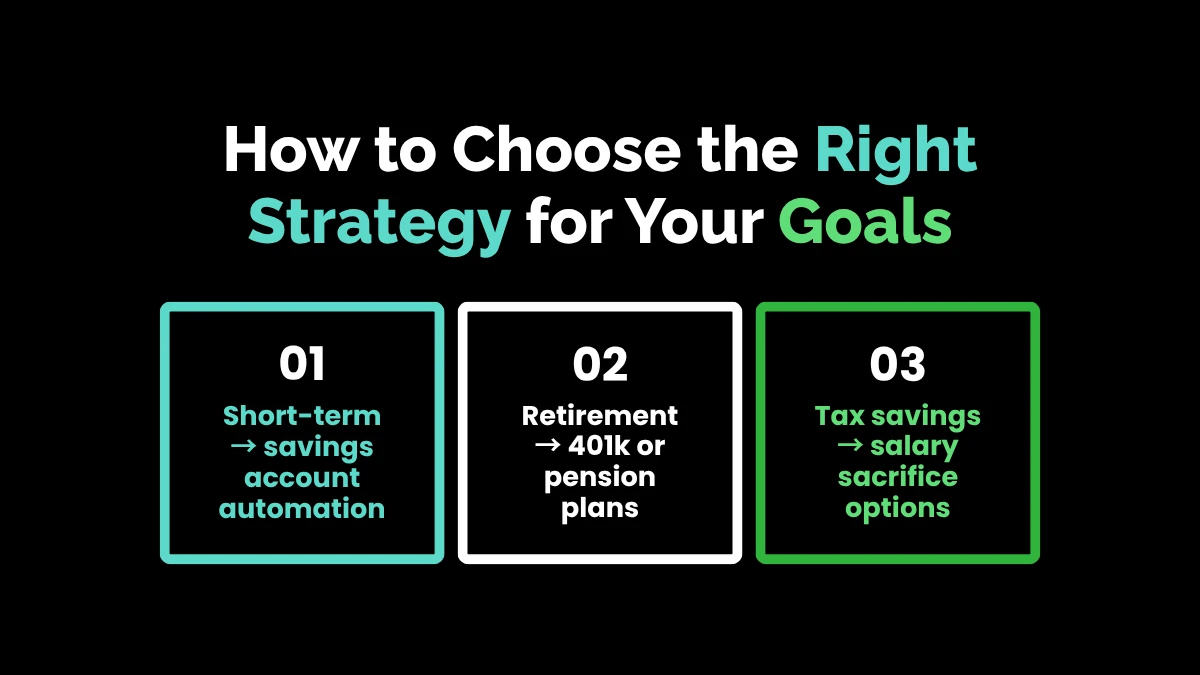
To help you decide which payroll savings plan components align with your current lifestyle, the team at Weird Wealth has compiled a quick breakdown of how these options compare based on accessibility and primary financial intent to help you save money from paycheck limits effectively.
| Scheme Type | Accessibility | Primary Benefit | Best For |
| Automatic Salary Deduction | Immediate (Liquid) | Prevents impulse spending | Emergency funds & short-term goals |
| 401k Salary Deduction | Restricted (Age 59½) | Pre-tax growth & employer match | Long-term retirement security |
| Salary Sacrifice Savings | Variable | Tax optimization | High earners & maximizing benefits |
| Employee Savings Scheme | Moderate | Often includes company bonuses | Mid-term milestones (e.g., a home downpayment) |
Step-by-Step Guide on How to Save From Salary Effectively
Transitioning to a rigid salary saving scheme can feel intimidating if you are accustomed to spending freely. However, establishing a sustainable employee savings scheme mind-shift and mastering how to save from salary targets requires only a few intentional, orderly adjustments to your banking habits.
-
Audit Your Baseline Expenses: Before automating an automatic salary deduction, review your last three months of bank statements to calculate your true living costs and determine how to save from salary allocations safely.
-
Establish an Emergency Buffer: Aim to direct your initial payroll savings plan funds toward building a liquid cushion of three to six months’ worth of expenses.
-
Activate Your Workplace Match: If your employer offers a matching contribution for a 401k salary deduction, contribute at least enough to capture the full match. Turn down free money? Not on our watch.
-
Gradually Increase Your Percentages: Start by automating a modest 5% deduction using the pay yourself first strategy, then bump it up by 1% every six months until you reach your target savings rate.
Pro Actionable Best Salary Saving Tips for 2026
Succeeding with a salary saving scheme requires combining structural automation with smart daily habits.
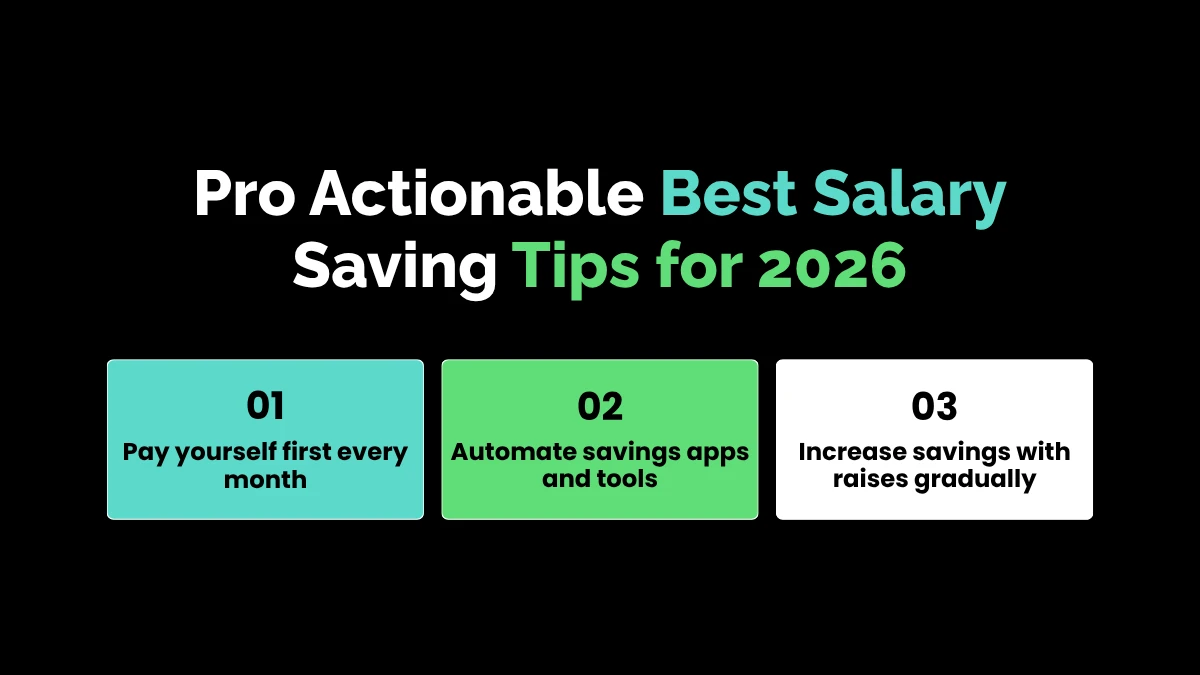
If you truly want to implement the best salary saving tips, you must treat your savings goals as non-negotiable monthly expenses. These best salary saving tips focus on changing your behavioral relationship with money.
Embrace the “Pay Yourself First” Philosophy
Most people pay their landlord, the utility company, and the local coffee shop first, leaving their financial future with whatever crumbs remain.
Embracing a strict pay yourself first strategy ensures that your savings goals are treated with the exact same urgency as your rent or mortgage payment. One of the best salary saving tips is to never deviate from this pay yourself first strategy.
Harness the Power of AI and App Integration
In 2026, financial technology is smarter than ever. Many modern banking apps analyze your spending patterns and use micro-saving algorithms to sweep spare change into your employee savings scheme without you ever noticing.
Combining these smart apps with your workplace payroll savings plan creates a multi-layered defense system against inflation and lifestyle creep. Following these best salary saving tips will supercharge your savings rate.
Optimize Your Tax Tranches
Whenever you receive a raise or a performance bonus, instantly allocate at least half of that increase to your 401k salary deduction or salary sacrifice savings plan.
Because you are already accustomed to living on your previous income level, routing these raises directly into a salary saving scheme allows you to accelerate your wealth-building journey without experiencing any perceived drop in your daily standard of living.
Common Mistakes to Avoid When Saving Money From Your Paycheck
While setting up an automatic salary deduction is an incredible milestone, there are a few common pitfalls that can derail your progress if you aren’t careful when trying to save money from paycheck deposits.
First, avoid the temptation to set your automated savings goal too high right out of the gate. If you abruptly shift 30% of your paycheck into a restricted account without adjusting your lifestyle, you may find yourself facing a cash shortage mid-month.
This often forces people to pull money back out of savings or rely on high-interest credit cards, which completely defeats the purpose of the pay yourself first strategy. Start small, build momentum, and scale up sustainably to master how to save from salary allocations.
Second, do not leave all of your automated savings sitting in a traditional, low-interest checking account. Inflation will quietly erode the purchasing power of your money over time.
Ensure that your short-term payroll savings plan deposits flow directly into a high-yield savings account (HYSA), while your long-term salary sacrifice savings or 401k salary deduction funds are actively invested in diversified index funds or market instruments that align with your risk tolerance.
Conclusion
Ultimately, a successful salary saving scheme removes human willpower from the financial equation. By relying on a structured payroll savings plan, an automatic salary deduction, or a workplace salary sacrifice savings agreement, you protect your money from your own impulse spending habits.
Building wealth isn’t about how much money you make; it’s about how much money you keep. Implementing a salary saving scheme will allow you to quietly build financial freedom in the background while you focus on living your life.
For more unconventional, straightforward financial advice and the best salary saving tips that cut through the mainstream fluff, keep exploring our resources right here at Weirdwealth.
Frequently Asked Questions
What is the ideal percentage to allocate to a salary saving scheme?
While individual circumstances vary, a standard recommendation based on traditional financial frameworks is to allocate 20% of your net income toward a salary saving scheme. If 20% feels out of reach initially, starting with just 5% via an automatic salary deduction and increasing it over time is a highly effective way to learn how to save from salary goals without putting a strain on your monthly obligations.
Can I withdraw money from a salary sacrifice savings plan early?
Withdrawal terms depend heavily on the specific type of employee savings scheme you utilize. Funds routed through a standard automatic salary deduction into a high-yield savings account can generally be accessed instantly. However, funds committed through a salary sacrifice savings arrangement or a 401k salary deduction are usually earmarked for retirement and may incur steep tax penalties if withdrawn prematurely.
How does a payroll savings plan differ from regular manual saving?
The primary differentiator is automation. A manual strategy requires you to log into your bank app every month and actively choose to move money, which leaves the door open for emotional spending or forgetfulness. A structured payroll savings plan removes human error entirely by utilizing an automatic salary deduction to move money before it ever touches your primary spending account, perfectly executing the pay yourself first strategy.
Is a 401k salary deduction safe from market volatility?
A 401k salary deduction is an investment vehicle, meaning the underlying assets (like stocks and bonds) will naturally fluctuate with the market. However, contributing consistently to a retirement-focused employee savings scheme allows you to benefit from dollar-cost averaging. This means you buy fewer shares when prices are high and more shares when prices are low, which historically builds robust wealth over the long term based on available historical financial data, allowing you to save money from paycheck limits safely over time.