
Key Takeaways
-
Annual salary of $124,800 before taxes
-
Gross monthly income of $10,400
-
Based on standard 40-hour workweeks
-
Realistic view of take-home pay
-
Smart budgeting steps for six-figure earners
Have you ever paused mid-day, stared at your screen, and wondered what your hourly wage actually looks like over a whole year?
Maybe you just got offered a new gig, or maybe you are setting fresh income goals. If you are eyeing $60 an hour, you are looking at a fantastic financial milestone. Let’s cut straight to the chase: 60 an hour is how much a year?
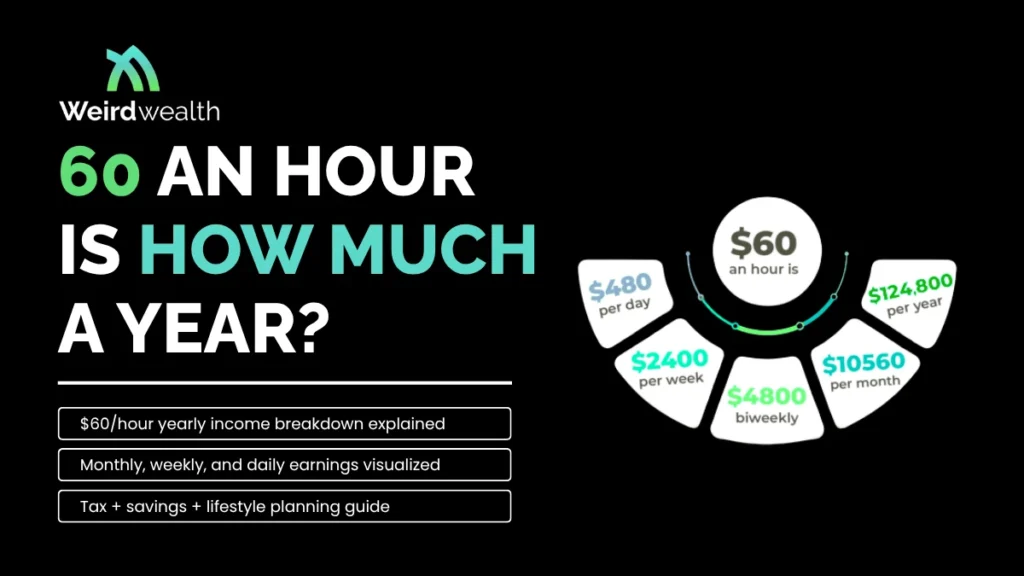
If you work a standard full-time schedule, making $60 an hour translates to a gross annual salary of $124,800 before taxes.
That is a serious six-figure income that puts you well above the national median wage.
Here at Weirdwealth, we love breaking down numbers so they actually make sense for your daily life. It is one thing to see a big shiny number on paper, but it is another thing entirely to know how that money changes your day-to-day budget. Let’s dive into exactly what this hourly rate looks like when it hits your bank account.
AI Overview
Wondering how a $60 hourly rate translates to long-term wealth? If you work full-time, 60 an hour is how much a year depends on your total hours, but it generally hits $124,800 annually. This $60 dollars an hour annual income translates to roughly $10,400 every month before taxes. Converting your $60 hourly to salary opens up incredible financial options, giving you a strong 60 an hour monthly income to build serious personal savings.
The Core Math: Converting $60 Hourly to Salary
To understand how a $60 hourly to salary conversion works, we assume you are working a traditional full-time schedule. In the corporate world, a standard workyear consists of 52 weeks. If you clock 40 hours each week, you are looking at exactly 2,080 working hours across the year.
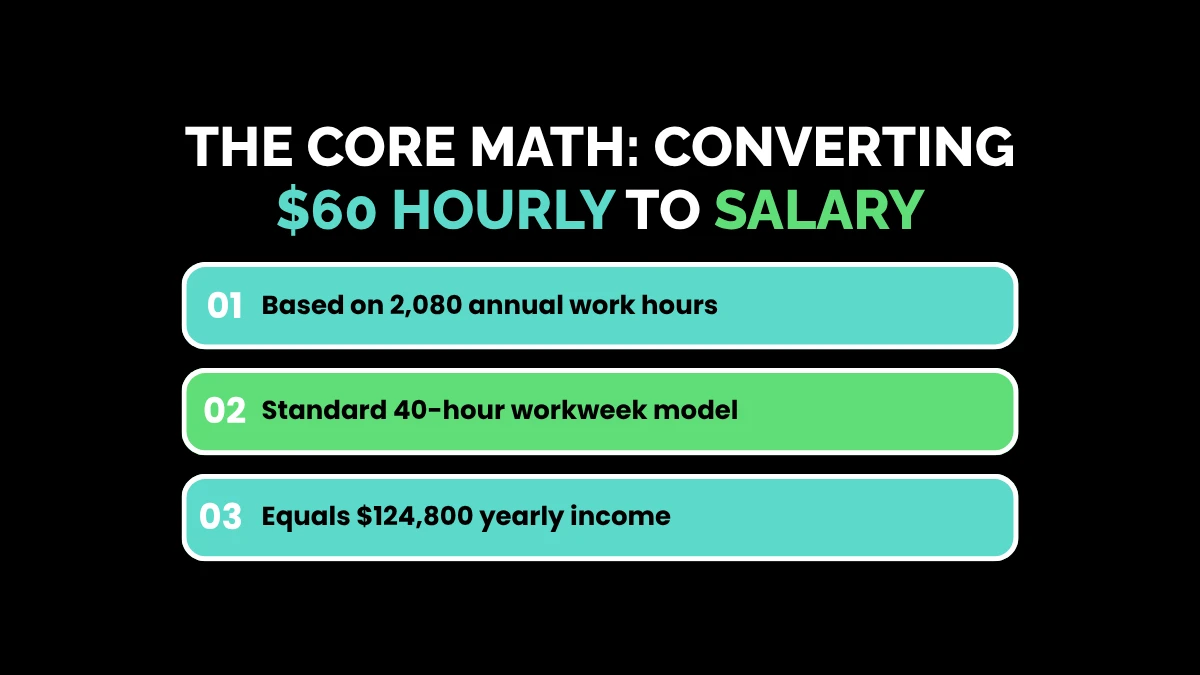
Of course, this assumes you work every single one of those hours without taking unpaid time off. It is a perfect baseline to see how your everyday time converts into a stable, yearly corporate salary.
The Standard Paid vs. Unpaid Reality
Not everyone gets the same perks at work. If you are a standard salaried employee, you likely get paid time off (PTO) for holidays and vacations. In that case, your $60 dollars an hour annual income stays locked in at that sweet $124,800 mark.
But what if you are a freelancer or an independent contractor? For many gig workers, if you do not work, you do not get paid. If you decide to take two weeks of unpaid vacation every year, your working weeks drop to 50.
It is a slight dip, but still an incredible financial cushion to build your life around.
The Complete $60/hr Income Breakdown
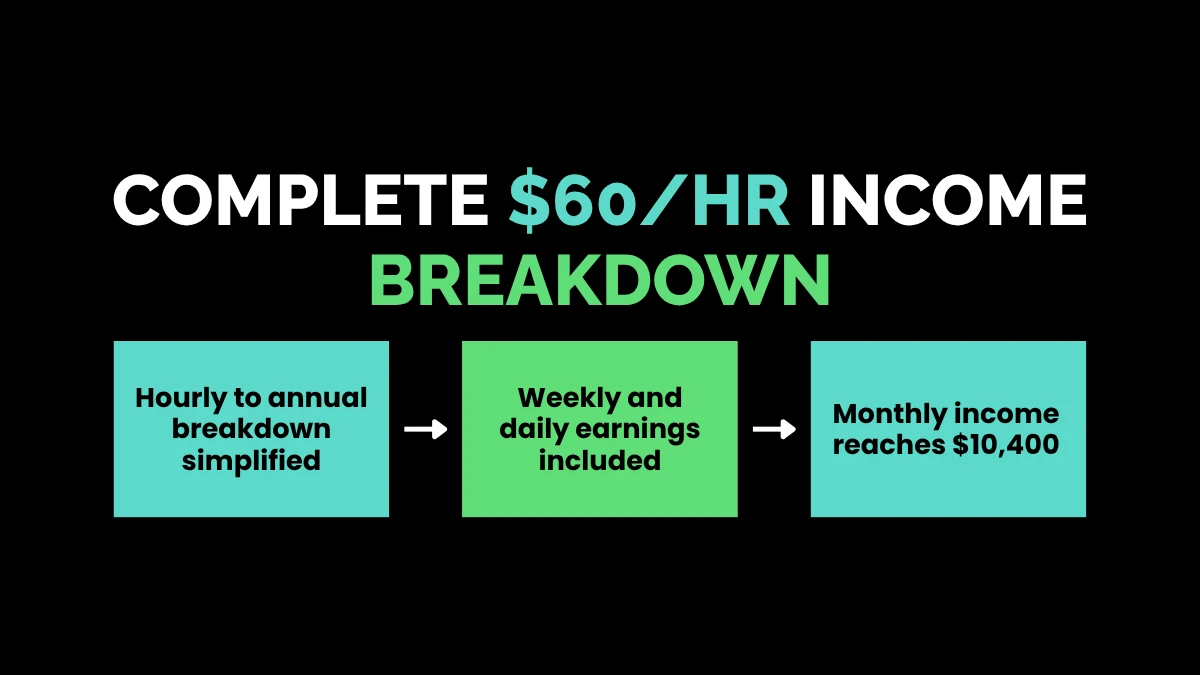
To truly map out your life, you need to see your money through different lenses. You do not just pay yearly bills; you buy groceries every week and pay rent every month.
| Time Period | Gross Income Calculation | Total Earnings |
| Hourly | Base rate | $60.00 |
| Daily | 8 hours per day | $480.00 |
| Weekly | 40 hours per week | $2,400.00 |
| Bi-Weekly | Every two weeks (80 hours) | $4,800.00 |
| Monthly | 173.33 average hours | $10,400.00 |
| Annual | 2,080 hours per year | $124,800.00 |
Seeing it laid out like this makes the transition from a $60 hourly to salary mindset feel incredibly real.
Your Daily and Weekly Cash Flow
When you earn $60 an hour, your daily output is worth $480. Think about that for a second. Every single day you wrap up work, you have generated nearly five hundred dollars before Uncle Sam takes his cut. On a weekly basis, you are bringing in $2,400. This kind of consistent cash flow makes covering basic living expenses feel smooth and low-stress.
Your 60 an Hour Monthly Income
Monthly bills are the ultimate test of any budget. Your gross 60 an hour monthly income sits right at $10,400. Why isn’t it just $2,400 multiplied by four? Because most months actually have slightly more than four weeks.
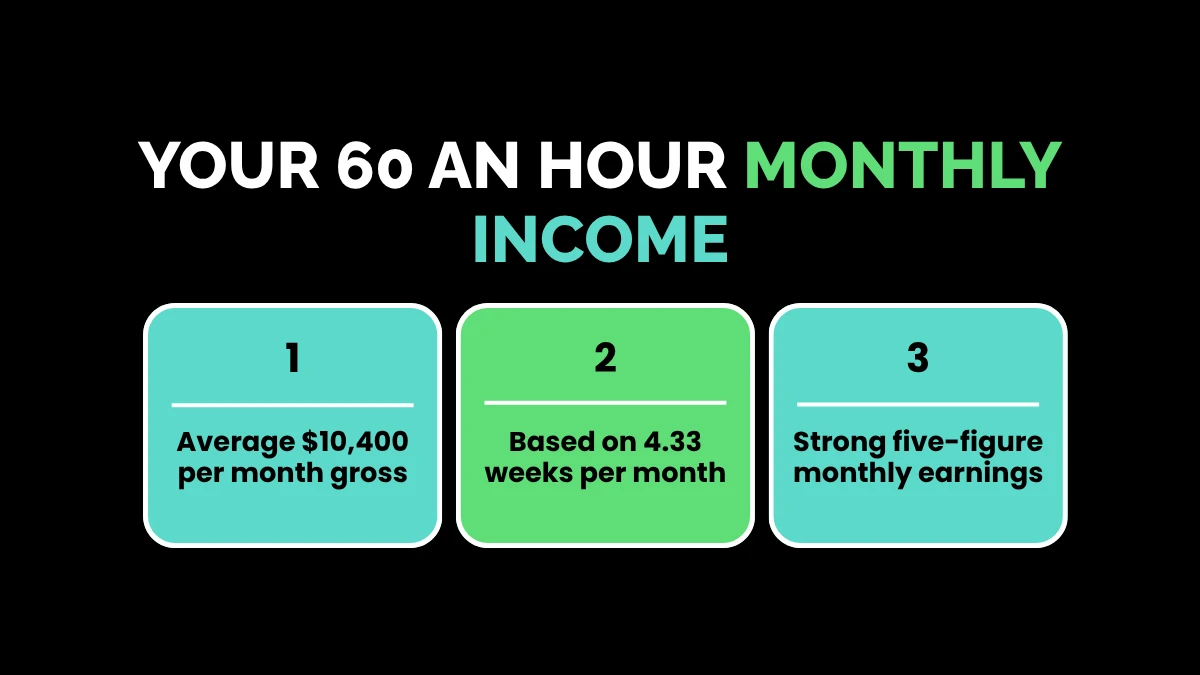
To find the exact average, we divide the 52 weeks of the year by 12 months, giving us roughly 4.33 weeks per month. This means your consistent monthly income hovers securely into five-figure territory, offering immense peace of mind.
The Tax Man Cometh: What is Your Actual Take-Home Pay?
We would love to tell you that you get to keep all $124,800 of your money. But as we all know, gross income and net income are two very different animals. When you shift your $60 hourly to salary perspective, taxes will take a noticeable bite out of your paycheck.
In most cases, your final take-home pay depends entirely on where you live and your specific tax filing status. You will have to pay federal income taxes, state income taxes, Social Security, and Medicare.
Estimated Federal and FICA Deductions
Based on available data for standard single filers, federal income taxes will likely eat up around 15% to 18% of your earnings at this bracket. FICA taxes (Social Security and Medicare) take a mandatory 7.65%.
If you live in a state with no income tax, like Texas or Florida, your take-home pay will be higher. If you live in a high-tax state like California or New York, your final check will look a bit smaller.
Generally, it is safe to estimate that you will keep roughly 70% to 75% of your gross earnings. That leaves you with an estimated net annual salary of around $87,000 to $93,000.
How to Live Large and Save Smart on $60 an Hour
Earning a $60 dollars an hour annual income places you in a fantastic financial position. But wealth is not just about what you make; it is entirely about what you keep.
At Weirdwealth, we always remind our community that lifestyle inflation can quietly destroy a six-figure salary if you aren’t paying attention.
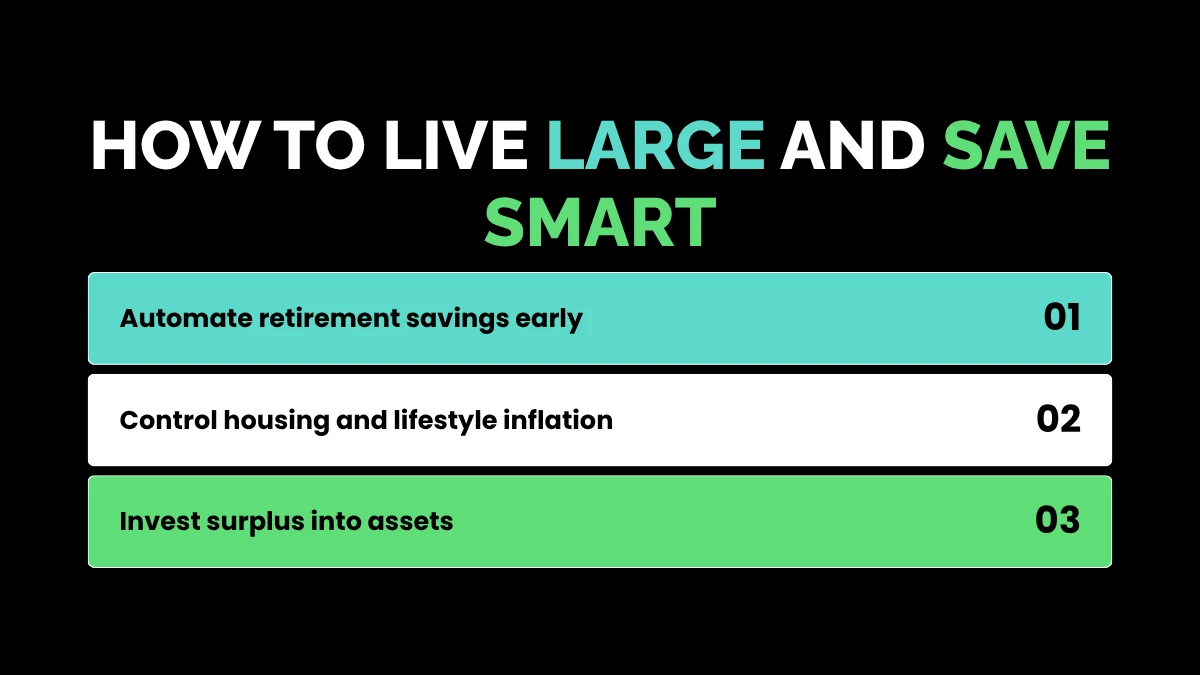
To maximize this income, you need a clear, actionable plan for your money. Here is how you can structure your 60 an hour monthly income to secure your long-term future:
-
Automate your retirement savings: Set up your accounts so that 15% of your income goes straight into a 401(k) or IRA before you ever see it.
-
Keep your housing costs low: Even though your monthly income is over $10,000, try to keep your rent or mortgage below $2,500 to maintain massive cash flow.
-
Build a robust emergency fund: Save six months of bare-minimum living expenses to protect yourself from sudden job losses or market shifts.
-
Invest in real assets: Use your extra monthly surplus to buy index funds, real estate, or build a side business.
Using a structured approach ensures that your hard work translates into real, lasting freedom.
Comparing $60/hr to the National Average
Is $60 an hour actually good? To give you some context, the median household income in the United States typically hovers around $75,000 to $80,000 a year. By earning a $60 dollars an hour annual income, your individual earnings will soar past what most entire households bring home.
Let’s look at how this wage compares to other common hourly rates across the country.
| Hourly Wage | Estimated Annual Income (Full-Time) |
| $30 an Hour | $62,400 |
| $45 an Hour | $93,600 |
| $60 an Hour | $124,800 |
| $75 an Hour | $156,000 |
As you can see, jumping up to $60 an hour elevates your financial reality into an entirely new tier of purchasing power and stability.
Turning Your Hourly Wage into Lasting Wealth
At the end of the day, knowing that 60 an hour is how much a year is just the first step. The real magic happens when you treat that income with respect. Making $124,800 a year gives you the rare opportunity to breathe easy, pay off your debts, and build a beautiful life.
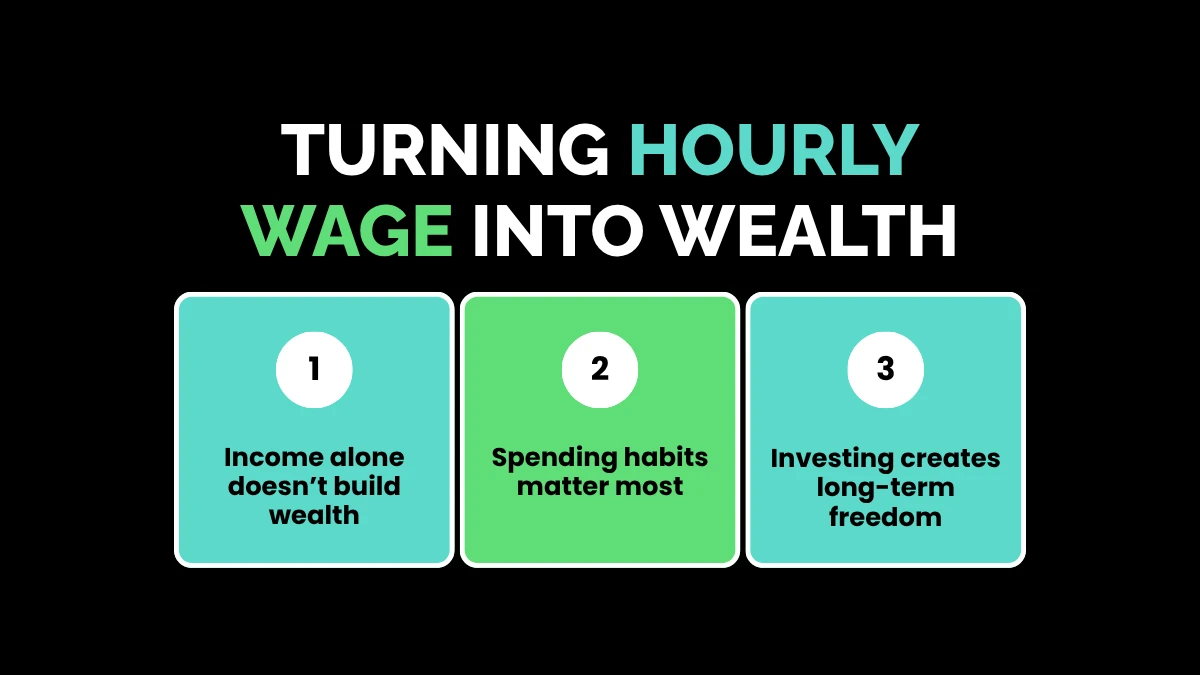
Keep your expenses reasonable, stay curious about investing, and celebrate the fact that your time is worth a premium. You have got the numbers down; now go make them work for you!
FAQs About Making $60 an Hour
Can I buy a house making $60 an hour?
Generally, yes. A $60 dollars an hour annual income equals $124,800 a year. In most cases, lenders will comfortably qualify you for a home loan valued around $350,000 to $450,000, assuming you have a solid down payment and minimal debt.
What is the bi-weekly take-home pay for $60 an hour?
Your gross bi-weekly pay is exactly $4,800. After estimating deductions for federal taxes, state taxes, and FICA, your actual take-home pay will generally hover between $3,300 and $3,600 every two weeks, depending on your location.
Is $60 an hour considered middle class or upper class?
In most parts of the country, an individual income of $124,800 puts you firmly in the upper-middle class. In high-cost-of-living metropolitan areas, it allows for a very comfortable, stable middle-class lifestyle with plenty of room for savings.
How much is $60 an hour part-time?
If you work a part-time schedule of 20 hours per week, your 60 an hour monthly income will average around $5,200. Annually, this cuts your gross earnings exactly in half, resulting in an estimated $62,400 a year before taxes.