

Key Takeaways
-
Gross yearly pay: $43,680 before tax
-
Monthly income: Around $3,640 gross
-
Estimated take-home: ~$34,000–$36,000 post-tax
-
Standard hours: Based on 2,080 annual hours
Have you recently received a job offer, asked for a raise, or looked at your pay stub and wondered, 21 dollars an hour is how much a year?
If you work a standard full-time schedule, making 21 dollars an hour is how much a year turns out to be exactly $43,680 per year before taxes.
That is a solid earnings milestone in many parts of the country. But let’s be real for a second gross income is only a partial number on paper.
What you actually bring home to pay for rent, groceries, utility bills, and savings is what matters most for your daily life.
Here at Weird Wealth, we love breaking down financial topics into plain, friendly conversations that help you plan your money with confidence.
In this comprehensive guide, we will walk through a detailed 21 dollar hourly wage breakdown to show you what your pay looks like daily, weekly, monthly, and after taxes.
AI Overview
If you work 40 hours a week for 52 weeks, earning 21 dollars an hour is how much a year comes out to exactly $43,680 in gross annual income. This equals roughly $3,640 per month or $1,680 every two weeks before deductions. After accounting for federal, state, and payroll taxes, your take-home pay generally drops to around $34,000 to $36,000 per year depending on where you live.
Calculating Your Pay: 21 Dollars an Hour Is How Much a Year?
Calculating your 21 an hour annual income is actually very simple when you look at standard work hours.
Most full-time roles assume you work 40 hours each week across all 52 weeks in a calendar year.
The Standard Full-Time Math
When you multiply 40 weekly hours by 52 weeks, you get 2,080 total working hours in a standard year.
Multiplying those 2,080 working hours by your 21 dollars hourly rate yields 43,680 dollars.
That $43,680 figure is your total gross yearly salary.
Gross income simply means the total money you earn before any taxes, insurance premiums, or retirement contributions are taken out.
Key Factors That Shift Your Yearly Total
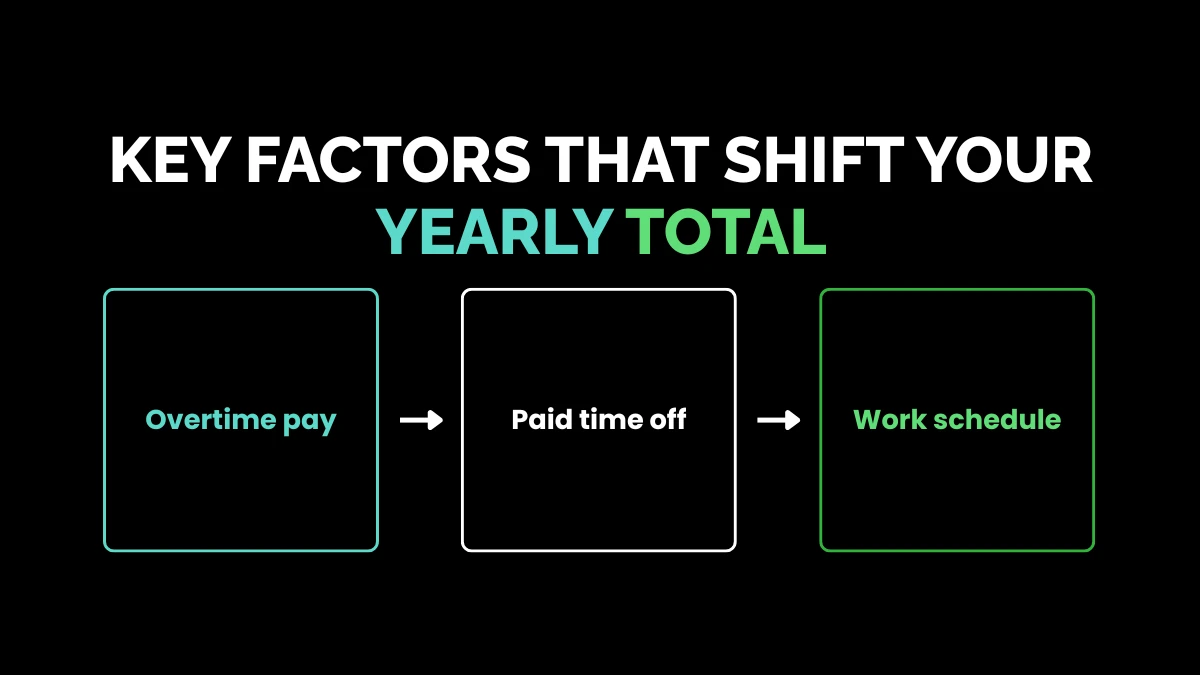
Your actual end-of-year total can shift based on how your job is structured.
If your employer offers paid time off (PTO) and paid holiday pay, your yearly earnings remain steady at $43,680.
However, taking unpaid time off or working seasonal hours will lower your yearly total.
On the flip side, logging overtime hours can boost your earnings significantly.
Under standard US labor laws, overtime is typically paid at time-and-a-half, which equals $31.50 per hour for a $21 base wage.
The Ultimate 21 Dollar Hourly Wage Breakdown
To build a realistic budget, it helps to see how your hourly rate converts into smaller pay periods.
Here is how a full-time 21 dollar hourly wage breakdown looks across common payment frequencies:
| Pay Period | Working Hours | Gross Earnings |
| Hourly | 1 Hour | $21.00 |
| Daily | 8 Hours | $168.00 |
| Weekly | 40 Hours | $840.00 |
| Bi-Weekly | 80 Hours | $1,680.00 |
| Semi-Monthly | ~86.67 Hours | $1,820.00 |
| Monthly | 173.33 Hours | $3,640.00 |
| Annual | 2,080 Hours | $43,680.00 |
Daily Pay Breakdown
When working a standard 8-hour workday, you earn $168 gross per day.
Knowing your daily earnings makes it easy to calculate how much a missed shift or an extra shift impacts your wallet.
Weekly Pay Breakdown
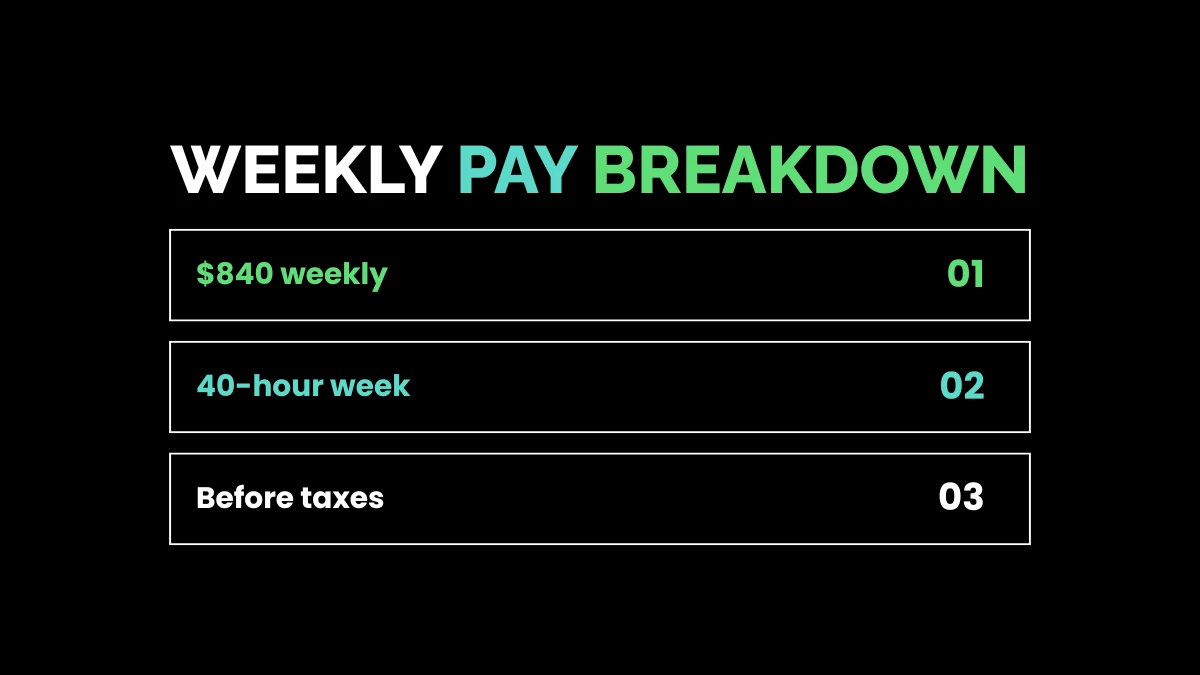
On a standard 40-hour work schedule, your gross weekly paycheck is $840.
If your company pays on a weekly basis, this is the main number you will see on your pay stub before deductions.
Bi-Weekly Pay Breakdown
Many employers issue paychecks every two weeks, resulting in 26 pay periods per year.
At $21 per hour, your bi-weekly paycheck comes to $1,680 gross for 80 hours of work.
Since there are 26 bi-weekly periods, two months out of the year will feature three paychecks instead of two.
Monthly Pay Breakdown
If you divide your $43,680 annual earnings across 12 calendar months, your average gross monthly pay is $3,640.
This monthly figure is essential when applying for apartments or calculating debt-to-income ratios for loans.
Real Take-Home Pay: How Taxes Impact Your $21/hr Full Time Salary
While earning a gross salary of $43,680 sounds great, taxes will always trim that number down.
When you earn a $21/hr full time salary, federal, state, and local tax authorities deduct their required shares first.
Common Payroll Deductions
Your paycheck will show several mandatory and optional deductions:
-
FICA Taxes: Federal Insurance Contributions Act taxes take 6.2% for Social Security and 1.45% for Medicare, totaling 7.65%.
-
Federal Income Tax: This rate depends on your income tax bracket, filing status, and standard deduction.
-
State and Local Income Tax: State tax rates range from 0% in states like Texas and Florida to over 5% in high-tax states.
Estimating Your Net Take-Home Pay
For most single filers, total taxes and payroll withholdings average around 15% to 20% of gross earnings.
That means your actual net take-home pay is estimated to land between $34,000 and $36,000 annually.
In monthly terms, you can expect around $2,800 to $3,000 net income landing directly into your bank account.
State Income Tax Comparison
Where you live makes a noticeable difference in your actual net earnings.
Here is an estimated look at annual take-home pay for a single filer earning $43,680 across different states:
| State | Estimated Tax Rate | Net Annual Take-Home | Net Monthly Pay |
| Texas (No State Tax) | ~15.5% | ~$36,900 | ~$3,075 |
| Florida (No State Tax) | ~15.5% | ~$36,900 | ~$3,075 |
| Ohio (Moderate Tax) | ~18.0% | ~$35,800 | ~$2,983 |
| New York (Higher Tax) | ~20.5% | ~$34,700 | ~$2,891 |
| California (Higher Tax) | ~21.0% | ~$34,500 | ~$2,875 |
Full-Time vs. Part-Time Hours at $21 per Hour
Not everyone works a traditional 40-hour schedule.
If you are balancing school, caregiving, or multiple jobs, you might work part-time hours instead.
Understanding how your 21 an hour annual income changes with weekly hours is critical for managing your personal finances.
Schedule Comparison Table
Here is a clear look at how annual and monthly gross earnings scale based on your weekly work commitment:
| Weekly Hours | Annual Hours | Gross Annual Pay | Gross Monthly Pay | Gross Bi-Weekly Pay |
| 15 Hours/Week | 780 Hours | $16,380 | $1,365 | $630 |
| 20 Hours/Week | 1,040 Hours | $21,840 | $1,820 | $840 |
| 25 Hours/Week | 1,300 Hours | $27,300 | $2,275 | $1,050 |
| 30 Hours/Week | 1,560 Hours | $32,760 | $2,730 | $1,260 |
| 35 Hours/Week | 1,820 Hours | $38,220 | $3,185 | $1,470 |
| 37.5 Hours/Week | 1,950 Hours | $40,950 | $3,412.50 | $1,575 |
| 40 Hours/Week | 2,080 Hours | $43,680 | $3,640 | $1,680 |
Impact of Shorter Workweeks
Working 37.5 hours per week which is standard in many corporate offices with unpaid lunch breaks—reduces your gross pay by $2,730 per year compared to a 40-hour schedule.
If you drop to 30 hours per week, your yearly gross drops to $32,760.
Always double-check your expected weekly hours before accepting a position so you know exactly what your paycheck will look like.
Can You Live Comfortably on a $21/hr Full Time Salary?
Determining whether a $21/hr full time salary offers a comfortable living depends on several key personal factors.
Location is by far the biggest variable in your financial equation.
Cost of Living Geography
In low to medium cost-of-living areas such as many Midwestern or Southern towns an annual income of $43,680 provides a comfortable foundation for an individual single worker.
You can easily cover rent, utilities, food, and basic entertainment while still putting money away in savings.
Conversely, in major metropolitan hubs like New York, San Francisco, or Seattle, average rent for a one-bedroom apartment can easily devour over 60% of your take-home pay.
In high-cost markets, living on $21 per hour usually requires sharing expenses with roommates or finding rent-controlled housing.
Essential Budgeting Principles
At Weird Wealth, we recommend following proven budgeting habits to maximize every dollar:
-
Use the 50/30/20 Framework: Allocate 50% of your net income to essential needs, 30% to personal wants, and 20% to savings or debt payoff.
-
Cap Housing Costs: Aim to keep your total monthly housing expenses under 30% of your gross pay, which equals roughly $1,090 per month.
-
Maintain an Emergency Buffer: Keep at least 3 to 6 months of basic living expenses in a high-yield savings account for unexpected emergencies.
Sample Monthly Budget for a 21 Dollar Hourly Wage Breakdown
To see how this works in everyday life, let’s build a realistic monthly budget.
Assuming an estimated net monthly take-home pay of $2,900, here is how a balanced budget looks:
| Expense Category | Allocation | Monthly Amount | Description |
| Housing & Rent | 33% | $950.00 | Apartment rent or room share |
| Utilities & Internet | 7% | $200.00 | Electricity, water, gas, Wi-Fi |
| Groceries & Food | 14% | $400.00 | Weekly grocery shopping and cooking |
| Transportation | 12% | $350.00 | Car payment, insurance, gas, transit |
| Health & Insurance | 7% | $200.00 | Out-of-pocket health costs & copays |
| Debt & Savings | 14% | $400.00 | Emergency fund & debt repayment |
| Personal & Fun | 13% | $400.00 | Dining out, hobbies, shopping |
| Total | 100% | $2,900.00 | Fully Balanced Budget |
This sample budget demonstrates that with clear planning, this earnings level allows you to meet your needs, enjoy life, and build financial security.
How to Increase Your Earnings Beyond $21 an Hour
If earning $21 per hour feels a bit tight for your long-term goals, there are actionable ways to increase your earnings trajectory.
Capitalize on Overtime
If your job offers overtime pay, taking on extra hours is one of the quickest ways to raise your annual income.
Working just 5 hours of overtime per week at $31.50 per hour adds $157.50 to your weekly paycheck.
Over a full year, those 5 weekly overtime hours boost your gross annual income by $8,190, bringing your total to $51,870.
Up-skill and Negotiate
Building specialized technical skills or certifications can quickly help you command a higher hourly rate.
Highlighting your key workplace achievements during annual performance reviews can help you negotiate a raise to $23 or $25 per hour.
Build Additional Income Streams
Starting a flexible side hustle such as freelance writing, tutoring, or delivery services can add several hundred dollars to your monthly budget without committing to a full second job.
Conclusion
Understanding 21 dollars an hour is how much a year gives you the knowledge and foundation you need to make smart financial moves.
A gross yearly income of $43,680 translates to roughly $34,000 to $36,000 in take-home pay, giving you solid footing to manage monthly bills and build savings.
By tracking your expenses, creating a practical monthly budget, and keeping your eye on long-term growth, managing your 21 an hour annual income can put you on a clear path toward financial freedom!
Frequently Asked Questions
What is 21 dollars an hour is how much a year before taxes?
Working full-time at 40 hours per week for 52 weeks at $21 per hour yields exactly $43,680 per year in gross income before taxes.
What is $21 an hour monthly after taxes?
After standard federal, state, and payroll tax deductions, $21 an hour usually leaves you with roughly $2,800 to $3,000 per month in net take-home pay.
How much is $21 an hour bi-weekly before taxes?
On a standard bi-weekly schedule of 80 working hours, a wage of $21 per hour results in a gross paycheck of $1,680 before deductions.
Is a $21/hr full time salary considered a good wage?
Yes, in many parts of the country, $21 per hour is well above the federal minimum wage and provides a solid living wage for individual workers.