
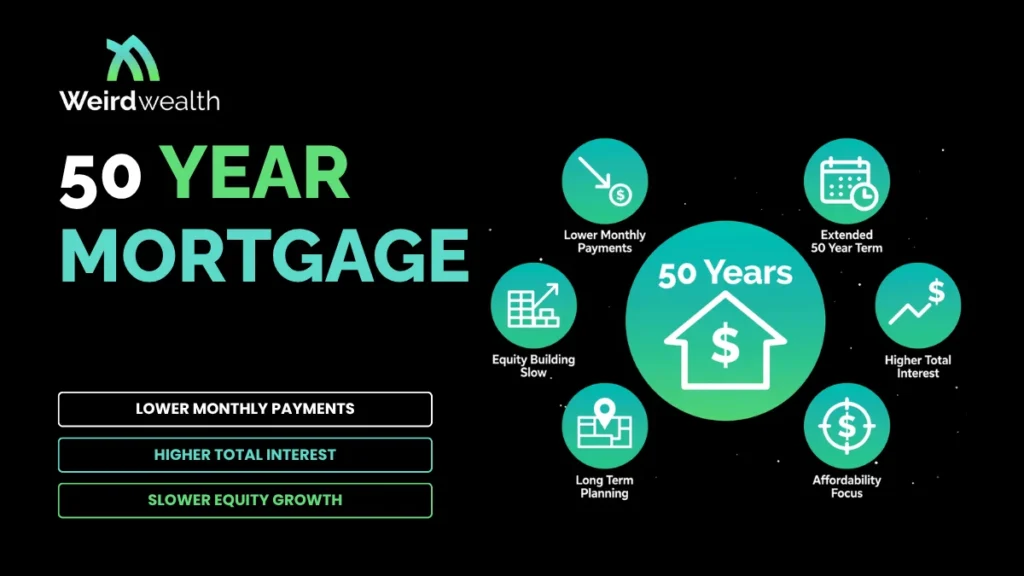
Key Takeaways
- Lower monthly payments but much higher total interest costs
- Extended loan terms dramatically slow down home equity growth
- Ideal for initial cash flow flexibility, less for overall wealth building
- Niche financing option requiring careful long-term planning
Imagine paying off your home over half a century.
A 50 year mortgage stretches your home loan repayment over five decades, dramatically lowering your monthly payment compared to traditional options.
While it makes initial homeownership more accessible, you end up paying significantly more in total interest over time.
AI Overview
A 50 year mortgage spreads home loan repayments across 50 years to reduce monthly costs. While it improves immediate monthly affordability, it significantly increases the total interest paid and slows down equity accumulation. It serves as an alternative financing strategy for buyers facing expensive real estate markets who prioritize lower immediate outlay over long-term interest savings.
What Is a 50 Year Mortgage and How Does It Work?
Have you ever wondered why standard home loans top out at 30 years?
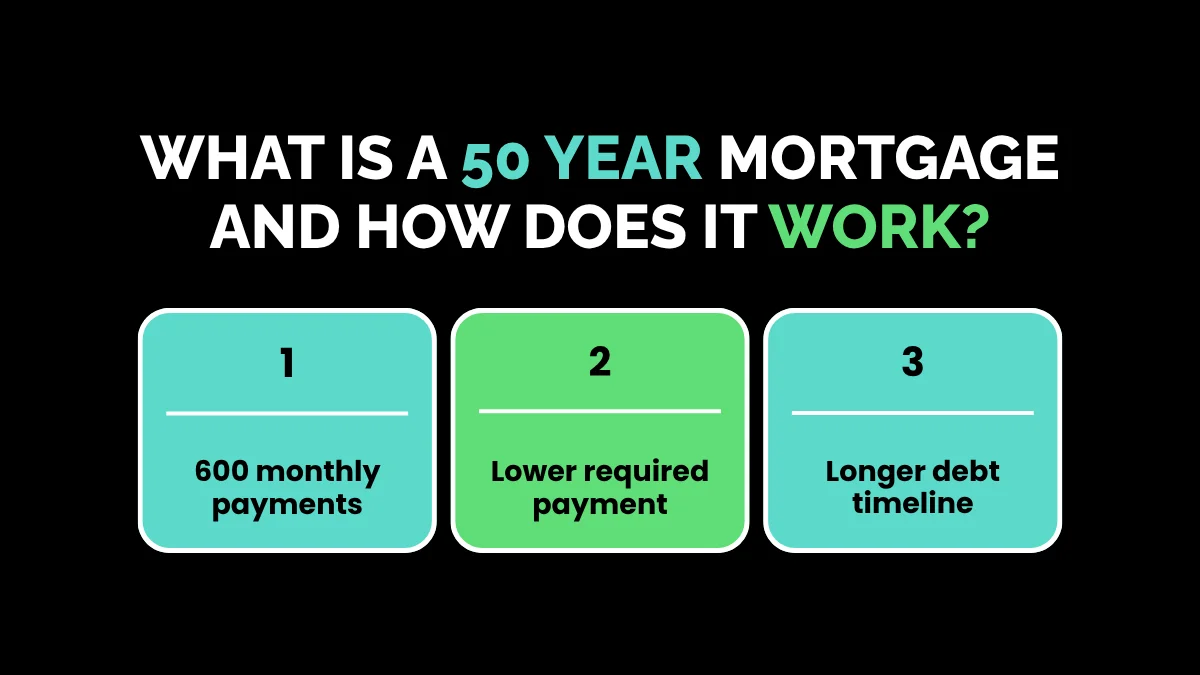
A 50 year mortgage breaks that mold by adding two extra decades to your repayment timeline.
When you take out an ultra-long loan, the total principal balance spreads over 600 monthly payments.
This extended amortization lowers your required monthly outlay compared to standard 15-year or 30-year terms.
It functions similarly to standard fixed-rate or adjustable-rate loans, but the timeline fundamentally alters your cash flow.
In the early decades, almost every dollar you pay goes directly toward paying interest charges.
That means your loan balance drops at a very slow pace for the first quarter-century.
Lenders offer these extended terms to help buyers qualify in high-cost real estate markets.
However, fewer traditional banks carry 50-year options on their primary lending sheets today.
They are generally offered through private lenders, specialty portfolio programs, or specific international housing authorities.
The Mechanics of a 50 Year Mortgage Loan
Understanding how a 50 year mortgage works requires looking closely at amortization schedules.
Amortization is the process of spreading out a loan into a series of equal payments.
Each payment gets divided between the principal balance and the interest fee.
On a standard 30-year loan, you begin making meaningful dent into your principal after a few years.
On a 50-year timeline, interest dominates the payment structure for nearly thirty years.
This happens because the bank carries risk over half a century of economic shifts.
Inflation, property value drops, and interest rate changes all increase lender risk over 50 years.
To compensate for that long exposure, lenders usually charge higher interest rates on 50-year loans.
Even a slight rate increase offsets much of the monthly savings you hoped to gain.
So while your required monthly payment drops, your long-term debt commitment grows drastically.
The Real Cost Breakdown: Evaluating the Long-Term Interest
Let’s look at how the math actually plays out on a standard purchase.
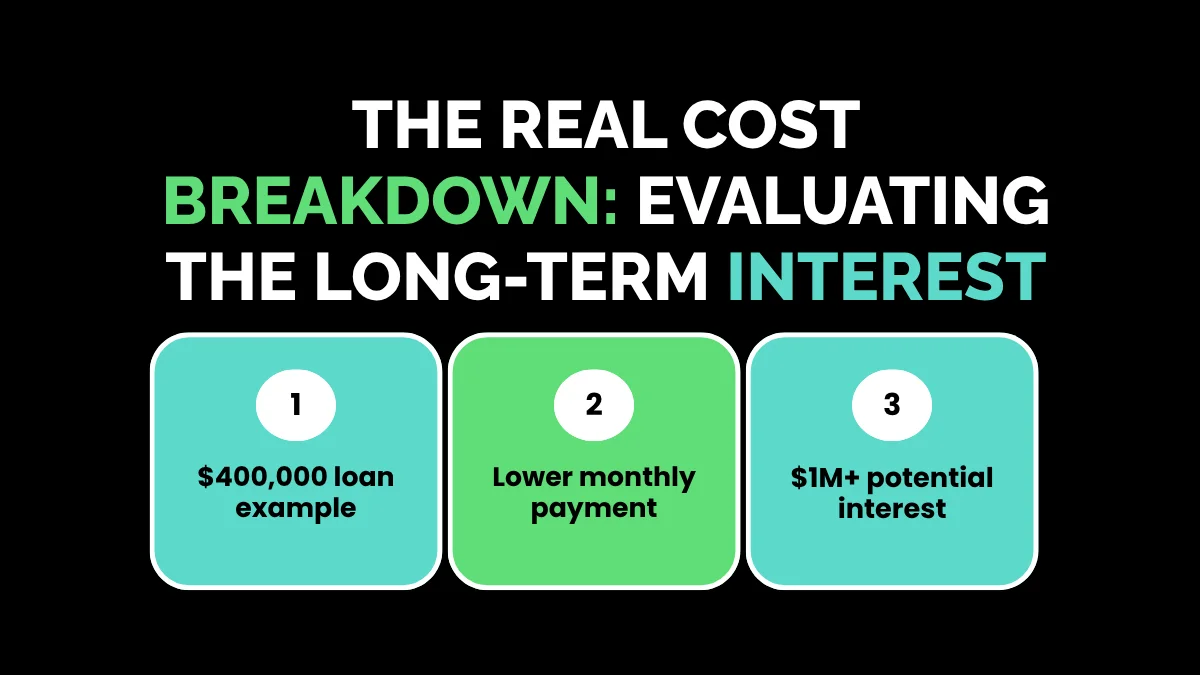
Suppose you purchase a home and take out a $400,000 mortgage balance.
On a standard 30-year fixed loan at 6.5%, your monthly payment sits around $2,528.
Over thirty years, you would pay approximately $510,218 in total interest charges.
Now let’s stretch that same $400,000 loan balance into a 50-year fixed loan structure.
Because of added risk, the rate might sit slightly higher at around 7.0%.
Your monthly payment drops to roughly $2,382, saving you about $146 each month.
However, over fifty years, total interest charges balloon to over $1,029,200.
You end up paying more than double the original loan amount purely in interest charges.
That is the true hidden cost of stretching debt across generations.
Comparing Home Loan Options
Before choosing an extended financing structure, compare how different loan terms perform side by side.
| Feature | 15-Year Mortgage | 30-Year Mortgage | 50-Year Mortgage |
| Monthly Payment | Highest | Moderate | Lowest |
| Interest Rate | Lowest | Moderate | Highest |
| Equity Building | Extremely Fast | Moderate | Extremely Slow |
| Total Lifetime Cost | Lowest | Moderate | Highest |
| Borrowing Flexibility | Strict Income Needs | Standard Qualification | Highest Cash Flow Relief |
Choosing between these terms depends on whether you prioritize immediate cash flow or lifetime wealth savings.
The Pros and Cons of a 50 Year Mortgage
Weighing the advantages against the drawbacks helps you decide if this structure fits your financial goals.
Advantages of Ultra-Long Financing
The main draw of a 50 year mortgage is initial affordability and payment flexibility.
Lower required monthly payments give your monthly budget more breathing room.
This extra cash flow can help you manage other living expenses or high-interest debt.
Lower payments also reduce your overall debt-to-income (DTI) ratio on paper.
A lower DTI ratio can make it easier to qualify for a home purchase initially.
For real estate investors, lower fixed payments can increase immediate monthly rental yield.
It allows investors to hold properties with positive cash flow while waiting for market appreciation.
Disadvantages and Financial Risks
The primary trade-off of a 50 year mortgage is the massive accumulation of interest over time.
You build equity at a snail’s pace during the first two to three decades.
If local housing prices decline, you risk falling into a negative equity situation easily.
Negative equity makes it difficult to sell or refinance without paying cash out of pocket.
Additionally, carrying debt into retirement years can jeopardize long-term financial security.
Paying off a home at age 80 or 90 leaves little room for debt-free retirement living.
Most borrowers end up refinancing or selling long before reaching the 50-year mark anyway.
Who Should Consider a 50 Year Mortgage?
Is this non-traditional home loan structure right for your specific scenario?
At Weird Wealth, we explore creative financial avenues to see where alternative strategies actually work.
An ultra-long loan is generally not meant to be held for the full fifty years.
Instead, it serves as a tactical financial bridge under specific circumstances.
First-time buyers squeezed out by high home prices might use it to enter expensive markets.
Once in the home, they can build initial stability and refinance into a shorter term later.
Investors prioritizing maximum cash flow might use it to keep rental expenses as low as possible.
Buyers expecting rapid income growth can use lower initial payments to preserve working capital.
If you plan to move within five to seven years, the long-term interest cost becomes less relevant.
However, if you plan to stay in the property permanently, a shorter term builds far greater wealth.
How Equity Building Works Over 50 Years
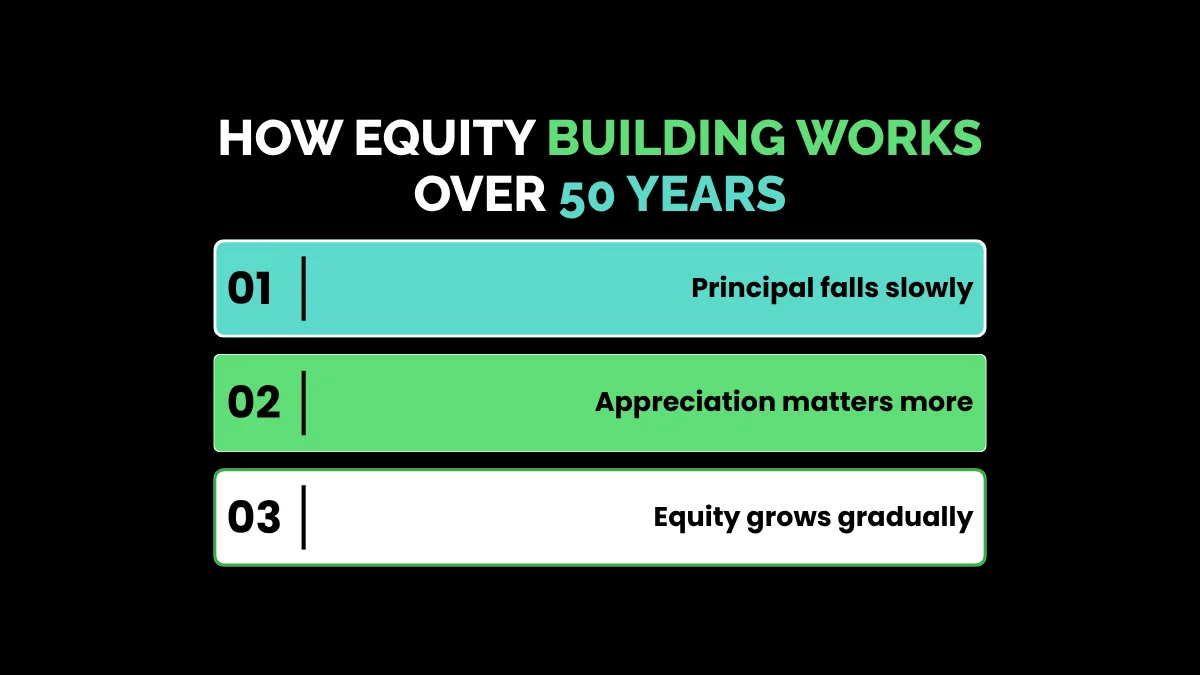
Equity is the portion of the home you truly own outright free of debt.
You gain equity in two ways: paying down principal and home market value appreciation.
With a standard 30-year loan, principal payoff starts steadily and accelerates over time.
With a 50 year mortgage, principal reduction moves at an extraordinarily slow pace initially.
During the first ten years, nearly 90% of your total payments go toward interest fees.
That means after a decade of prompt payments, your principal balance barely decreases.
You rely almost entirely on market appreciation to build meaningful home equity.
Relying solely on market appreciation leaves your balance vulnerable to real estate downturns.
At Weird Wealth, we advocate for structures that actively build net worth rather than relying on market luck.
The Role of Inflation in Ultra-Long Mortgages
Inflation plays a unique role when analyzing an extended fifty-year repayment timeline.
Over fifty years, inflation reduces the real purchasing power of the dollar significantly.
A monthly payment of $2,382 today will feel much smaller thirty or forty years from now.
Your wages and nominal income will generally rise with inflation over several decades.
As your income grows, a fixed mortgage payment takes up a smaller percentage of your earnings.
In real economic terms, you pay back later years of the loan with cheaper inflated dollars.
However, this inflationary benefit rarely offsets the total extra interest charged by the lender.
Lenders already factor expected long-term inflation into the higher base interest rate they charge.
So while inflation provides a mild tailwind, it does not make the loan cheap.
Comparing the 50 Year Mortgage to Other Extended Loans
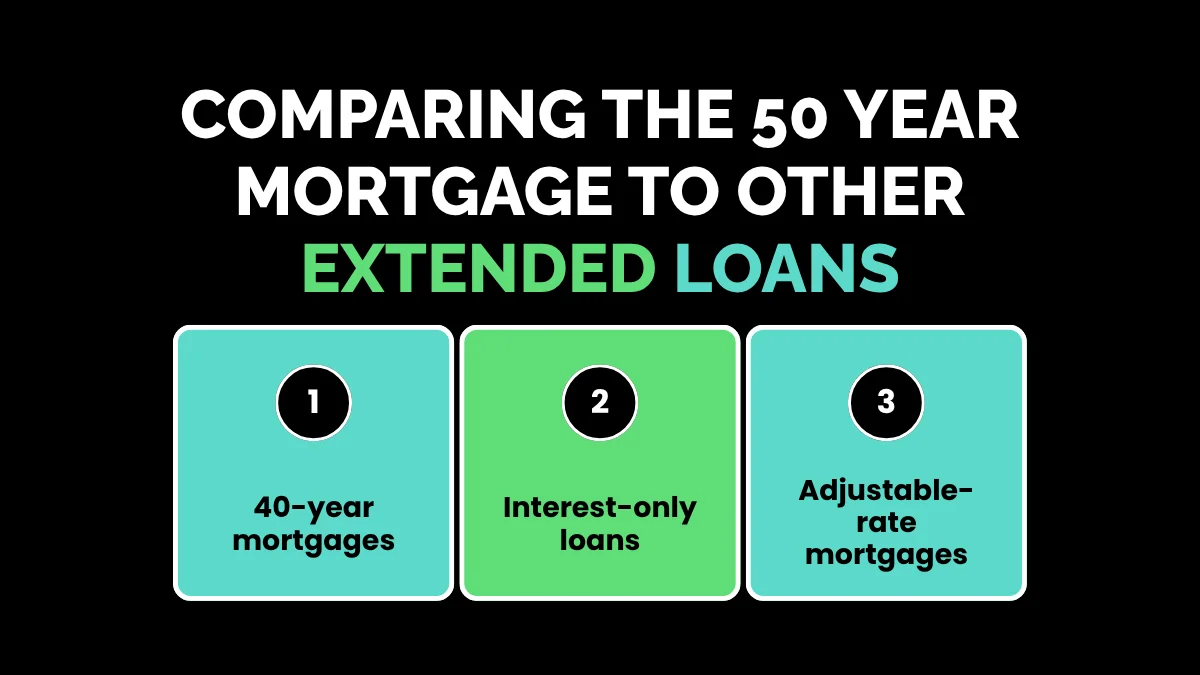
If a standard 30-year payment feels uncomfortable, explore other middle-ground alternatives first.
40-Year Fixed Mortgages
A 40-year mortgage offers a middle step between traditional loans and half-century loans.
It lowers your monthly payment below a 30-year term without incurring fifty years of interest.
Many government-backed loan modification programs utilize 40-year structures to aid struggling borrowers.
It provides cash flow relief while allowing faster equity growth than a 50-year schedule.
Interest-Only Mortgages
An interest-only loan allows you to pay only the interest charges for an initial period.
This period usually lasts between five and ten years, keeping initial payments very low.
After the interest-only period ends, the loan recalculates over the remaining term.
This structure suits buyers with variable income or short-term ownership plans better than a 50-year term.
Adjustable-Rate Mortgages (ARMs)
An adjustable-rate mortgage offers a lower fixed interest rate for an initial introductory period.
Common ARM terms include 5/1, 7/1, or 10/1 schedules before annual rate adjustments begin.
If you plan to move or refinance within seven years, an ARM often beats a 50-year loan.
It delivers lower initial payments without committing you to elevated long-term interest structures.
Real-World Examples: How People Use Ultra-Long Loans
To understand how this works in practice, let’s look at two practical scenarios.
Scenario A: The High-Cost Market Buyer
Sarah lives in an expensive metropolitan area where median home prices exceed $700,000.
Her current income makes standard 30-year mortgage payments tight for her monthly budget.
She chooses a 50 year mortgage to lower her required monthly payment by a few hundred dollars.
This lower payment allows her to buy her first townhouse instead of continuing to rent.
Her strategic plan is to live in the home for four years while advancing her career.
As her salary increases, she plans to refinance into a standard 30-year fixed loan.
For Sarah, the extended term acts as an entry ticket into a rising housing market.
Scenario B: The Cash-Flow Focused Investor
Marcus buys residential rental properties to generate steady monthly cash flow.
He purchases a single-family property using a 50-year financing program offered by a private lender.
The reduced monthly loan payment maximizes his net rental cash flow every month.
He puts the extra monthly cash flow into a high-yield reserve account for property maintenance.
Marcus does not care about paying off the principal over fifty years.
His goal is immediate operational income and tax depreciation benefits.
When the property appreciates, he sells or executes a tax-deferred exchange into larger assets.
Market Availability and Lender Requirements
Finding a 50 year mortgage is not as simple as visiting your local bank branch.
Major conventional mortgage conduits rarely purchase or securitize 50-year residential loans.
Because these loans sit outside standard guidelines, they are classified as non-qualified mortgages (Non-QM).
Non-QM loans are kept on the private balance sheets of specialized lenders or portfolio institutions.
As a result, qualification criteria can differ from standard government-backed housing programs.
Lenders may require higher credit scores to compensate for the extended term length.
They might also ask for larger down payments, typically ranging from 15% to 20% down.
Reserves requirements may also be stricter, forcing you to show several months of savings.
Working with an experienced mortgage broker can help you locate specialty lenders offering these products.
Key Tax Considerations for Ultra-Long Loans
Borrowing over five decades impacts your personal tax strategy in specific ways.
In many jurisdictions, mortgage interest payments remain tax-deductible up to certain statutory limits.
Because early payments on a 50-year loan consist almost entirely of interest, deductions stay high.
This high interest deduction can help offset taxable income if you itemize deductions.
However, tax laws change frequently over extended multi-decade time horizons.
Relying on fifty years of tax deductions is an uncertain long-term strategy.
Always consult a certified tax professional to see how extended interest schedules affect your tax profile.
Refinancing Strategies Out of a 50 Year Mortgage
If you enter a 50-year loan, having a clear exit strategy is essential for wealth protection.
Most buyers do not remain in a 50-year structure for the entire half-century term.
Refinancing allows you to replace your existing loan with a new loan with better terms.
You can refinance once your credit score improves or when overall interest rates decline.
You can also refinance into a 15-year or 30-year term after your income increases over time.
Transitioning to a shorter term dramatically accelerates your principal reduction timeline.
Another exit strategy involves making voluntary prepayments directly toward your loan principal balance.
Even adding $100 or $200 extra toward principal each month shaves years off the loan.
Extra principal payments directly reduce the overall compound interest charged by your lender over time.
Frequently Asked Questions
Is a 50 year mortgage a real option for homebuyers?
Yes, though uncommon, extended-term mortgages exist through specialized lenders, custom portfolio products, and select international real estate markets today.
Does a 50 year mortgage lower monthly payments significantly?
It lowers the monthly principal payment, but higher interest rates on extended terms usually make the savings surprisingly small overall.
Can you refinance out of a 50 year mortgage early?
Yes, most lenders allow you to refinance into a shorter term once your income increases or interest rates drop lower.
Do you pay more total interest on a 50 year mortgage?
Yes, extending repayment over five decades generally results in paying more than double the original loan amount in total interest.
Choosing a 50 year mortgage comes down to balancing immediate cash flow needs against your long-term financial freedom. Lower payments can help you cross the homeownership threshold in expensive markets, but the total interest drag is substantial. Evaluate your exit strategy, analyze your long-term goals, and make sure your debt structure actively supports your broader wealth journey.