
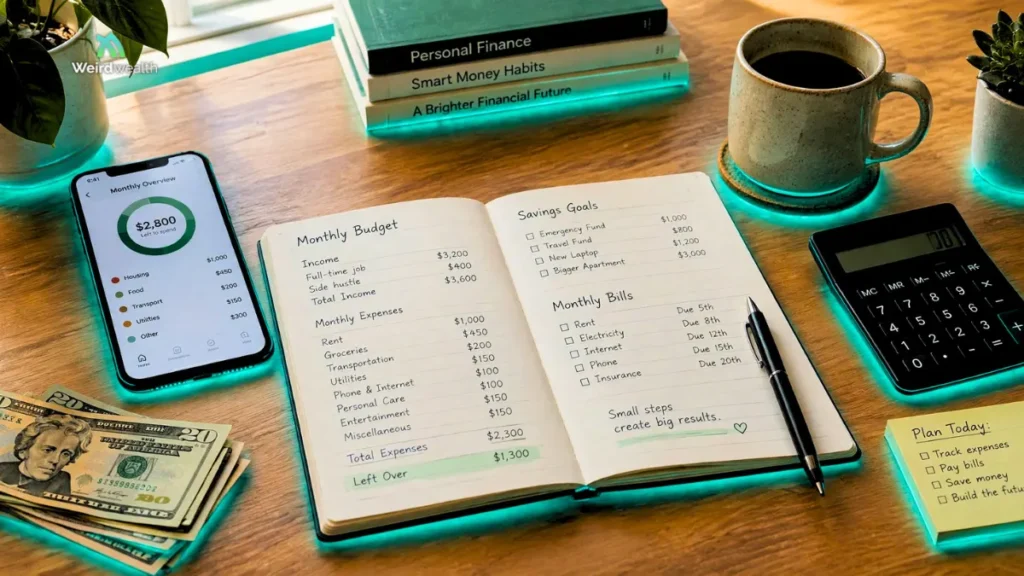
A budget should give you more control over your money, not make every purchase feel like a mistake. Yet many people abandon budgeting after a few weeks because their plans are too restrictive, their expenses are unpredictable, or they underestimate how much everyday life actually costs. Following Budgeting for Beginners principles can help you create a realistic spending plan that fits your lifestyle and is easier to maintain.
The solution is to build a budget around your real income, actual spending, and personal priorities. You do not need a complicated spreadsheet or a perfect month to get started. You need a system that helps you pay your bills, prepare for unexpected expenses, and make progress toward your financial goals.
Budgeting for beginners starts with one simple idea: decide where your money should go before it disappears into everyday spending.
Key Takeaways
- Start with your actual take-home income and recent spending rather than idealized estimates.
- Use a budgeting method that fits your lifestyle, whether that is a percentage-based plan or a simple spending limit.
- Include irregular expenses and small purchases to avoid repeatedly breaking your budget.
- Build emergency savings gradually while keeping up with essential bills and debt payments.
- Review your budget regularly and adjust it when your income, expenses, or priorities change.
What Is a Budget, and Why Does It Matter?
A budget is a plan for how you will use your money over a specific period, usually a month. It helps you understand how much you earn, where your money goes, and how much you can direct toward savings, debt repayment, and other goals.
Without a budget, it is easy to spend money based on what is available in your account without accounting for bills that have not arrived yet.
A budget makes those obligations visible. It can also reveal when your income is not enough to cover your essential expenses, helping you identify whether you need to reduce major costs, increase earnings, or seek appropriate support.
Budgeting is not about spending as little as possible. It is about making deliberate choices with the money you have.
How Do You Create a Budget From Scratch?
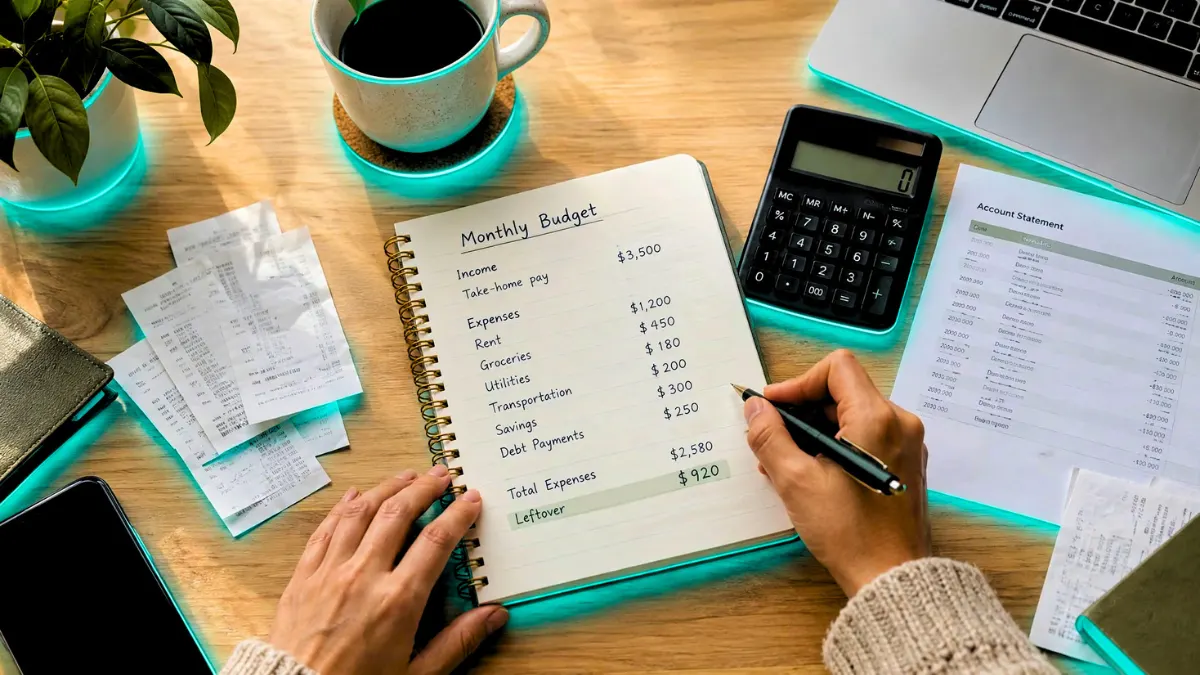
You can build a useful first budget in five steps.
Step 1: Calculate Your Monthly Take-Home Income
Start with the money you actually receive after taxes and payroll deductions.
If your income varies, review several recent months and use a conservative estimate rather than assuming your best month will repeat.
Include reliable income sources such as wages, regular freelance payments, or established business income. Treat irregular bonuses and uncertain side-hustle earnings cautiously. Explore more ways to earn to discover additional income opportunities.
For example, if your take-home pay is $2,800 per month, that is the starting amount available for your monthly plan not your salary before deductions.
Step 2: List Your Essential Expenses
Write down the costs you must cover to maintain your household and meet your obligations.
Common examples include:
- Rent or mortgage payments
- Groceries and household supplies
- Utilities and phone service
- Transportation
- Insurance and necessary healthcare
- Minimum debt payments
- Childcare or other essential family expenses
Use bank statements, receipts, and bills to estimate these costs accurately.
If your essential expenses already exceed your take-home income, do not assume that cutting coffee or entertainment will fix the problem. Focus on the largest costs and explore realistic ways to increase income or access assistance.
Step 3: Track Flexible Spending
Next, examine the expenses that vary from month to month.
These may include restaurants, entertainment, shopping, subscriptions, hobbies, and convenience purchases.
Look at your actual spending rather than judging yourself for it. The purpose is to identify where your money is going and decide whether those purchases match your priorities.
If you spend $120 per month on subscriptions and use only half of them, canceling the unused services could free up money without significantly affecting your lifestyle.
Step 4: Set Savings and Debt Goals
A budget should not only cover today’s expenses. It should also help you prepare for tomorrow.
Choose a manageable amount to put toward goals such as:
- Building an emergency fund
- Paying down high-interest debt
- Saving for an upcoming expense
- Investing for long-term goals when appropriate
- Saving for a major purchase
If money is tight, start with a small amount you can maintain. You can increase it when your income rises or your expenses fall.
Step 5: Give Every Dollar a Job
Compare your take-home income with your planned expenses and goals.
If your plan exceeds your income, adjust it before the month begins. If money remains unassigned, decide whether to save it, repay debt, or allocate it toward a meaningful priority.
This approach is sometimes called zero-based budgeting. It does not mean you must spend every dollar; savings and extra debt payments can also be assigned jobs.
Which Budgeting Method Is Best for Beginners?
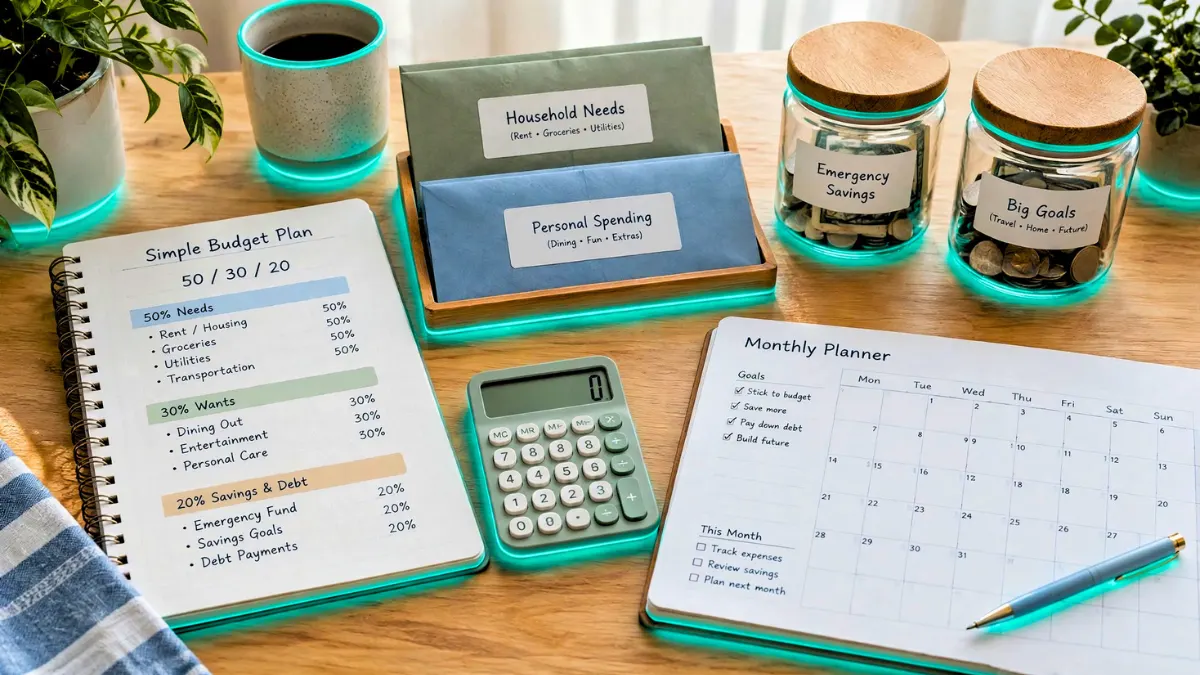
There is no single method that works for everyone. Choose a system that is simple enough to maintain.
| Method | How it works | Best suited for |
| 50/30/20 budget | A guideline for dividing income among needs, wants, and savings or debt goals | People who want a simple starting framework |
| Zero-based budget | Assign every dollar of income to a category or goal | People who want detailed control |
| Pay-yourself-first | Move a planned amount to savings before discretionary spending | People who want to build savings consistently |
| Envelope budgeting | Set spending limits for categories, using cash or separate digital accounts | People who need clear limits on flexible spending |
| Two-account system | Separate money for bills and everyday spending | People who want fewer decisions and simpler tracking |
How the 50/30/20 Budget Works
The 50/30/20 method is a popular starting guideline. It suggests allocating approximately:
- 50% of take-home income to needs
- 30% to wants
- 20% to savings and debt goals
Suppose your monthly take-home income is $3,000.
| Category | Illustrative allocation |
| Needs — 50% | $1,500 |
| Wants — 30% | $900 |
| Savings and debt goals — 20% | $600 |
| Total | $3,000 |
These percentages are guidelines, not rules. Someone living in a high-cost area may need to spend considerably more than half their income on necessities. A person paying off expensive debt may also choose a different allocation.
The useful part of the method is that it encourages you to distinguish essential spending from optional spending and future financial goals.
How Can You Make a Budget When Your Income Is Irregular?

Freelancers, contractors, commission-based workers, and small-business owners often earn different amounts each month.
In this situation, budgeting from your highest-earning month can create problems when income drops.
Instead, try this approach:
- Review several months of actual income.
- Identify your essential monthly expenses.
- Use a conservative income estimate for planning.
- Build a cash buffer during stronger months.
- Delay optional spending until essential obligations are covered.
If you run a business, separate business finances from personal spending where practical. Remember that business revenue is not the same as personal income: operating expenses and tax obligations may need to be covered first.
Your goal is to make essential expenses manageable even when earnings fluctuate.
How Do You Budget When You Are Living Paycheck to Paycheck?
When most of your income goes toward necessities, budgeting can feel frustrating. You may already be spending carefully and have very little room to save.
Start by prioritizing expenses in this order:
- Housing, food, utilities, and other immediate necessities.
- Essential transportation and healthcare.
- Required debt payments and obligations.
- A small emergency buffer, if affordable.
- Other spending and longer-term goals.
Review major costs such as housing, transport, insurance, and debt interest before focusing on minor purchases. A change to one major expense can have a much larger impact than dozens of tiny cuts.
If the numbers still do not work, that is useful information. You may need additional income, lower-cost housing or services, debt assistance, or support programs available in your area.
A budget cannot create money that is not there, but it can help you identify the problem more clearly and make better decisions about the next step.
How Can You Stop Overspending?
Overspending often happens when your budget is too vague or when spending decisions happen automatically. Try making your limits more specific.
Instead of saying, “I will spend less on food,” set a realistic grocery budget based on your household’s needs and recent receipts.
Instead of trying to eliminate entertainment, decide how much you can spend without affecting essential bills and financial goals. You can also explore affordable living options to understand how living costs can influence your budget.
A few other techniques can help:
- Remove unused subscriptions.
- Set alerts when account balances are low.
- Use a separate account for planned bills.
- Wait a day before making nonessential purchases you are unsure about.
- Review purchases weekly instead of waiting until the end of the month.
For additional practical strategies, explore ways to save money without feeling miserable.
How Often Should You Review Your Budget?
Check your spending once a week and review the full budget at the end of each month.
A short weekly review helps you spot overspending before it becomes a problem. A monthly review allows you to compare your plan with what actually happened.
Ask yourself three questions:
- Which expenses were higher or lower than expected?
- Did I make progress toward my main financial goal?
- What should I change next month?
Do not treat every difference as failure. A higher utility bill or an unexpected repair may be outside your control. Adjust your plan when circumstances change.
A useful budget is one you can revise, not one you must follow perfectly.
Common Budgeting Mistakes to Avoid
Setting unrealistic limits. A budget that removes every enjoyable expense may be difficult to maintain. Leave room for reasonable discretionary spending when your circumstances allow it.
Forgetting irregular costs. Annual insurance premiums, vehicle maintenance, gifts, and school expenses can disrupt a monthly budget. Estimate these costs and set aside money gradually when possible.
Counting uncertain income too early. Do not rely on a freelance project or business sale that has not been secured to cover essential bills.
Ignoring debt interest. Making only minimum payments on expensive debt can slow financial progress. Understand your rates and repayment options.
Giving up after one difficult month. An unexpected expense does not mean budgeting has failed. Review what happened and update your plan.
Frequently Asked Questions
What is the easiest budget for beginners?
A simple income-and-expense list is a good starting point. Once you understand your spending, you can try a percentage-based budget such as 50/30/20 or assign every dollar to a category.
How much money should I save each month?
There is no universal amount. Your income, essential expenses, debt, and responsibilities determine what is realistic. Start with a sustainable contribution and increase it when your financial position improves.
Should I pay off debt or save money first?
The right balance depends on your debt interest rates and financial stability. Many people benefit from keeping some accessible emergency savings while prioritizing expensive debt. Avoid a plan that leaves you unable to cover an unexpected essential expense.
Can I budget with cash instead of an app?
Yes. A notebook, spreadsheet, cash envelopes, or a simple banking system can all work. The best method is the one you will use consistently.
What should I do if my expenses are higher than my income?
Prioritize essential needs, review major costs, and look for realistic ways to increase income or access assistance. Avoid using new high-interest debt to cover an ongoing shortfall without addressing its cause.
Build a Budget You Can Actually Maintain
A successful budget is not the most complicated one. It is the one that helps you cover your needs, make intentional spending decisions, and gradually improve your financial position.
Start with your real numbers. Choose a simple method, set one meaningful financial goal, and review your progress regularly. Adjust the plan when life changes rather than abandoning it because one month did not go as expected.
Your next action: Open your bank statements, calculate your monthly take-home income, and list your five largest expenses. That small exercise gives you a starting point for a budget based on reality rather than guesswork.
Disclaimer: This article is for informational and educational purposes only. It does not constitute personalized financial, tax, or investment advice.