

A Simple Lifestyle Isn’t Always a Sign of a Small Bank Account. Frugal billionaires prove that massive wealth doesn’t require massive spending, and their habits reveal a completely different mindset about money.
Why some of the world’s richest people choose simple living, and what you can realistically learn from their financial mindset.
A few years ago, I noticed something surprising while reading biographies of successful entrepreneurs. Many people assume that once someone becomes a billionaire, luxury cars, mega mansions, and extravagant spending naturally follow. Yet the more I researched frugal billionaires, the more I realized the opposite is often true.
That discovery completely changed how I looked at wealth. Some of the richest people in the world deliberately avoid expensive lifestyles, not because they can’t afford them, but because they believe every unnecessary dollar spent is a dollar that could be invested, donated, or used to build something bigger.
In this article, you’ll discover why several billionaires choose simplicity over status, the psychology behind their financial decisions, real-world examples from some of the world’s wealthiest individuals, and practical lessons you can apply without having a billion-dollar fortune.
AI Overview
Frugal billionaires are ultra-wealthy individuals who intentionally live below their financial means despite having enormous fortunes. Instead of chasing luxury, they focus on preserving capital, avoiding lifestyle inflation, and directing money toward business growth or philanthropy.
Their habits include living in modest homes, driving practical vehicles, wearing simple clothes, and maintaining disciplined daily routines. While not every habit is suitable for everyone, the mindset behind these decisions offers valuable lessons about long-term wealth creation.
Key Takeaways
- Many billionaires remain wealthy by controlling spending rather than increasing it.
- Personal frugality often mirrors disciplined business management.
- Warren Buffett still lives in the Omaha house he bought in 1958.
- Mark Zuckerberg became known for wearing simple gray T-shirts to reduce decision fatigue.
- Chuck Feeney gave away approximately $8 billion while living an exceptionally modest lifestyle.
- Frugality is usually about maximizing opportunity rather than denying comfort.
- You can apply many of these principles without copying every billionaire habit.
What are frugal billionaires?
Frugal billionaires are extremely wealthy individuals who intentionally spend far less than they can afford. Rather than displaying luxury, they prioritize investing, preserving capital, minimizing unnecessary expenses, and directing resources toward long-term business growth or philanthropy.
What Are Frugal Billionaires?
The term frugal billionaires describes people whose net worth exceeds one billion dollars but who deliberately choose modest lifestyles.
Unlike celebrities who publicly display wealth, these individuals often reject unnecessary luxury and focus on efficiency instead.
Their approach directly contrasts with the idea of conspicuous consumption, a concept introduced by sociologist Thorstein Veblen. Instead of using expensive possessions to signal status, frugal billionaires often see excessive spending as an obstacle to long-term wealth.
This philosophy became widely recognized after Thomas J. Stanley and William D. Danko published The Millionaire Next Door in 1996. Their research showed that many self-made wealthy individuals accumulated fortunes through disciplined spending rather than extravagant lifestyles.
Over the following decades, many founders carried that same philosophy into billionaire status.
Why Do Some Billionaires Choose Simplicity Instead of Luxury?
The answer isn’t that they dislike money.
It’s that they think differently about it.
Most people see money as something to spend after earning it.
Many billionaires see money as capital that continues producing future wealth.
Every expensive purchase has an opportunity cost.
Money invested into businesses, stocks, or philanthropy may continue generating value for decades, while luxury purchases often lose value almost immediately.
This perspective explains why billionaires who live below their means often appear surprisingly ordinary despite extraordinary wealth.
The Psychology Behind Frugal Billionaires
Research in your report identifies three recurring psychological principles shared by many wealthy founders.
Capital Preservation
Every dollar spent on a depreciating luxury item is one less dollar available for investing.
Rather than asking, “Can I afford this?”
They often ask,
“What return could this money generate instead?”
This habit allows capital to continue compounding for years.
Avoiding Lifestyle Creep
Lifestyle creep happens when spending rises every time income increases.
Many successful entrepreneurs intentionally avoid this trap.
Once they establish a comfortable standard of living, they rarely feel pressure to upgrade everything simply because their wealth grows.
That explains why some billionaires remain in homes they purchased decades before becoming famous.
Protecting Mental Energy
Another overlooked reason is decision fatigue.
Choosing clothes, luxury purchases, multiple homes, and expensive hobbies all require attention.
Many billionaires simplify these decisions so they can focus on running companies, investing, or solving larger problems.
Simple routines reduce unnecessary mental workload.
Characteristics Shared by Frugal Billionaires
Although every billionaire is different, your research identifies four major characteristics that appear repeatedly.
1. Residential Restraint
Many wealthy founders continue living in long-term family homes instead of constantly upgrading.
Their houses are often practical rather than extravagant.
The home becomes a place to live, not a status symbol.
2. Practical Transportation
Luxury supercars are surprisingly uncommon among many famous frugal billionaires.
Instead, they often drive practical consumer vehicles or keep older cars for years.
Transportation is treated as a tool rather than a public display of wealth.
3. Simple Daily Clothing
Several technology founders became known for wearing nearly identical outfits every day.
A consistent wardrobe saves time while eliminating unnecessary decisions.
It also reinforces the belief that appearance should not distract from meaningful work.
4. Everyday Spending Discipline
Many wealthy founders continue eating inexpensive meals, shopping at wholesale retailers, or choosing practical everyday products.
The goal isn’t to appear poor.
The goal is to avoid spending simply because wealth makes it possible.
2026: Why Frugal Billionaires Are Receiving More Attention Than Ever
The conversation around billionaire lifestyles has changed significantly in 2026.
According to Forbes Real-Time Billionaires (2026), the wealth gap between the average billionaire and the average American has reached approximately 1,449,909%.
That enormous difference has increased public scrutiny of how wealthy individuals live and spend.
As a result, visible personal restraint has become more than a personal preference.
It now influences public perception, corporate leadership, and investor confidence.
Financial analysts have also observed that longtime advocates of modest living, particularly Warren Buffett, continue following decades-old routines despite historic increases in wealth.
Meanwhile, many technology leaders increasingly combine simple personal lifestyles with philanthropy, family-focused living, and practical consumer choices rather than traditional luxury.
Why Personal Frugality Often Reflects Business Success
One fascinating pattern appears throughout nearly every example in this article.
The way these billionaires manage personal money often mirrors the way they manage billion-dollar companies.
Business efficiency begins with personal discipline.
Someone who dislikes wasting money at home is often equally committed to reducing waste inside an organization.
That mindset explains why many frugal habits of the rich eventually become part of their corporate culture.
Employees notice these behaviors.
Investors notice them too.
Instead of encouraging unnecessary spending, these leaders usually promote efficiency, reinvestment, and long-term thinking.
7 Frugal Billionaires Who Prove Wealth Isn’t About Spending
Every billionaire has a unique personality.
Yet these seven individuals share one common belief: money is a tool for creating value,not a reason to increase personal consumption.
Let’s look at how each of them applies that philosophy in everyday life.
1. Warren Buffett: The Billionaire Who Never Felt the Need to Upgrade
When people imagine one of the richest investors in history, they often picture private islands and luxury estates.
The reality is surprisingly different.
According to Business Insider and Berkshire Hathaway disclosures, Warren Buffett still lives in the Omaha, Nebraska house he purchased in 1958 for just $31,500.
Today, that home represents less than 0.001% of his total net worth, yet he has repeatedly described it as one of the best investments he ever made.
His daily routine has barely changed despite decades of extraordinary wealth.
Almost every morning, Buffett stops at McDonald’s before heading to work.
He chooses one of three inexpensive breakfast meals, priced around $2.61 to $3.17, and reportedly adjusts his order depending on how the stock market performs that morning.
His breakfast routine has become one of the most famous examples of billionaire simplicity.
Why It Matters
Buffett’s habits demonstrate that increasing wealth doesn’t automatically require increasing lifestyle costs.
Instead of upgrading everything, he chose stability.
That decision allowed him to focus almost entirely on investing and business.
Should You Copy This Habit?
Yes.
You don’t need to eat McDonald’s every morning, but avoiding lifestyle inflation is one of the healthiest financial habits you can adopt.
2. Mark Zuckerberg: Keeping Life Simple to Reduce Decision Fatigue

For years, people joked about Mark Zuckerberg wearing the same gray T-shirt every day.
There was actually a practical reason behind it.
Rather than spending mental energy deciding what to wear, Zuckerberg simplified one small decision so he could focus on much bigger ones.
This approach became one of the most recognizable examples of billionaires who avoid spending unnecessary time and money on appearances.
According to your research, Zuckerberg has also been known for driving practical vehicles such as a Volkswagen GTI, an Acura TSX, and other relatively inexpensive consumer cars.
He has also been photographed shopping with his family at Costco instead of luxury boutiques.
Real-World Example
One widely reported Costco shopping trip surprised many people because shoppers expected one of the world’s richest individuals to avoid ordinary retail stores.
Instead, he was buying everyday household items alongside everyone else.
Why It Matters
His choices show that convenience and function often matter more than status.
Simple routines also reduce decision fatigue, allowing greater focus on leadership.
Should You Copy This Habit?
Absolutely.
Creating routines for clothing, meals, or shopping can reduce unnecessary mental clutter without reducing your quality of life.
3. Carlos Slim Helú: Investing Instead of Impressing
Carlos Slim Helú consistently ranks among the wealthiest people on Earth.
Yet his lifestyle rarely resembles traditional billionaire luxury.
According to Forbes (2026), he has continued living in the same six-bedroom family home in Mexico for more than forty years.
Unlike many wealthy executives, he reportedly avoids owning private yachts and treats transportation primarily as a practical necessity.
His companies are also known for maintaining strict operational discipline.
Why It Matters
Carlos Slim often compares wealth to an orchard.
Rather than consuming everything the orchard produces, you keep reinvesting so future harvests become even larger.
That philosophy explains both his personal spending habits and his business strategy.
Should You Copy This Habit?
Yes.
Reinvesting before upgrading your lifestyle is one of the biggest differences between wealth builders and wealth spenders.
4. Charlie Ergen: Small Savings Build Big Discipline
Charlie Ergen, founder of Dish Network, became famous for habits that many office workers would recognize.
Instead of expensive executive lunches, he packed a simple sandwich and a bottle of Gatorade from home.
He also shared hotel rooms with colleagues during business trips for years.
Those habits weren’t about lacking money.
They reflected lessons learned from parents who experienced the hardships of the Great Depression.
Real-World Example
Employees often described Ergen arriving at work carrying his own lunch instead of dining at expensive restaurants.
For a billionaire CEO, that remains highly unusual.
Why It Matters
Frugality is often less about saving dollars than maintaining discipline.
Small decisions reinforce larger financial behaviors.
Should You Copy This Habit?
Yes.
Packing lunch occasionally or avoiding unnecessary travel expenses may seem insignificant, but consistent habits shape long-term financial outcomes.
5. Azim Premji: Every Resource Matters
Azim Premji built one of India’s largest technology companies while maintaining remarkably modest personal habits.
According to reports referenced in your research, he drives used vehicles, sometimes takes auto-rickshaws from airports, and frequently flies economy.
Inside Wipro, his attention to efficiency became legendary.
Employees have described Premji personally checking office lights, monitoring electricity usage, and encouraging double-sided printing to reduce waste.
Real-World Example
Rather than leaving cost control to finance departments, Premji reportedly demonstrated those behaviors himself.
That leadership style encouraged employees to treat company resources with greater care.
Why It Matters
Leaders influence organizational culture through actions far more than speeches.
Small examples often create lasting corporate habits.
Should You Copy This Habit?
Definitely.
Respecting resources, whether money, electricity, or time, creates habits that improve both personal and professional life.
6. Tim Cook: Modest Living Despite Extraordinary Success
Although Tim Cook leads one of the world’s most valuable companies, his personal lifestyle remains relatively understated.
According to your research, he lives in a modest $1.9 million home in Palo Alto.
For Silicon Valley, that’s surprisingly restrained considering his financial position.
Reports also describe Cook as a careful shopper who looks for sales at department stores rather than automatically purchasing premium products.
Why It Matters
Frugality doesn’t require rejecting comfort.
Instead, it means refusing to spend simply because you can.
Should You Copy This Habit?
Yes.
Looking for value instead of prestige often leads to smarter financial decisions without reducing quality.
7. David Cheriton: Investing in Knowledge Instead of Luxury
Stanford professor David Cheriton became a billionaire through early investments in Google.
Despite immense wealth, he openly describes himself as “cheap.”
Rather than buying luxury possessions, he reportedly cuts his own hair, avoids expensive vehicles, and directs much of his wealth toward academic research and technological innovation.
Real-World Example
Instead of collecting luxury assets, Cheriton has consistently preferred investing in education and research.
That reflects a long-term mindset focused on creating value rather than displaying wealth.
Why It Matters
Many wealthy individuals see knowledge as an appreciating asset.
Luxury products usually depreciate.
Education and innovation often create future opportunities.
Should You Copy This Habit?
Absolutely.
Investing in your skills will usually generate greater long-term returns than buying status symbols.
What These Seven Frugal Billionaires Have in Common
Although their industries are completely different, several consistent patterns emerge.
| Habit | Why They Do It | Long-Term Benefit |
| Living in modest homes | Avoid unnecessary expenses | More capital available for investing |
| Driving practical cars | Transportation is a tool | Lower depreciation costs |
| Wearing simple clothes | Reduce decision fatigue | More mental focus |
| Eating inexpensive meals | Build routine and discipline | Consistent spending habits |
| Reinvesting instead of consuming | Maximize compound growth | Greater long-term wealth |
| Maintaining simple lifestyles | Prevent lifestyle inflation | Financial flexibility |
The Hidden Psychology Behind Frugal Billionaires
Many people believe these habits exist because billionaires enjoy saving money.
The research suggests something deeper.
Their goal isn’t saving dollars.
Their goal is preserving attention, discipline, and opportunity.
Every unnecessary purchase carries a hidden cost.
Not only does it reduce available capital, but it also creates maintenance, distractions, and additional decisions.
This explains why so many billionaires who live simply continue following routines established long before they became extraordinarily wealthy.
The Historical Evolution of Frugal Billionaires
Many people think billionaire frugality is a modern Silicon Valley trend.
The reality is that this philosophy has existed for decades. What has changed is how it is practiced and perceived.
The Early Foundations: Sam Walton and Ingvar Kamprad
Long before tech founders became famous for simple lifestyles, business leaders like Sam Walton and Ingvar Kamprad proved that personal discipline could become a competitive advantage.
Sam Walton, the founder of Walmart, was known for driving a basic 1979 Ford F-150 pickup truck even after becoming America’s richest man. He believed he couldn’t ask employees to control costs while living extravagantly himself.
Ingvar Kamprad, founder of IKEA, followed the same principle. He drove a 1993 Volvo 240 GL for decades, stayed in budget hotels, flew economy whenever possible, and even looked for inexpensive haircuts while traveling.
These weren’t publicity stunts.
They reflected the same cost-conscious mindset that built two of the world’s largest companies.
The Transition to Modern Tech Billionaires
As wealth shifted toward technology companies in the 2000s, billionaire frugality evolved.
Instead of pickup trucks and budget hotels, modern founders embraced minimalism.
Mark Zuckerberg became known for wearing the same gray T-shirt daily.
Tim Cook focused on practical living rather than luxury.
David Cheriton invested more in education than expensive possessions.
Although their lifestyles looked different from earlier business leaders, the underlying principle remained identical:
Spend intentionally. Invest aggressively.
Why 2026 Looks Different
According to your research, billionaire frugality has become more visible in 2026 because public scrutiny has increased dramatically.
With social media, real-time wealth tracking, and public discussions around inequality, visible simplicity has become both a personal philosophy and, in some cases, part of corporate leadership.
Today, modest living helps founders demonstrate alignment with employees, investors, and customers during uncertain economic periods.
How Frugal Billionaires Build Wealth Differently
The world’s wealthiest people don’t simply spend less.
They follow a different financial framework.
Step 1: Capital Preservation
Most people evaluate purchases based on affordability.
Frugal billionaires evaluate them based on opportunity cost.
Every dollar spent on a luxury purchase is one less dollar available for investments, business expansion, or philanthropy.
That shift in thinking changes nearly every financial decision.
Step 2: Avoiding Lifestyle Inflation
As income increases, many people gradually increase spending.
This pattern is known as lifestyle creep.
Frugal billionaires deliberately avoid it.
Whether their fortune grows from one million dollars to one hundred billion dollars, their personal spending often changes very little.
Step 3: Reinvesting Instead of Consuming
Money sitting inside a growing business often creates far more value than money spent on luxury.
Carlos Slim has compared wealth to an orchard.
Instead of eating all the fruit today, you continue planting more trees so future harvests become even larger.
That philosophy explains why many billionaires continuously reinvest instead of upgrading their lifestyles.
Why This Lifestyle Works
The habits discussed throughout this article aren’t random.
Each one creates practical advantages.
More Capital for Growth
Less personal spending leaves more money available for investments and business expansion.
This is one reason many successful entrepreneurs continue compounding wealth long after becoming billionaires.
Better Decision Making
Simple routines reduce decision fatigue.
Choosing identical clothes, maintaining one primary home, or following consistent daily habits allows more mental energy for important decisions.
This is one reason founders like Mark Zuckerberg simplified their wardrobes.
Stronger Corporate Leadership
Employees often pay close attention to how leaders behave.
When executives practice restraint themselves, cost-saving initiatives inside the company become more believable.
Research from your report notes that founder frugality often reduces resistance during corporate budget reductions.
Greater Philanthropic Impact
Money not spent on luxury can create enormous social impact.
The greatest example is Chuck Feeney, who donated approximately $8 billion through The Atlantic Philanthropies while maintaining an exceptionally modest lifestyle.
Instead of measuring wealth by possessions, he measured it by contribution.
The Other Side of Billionaire Frugality
Not every aspect of this lifestyle deserves imitation.
Several important limitations deserve equal attention.
The Private Jet Paradox
One of the biggest criticisms involves transportation.
Some billionaires publicly promote modest living while still using private aircraft for business travel.
Supporters argue these flights maximize productivity.
Critics argue they contradict claims of personal frugality.
Both perspectives contain some truth.
Security Changes Everything
Living like an average person becomes increasingly difficult when millions of people recognize your face.
Your research notes that figures like Mark Zuckerberg require extensive private security.
Those costs can reach tens of millions of dollars annually.
So while their visible lifestyle appears modest, many hidden expenses remain unavoidable.
Is It Sometimes Public Relations?
Some critics believe billionaire frugality is carefully managed branding.
A simple wardrobe or inexpensive breakfast creates a relatable public image.
However, people like Warren Buffett and Azim Premji have followed remarkably consistent habits for decades, long before modern social media existed.
That consistency makes their choices appear more authentic than performative.
Frugal Billionaires vs Flashy Billionaires vs Quiet Luxury
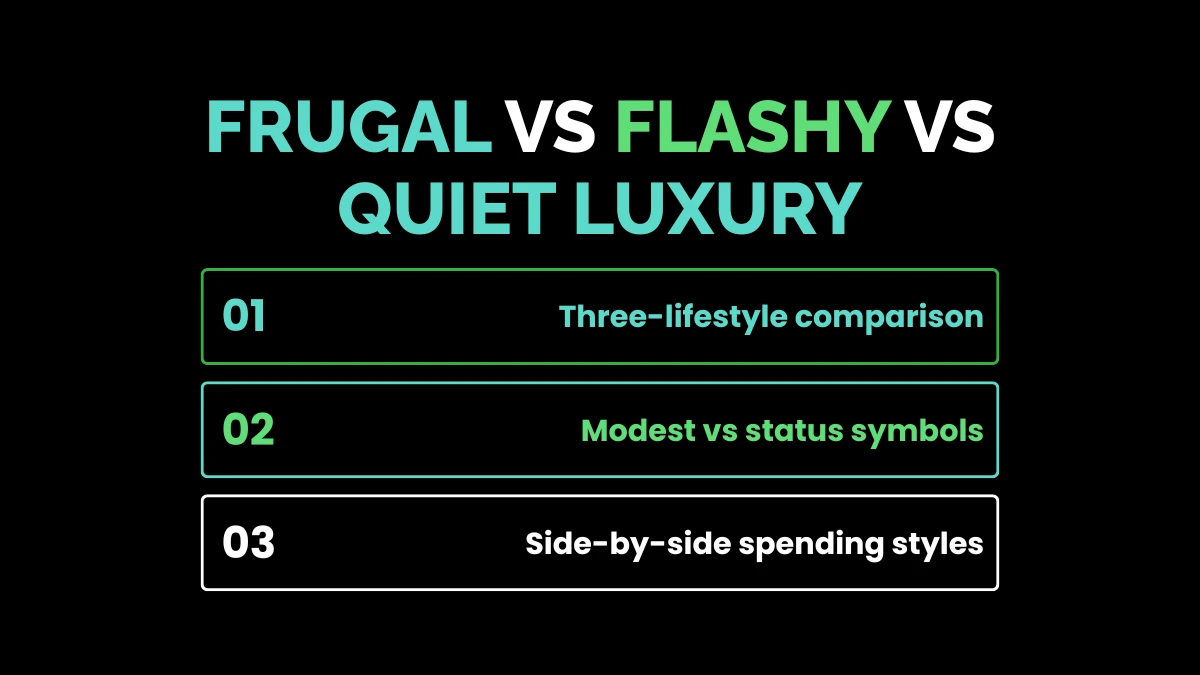
| Feature | Frugal Billionaires | Flashy Wealth | Quiet Luxury |
| Primary Goal | Capital preservation | Status and visibility | Private comfort |
| Home | Long-term modest residence | Multiple luxury estates | Large but understated homes |
| Vehicle | Practical everyday cars | Exotic supercars | Premium luxury sedans |
| Clothing | Simple, inexpensive wardrobe | Designer brands with logos | High-end brands without visible logos |
| Spending Style | Utility first | Lifestyle first | Comfort first |
| Public Image | Disciplined and relatable | Attention-grabbing | Discreet and exclusive |
Practical Lessons You Can Apply Without Being a Billionaire
You don’t need billions of dollars to benefit from these ideas.
Focus on the principles rather than copying every habit.
Start With Lifestyle Inflation
Every time your income increases, avoid increasing every expense.
Allow your investments to grow before upgrading your lifestyle.
Create Simple Daily Systems
Reduce small daily decisions.
Planning meals, organizing clothes, and automating bills saves time and mental energy.
Buy for Value, Not Status
Before making a purchase, ask one simple question:
Will this improve my life, or am I buying it to impress someone else?
That question alone can prevent many unnecessary expenses.
Invest in Assets Before Luxuries
Many billionaires delayed luxury purchases until after they built meaningful assets.
The order matters.
Assets create future income.
Luxury usually creates future expenses.
Who Should Follow These Habits?
These principles are especially valuable for:
- Entrepreneurs building long-term businesses.
- Investors focused on compound growth.
- Young professionals avoiding lifestyle inflation.
- Anyone working toward financial independence.
- Families trying to improve long-term financial stability.
Who Should Avoid Taking These Habits Too Literally?
Not every billionaire habit fits every lifestyle.
Avoid copying behaviors that negatively affect your health, relationships, or quality of life.
Extreme cost-cutting should never replace reasonable comfort, generosity, or personal well-being.
Healthy financial discipline is very different from unhealthy deprivation.
Common Mistakes People Make
Many readers misunderstand billionaire frugality.
Avoid these common mistakes:
- Assuming frugality means being cheap.
- Copying visible habits while ignoring the underlying mindset.
- Focusing only on saving instead of increasing income.
- Treating every expense as bad rather than evaluating long-term value.
- Forgetting that time is often more valuable than money.
The real lesson isn’t spending less at every opportunity.
It’s spending intentionally.
Conclusion
Remember the moment from the beginning of this article:
The surprise of seeing one of the world’s richest people living in a way that looked almost ordinary.
That reaction is common because most of us naturally associate wealth with luxury. The lives of these frugal billionaires challenge that assumption.
After looking at real-world examples from Warren Buffett, Mark Zuckerberg, Carlos Slim Helú, Azim Premji, Chuck Feeney, Tim Cook, and David Cheriton, a clear pattern appears. Their modest choices are rarely about saving a few dollars. They are about protecting focus, avoiding lifestyle inflation, preserving capital, and directing resources toward business growth or philanthropy.
That doesn’t mean every habit should be copied. A billionaire’s lifestyle is shaped by unique responsibilities, security needs, and financial opportunities that most people don’t have. The lesson worth adopting is the mindset behind the decisions rather than the decisions themselves.
Perhaps that’s why these stories continue to fascinate people. Real wealth often looks quieter than we expect, and sometimes the people who can afford everything choose to prove that they don’t need it.
Frequently Asked Questions
1. Why do frugal billionaires choose to live below their means?
Most frugal billionaires see money as a tool rather than a reward. Instead of spending heavily on luxury items, they prefer to preserve capital that can be reinvested in businesses, investments, or charitable causes.
Research highlighted in The Millionaire Next Door and modern billionaire case studies shows that disciplined spending habits often remain unchanged even after enormous wealth is created. Their identity is built on creating value rather than displaying wealth.
2. Does Warren Buffett really still live in the same house?
Yes. Warren Buffett still lives in the Omaha home he purchased in 1958 for $31,500, according to Berkshire Hathaway disclosures and Business Insider.
Even though his net worth exceeds $150 billion, he has repeatedly described that house as one of the best investments he ever made. His long-term approach reflects stability rather than luxury.
3. Are billionaire frugal habits actually responsible for their success?
Not entirely. Frugal habits alone do not create billion-dollar companies.
However, these habits support behaviors that contribute to long-term success, including disciplined decision-making, reduced lifestyle inflation, better capital allocation, and consistent reinvestment. The habit itself is valuable because of the thinking behind it.
4. Is billionaire frugality genuine or just a public relations strategy?
The answer depends on the individual.
Some critics argue that visible modesty can strengthen a public image while expensive assets remain hidden behind the scenes. On the other hand, decades-long examples such as Warren Buffett, Chuck Feeney, Carlos Slim Helú, and Azim Premji demonstrate that many leaders practiced frugality long before it became beneficial for public relations.
5. Which frugal billionaire is considered the greatest example of generosity?
Chuck Feeney is widely regarded as one of the strongest examples.
Through The Atlantic Philanthropies, he donated approximately $8 billion during his lifetime and reduced his own fortune to less than $2 million before his death. He chose to give away nearly everything while he was alive rather than leaving it behind, making him one of history’s most remarkable examples of purposeful wealth.