
Why the Habits of Self-Made Billionaires Matter More Than Their Net Worth
A few years ago, I noticed something interesting while reading biographies of successful entrepreneurs. The headlines always focused on billion-dollar companies, but the small daily routines hidden between the chapters were often far more revealing. Those seemingly odd behaviors kept appearing again and again.
That curiosity led me to study the habits of self-made billionaires through biographies, behavioral research, and executive performance studies. I expected to find shortcuts to wealth. Instead, I found disciplined systems designed to protect attention, reduce unnecessary decisions, and make every day more intentional.
You don’t need a billion-dollar business to benefit from these ideas. Many of these habits can be adapted to everyday life, while others are fascinating reminders that extraordinary success often comes with unconventional thinking.
In this article, you’ll discover twelve habits shared by many self-made billionaires, why those routines work from a psychological perspective, which ones deserve your attention, and which extreme practices are better admired than copied.
AI Overview
The habits of self-made billionaires go far beyond waking up early or working long hours. Many successful founders intentionally reduce everyday decisions, protect their focus, and build routines that improve long-term thinking.
Research from Thomas Corley’s Rich Habits, executive leadership studies, and biographies of well-known billionaires suggests these behaviors are designed to maximize mental energy rather than simply increase productivity.
Some habits are practical for almost anyone, while others are highly personal or medically questionable. Understanding the reasoning behind them is far more valuable than copying them exactly.
Key Takeaways
- Research by Thomas Corley found that 88% of wealthy individuals spend at least 30 minutes every day reading or learning, compared with 2% of the general population.
- Nearly 50% of self-made billionaires wake several hours before work to prepare mentally or physically for the day.
- Many billionaires intentionally eliminate small daily decisions to reduce decision fatigue.
- Strange routines often exist to improve focus rather than attract attention.
- Long-term systems usually matter more than short bursts of motivation.
- The most successful habits are consistent, repeatable, and built around protecting cognitive energy.
What Are the Habits of Self-Made Billionaires?
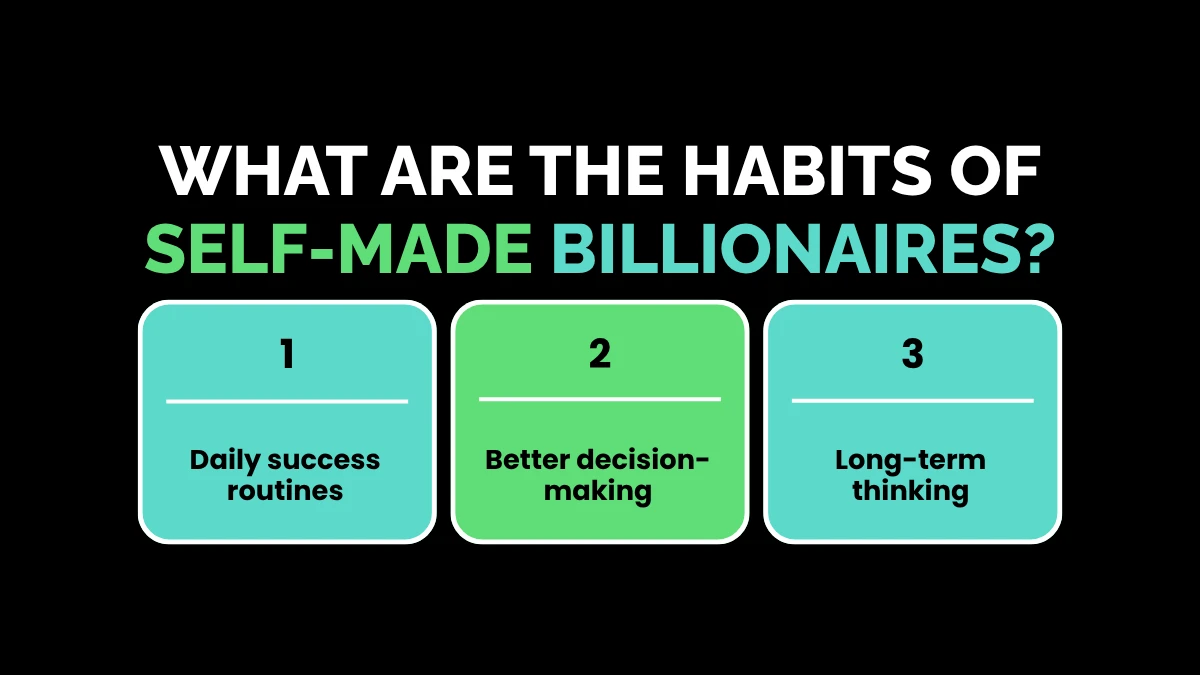
The habits of self-made billionaires are daily routines designed to improve focus, decision-making, and long-term performance. Common examples include continuous learning, structured schedules, minimizing unnecessary choices, disciplined health routines, and protecting time for deep work instead of constant distractions.
Why Do Self-Made Billionaires Think Differently?
One of the biggest differences between wealthy founders and most professionals isn’t intelligence.
It’s how they protect their attention.
Every decision you make consumes a small amount of mental energy. Choosing clothes, deciding what to eat, checking unnecessary notifications, or attending unproductive meetings all create cognitive load.
Many billionaires intentionally remove those decisions before the day even begins.
The research describes this principle as decision fatigue elimination. By automating routine choices, they preserve mental resources for business strategy, leadership, and complex problem-solving.
Instead of asking, “What should I wear today?”
They’ve already answered that question months or even years ago.
Average Thinking vs. Billionaire Thinking
| Average Approach | Billionaire Approach |
| Make dozens of small daily decisions | Automate routine decisions |
| React to interruptions | Schedule focused work intentionally |
| Manage time by the hour | Some divide time into micro-blocks |
| Seek motivation | Build repeatable systems |
| Solve today’s problems | Build solutions that scale for years |
This doesn’t mean billionaires never waste time.
It means many actively design their environment to waste less of it.
12 Habits of Self-Made Billionaires
1. They Read to Build Knowledge, Not Simply to Finish Books
Among all success habits of billionaires, continuous learning appears most consistently.
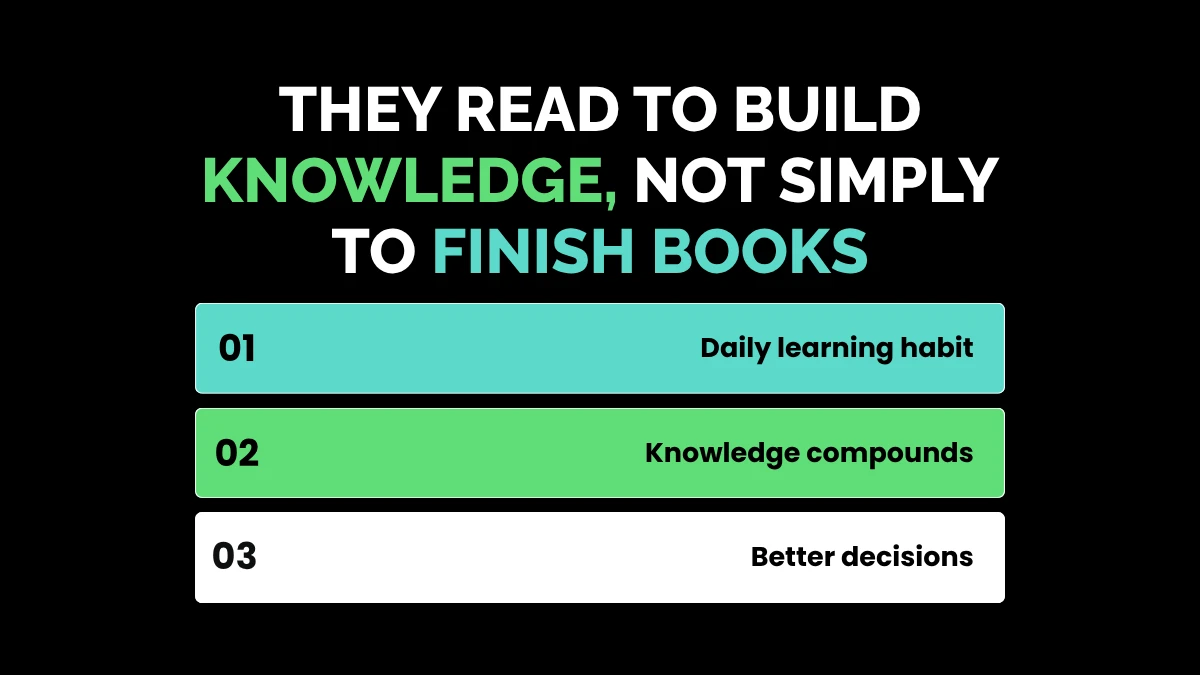
According to Thomas Corley’s Rich Habits study, 88% of self-made wealthy individuals spend at least 30 minutes each day reading or educating themselves, compared with only 2% of the general population.
That’s an extraordinary difference.
Warren Buffett has repeatedly described reading as one of his greatest competitive advantages. According to the research, he spends roughly 80% of his working day reading financial reports, books, and company information because he believes knowledge compounds like interest.
Why This Habit Works
Reading expands your decision-making ability.
Instead of relying only on personal experience, you benefit from thousands of hours of someone else’s research, failures, and successes.
Practical Takeaway
Don’t measure reading by pages.
Measure it by ideas you can apply.
2. They Eliminate Small Decisions
By automating routine choices, they save executive cognitive processing every week. This elimination of decision fatigue is one of the most practical habits of self-made billionaires that anyone can adopt.
One of the most famous weird billionaire habits isn’t actually strange once you understand the psychology behind it.
Mark Zuckerberg is well known for wearing nearly identical gray T-shirts and hoodies every day.
The reason isn’t fashion.
It’s mental efficiency.
Research referenced in your source explains that automating routine choices can save an estimated 3–4 hours of executive cognitive processing every week by reducing decision fatigue.
That’s mental energy that can be redirected toward higher-value work.
Why It Matters
Small choices seem harmless individually.
Together, they quietly consume attention that could be used for solving more important problems.
3. They Schedule Every Minute That Matters
Most professionals organize their calendars in 30- or 60-minute blocks.
Some billionaires go much further.
According to the research, Elon Musk became known for dividing his day into 5-minute scheduling blocks, allowing him to manage multiple businesses while maintaining extraordinary time awareness.
Executive productivity research cited in your report suggests that this strategy can improve operational throughput by approximately 25% compared with traditional hourly scheduling.
The exact percentage may vary by individual, but the underlying principle remains powerful.
Common Mistake
Many people confuse being busy with being intentional.
Micro-scheduling isn’t about filling every minute.
It’s about assigning every important minute a purpose.
4. They Wake Up Before the World Does
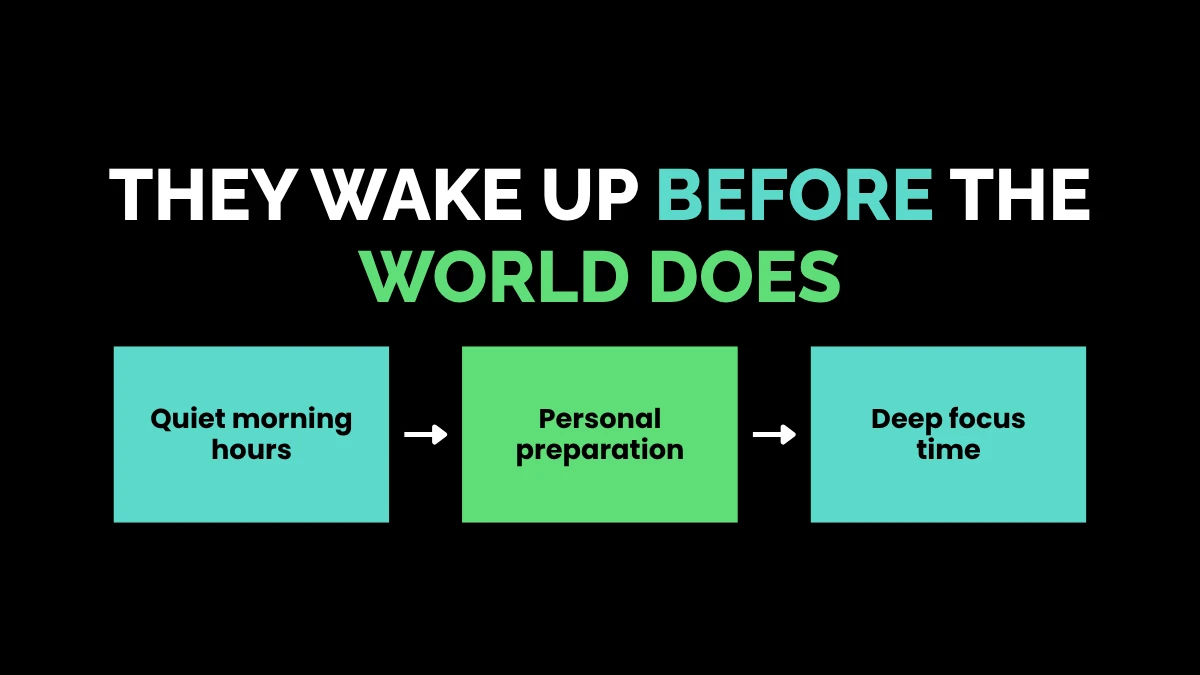
One of the most recognizable billionaire daily habits is protecting quiet hours before normal business activity begins.
Research included in your source found that nearly 50% of self-made billionaires wake at least three hours before their official workday starts.
Those early hours aren’t necessarily spent answering emails.
They’re often reserved for reading, exercise, strategic planning, meditation, or uninterrupted thinking.
Richard Branson, for example, reportedly begins his day around 5:00 AM, using the morning for physical activity before business responsibilities take over.
Why It Works
Morning hours contain fewer interruptions.
That allows deeper concentration before meetings, notifications, and unexpected problems begin competing for attention.
5. They Create Personal Rules That Never Change
Many successful founders remove uncertainty by following fixed personal rules.
Warren Buffett’s breakfast routine is one of the best-known examples.
According to the research, he stops at McDonald’s each morning and chooses one of three inexpensive breakfasts, spending less than $4, with his choice influenced by the stock market’s performance that day.
The meal itself isn’t the secret.
The consistency is.
By removing one more daily decision, he keeps his attention available for investment decisions that matter far more.
Lesson You Can Use
Simple routines reduce mental clutter.
Your routine doesn’t have to match Buffett’s.
It simply needs to eliminate unnecessary thinking.
6. They Treat Their Environment Like a Productivity Tool
Cognitive environmental conditioning is highly effective. When studying the daily habits of self-made billionaires, you quickly notice how intentionally they design their physical workspaces to encourage deep concentration.
Most people try to improve productivity by changing themselves.
Many billionaires first change their surroundings.
Research describes this approach as cognitive environmental conditioning.
Instead of relying on willpower, they redesign their workspace to encourage focus naturally.
Examples include standing desks, quiet workspaces, barefoot walking on natural surfaces, or eliminating digital distractions.
These choices may appear unusual.
Yet each one serves the same purpose making concentration easier and distractions harder.
Who Should Try This?
This habit works well if you regularly struggle with interruptions, multitasking, or maintaining focus during demanding work.
Who Should Avoid It?
Avoid copying extreme environmental experiments simply because a billionaire uses them.
Small changes such as reducing notifications or creating a dedicated workspace are generally more practical and sustainable than radical productivity rituals.
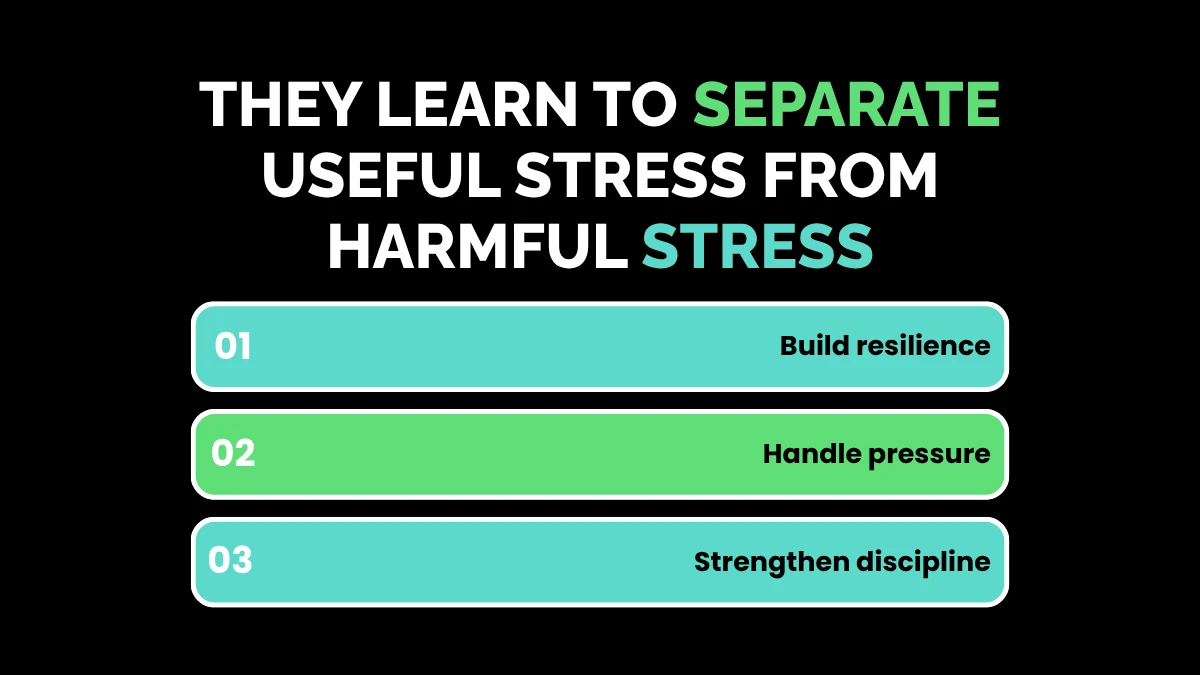
7. They Learn to Separate Useful Stress from Harmful Stress
One pattern appears repeatedly when studying billionaire biographies.
They don’t try to eliminate pressure.
They build routines that help them respond to it more effectively.
According to the research, practices such as cold exposure, structured exercise, and disciplined schedules are intended to increase resilience rather than provide temporary comfort.
Jack Dorsey, for example, became known for combining extended fasting with early-morning ice baths as part of his personal wellness routine.
Why This Habit Works
Difficult situations become easier when your mind regularly practices discipline in controlled environments.
That doesn’t mean extreme routines create success.
It means consistent challenges can strengthen your ability to remain calm under pressure.
Common Mistake
Don’t assume uncomfortable automatically means productive.
Extreme fasting or cold exposure may carry health risks and should never replace professional medical advice.
8. They Invest in Thinking Time
Many people fill every empty minute with emails, meetings, or social media.
Several successful entrepreneurs intentionally do the opposite.
One of the most interesting weird billionaire habits belongs to Sara Blakely, founder of Spanx.
According to the research, she created a “fake commute,” driving without a destination simply to spend uninterrupted time thinking before beginning work.
At first glance, that sounds unproductive.
In reality, it protects something many professionals rarely schedule deep reflection.
Why It Matters
Creative solutions usually appear when your brain has room to connect ideas instead of constantly reacting to notifications.
Practical Takeaway
Reserve 20 to 30 minutes each week with no phone, meetings, or distractions.
Think instead of consuming.
9. They Think in Years, Not Days
One of the defining success habits of billionaires is patience.
While many people measure progress by this week’s results, billionaires often evaluate decisions by how they will perform years from now.
Warren Buffett is a strong example.
According to the research, he believes knowledge compounds just like investments, which explains why he dedicates so much time to reading and studying businesses before making decisions.
This long-term perspective influences everything from investing to hiring and business strategy.
Why It Works
Short-term thinking encourages quick wins.
Long-term thinking builds lasting advantages.
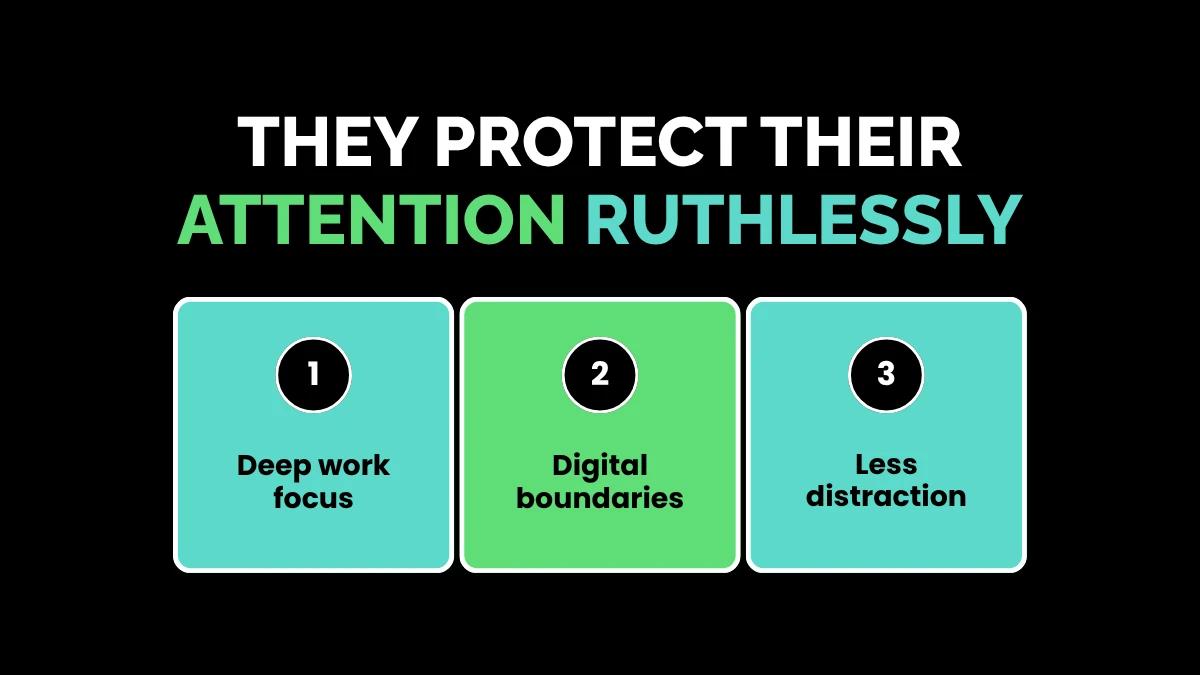
10. They Protect Their Attention Ruthlessly
Modern distractions compete for your attention every minute.
Successful founders understand that attention is often more valuable than time itself.
Research highlights several approaches used by high performers, including noise-canceling headphones, private workspaces, ignoring unscheduled calls, and strict digital boundaries.
These methods aren’t about avoiding people.
They’re about protecting periods of uninterrupted concentration.
Common Mistake
Many people believe multitasking improves productivity.
In reality, constant context switching often reduces the quality of both thinking and execution.
11. They Embrace Technology Without Depending Entirely on It
The research shows a major shift occurring in 2026.
Instead of relying only on intuition, many billionaires now combine personal discipline with wearable technology and AI-powered health monitoring.
Executive biohacking has expanded to include continuous biometric tracking, longevity protocols, and predictive wellness systems.
Rather than replacing good habits, technology is being used to refine them.
This represents an evolution from instinct-driven routines toward data-informed decision-making.
What This Means for You
You don’t need expensive technology to improve your habits.
Simple consistency usually delivers greater benefits than buying another productivity gadget.
12. They Constantly Improve Small Daily Systems
Perhaps the biggest lesson isn’t any single routine.
It’s the commitment to continuous improvement.
The research describes billionaire habits as “keystone habits” foundational behaviors that influence many other areas of life.
Instead of chasing dramatic overnight transformations, successful entrepreneurs repeatedly improve small systems.
Over time, those improvements compound into significant advantages.
Practical Takeaway
Focus on improving one routine each month.
Small improvements maintained for years usually outperform ambitious plans abandoned after a few weeks.
Billionaire Daily Habits vs. Average Daily Habits
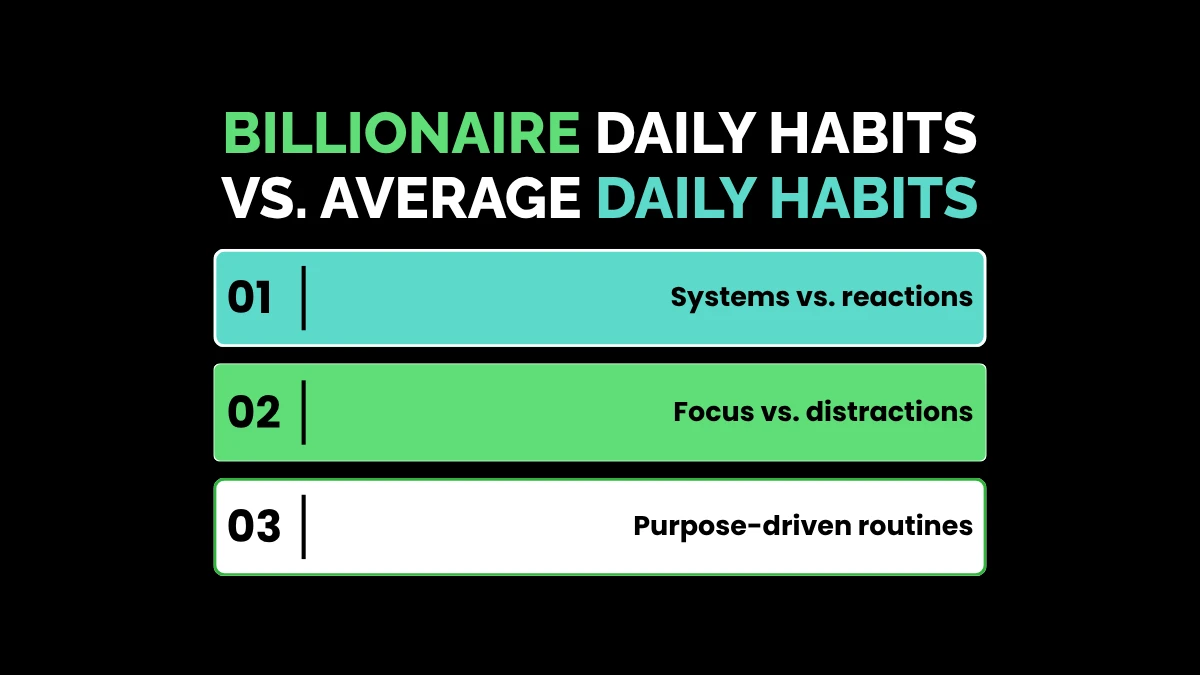
Understanding how billionaires think differently becomes easier when you compare their routines with more typical daily behaviors.
| Daily Activity | Average Routine | Self-Made Billionaire Routine |
| Morning | React to emails and notifications | Reading, exercise, planning, reflection |
| Clothing | Decide every day | Simplify or automate choices |
| Calendar | Hourly meetings | Purpose-driven scheduling, sometimes using micro-blocks |
| Learning | Occasional reading | Daily learning habit |
| Decision Making | Many small choices | Eliminate low-value decisions |
| Focus | Frequent interruptions | Protected deep-work sessions |
| Long-Term Planning | Weekly goals | Multi-year thinking |
The goal isn’t to imitate every billionaire habit.
It’s to recognize the principles behind them.
Real-World Examples of Self-Made Billionaire Habits in Action
1. Benjamin Franklin’s “Air Baths” (Historical Example)
Historical Example: Benjamin Franklin’s “Air Baths”
Long before wearable technology and cold plunges became popular, Benjamin Franklin experimented with what he called “air baths.”
According to historical accounts referenced in your research, Franklin would sit unclothed near an open window each morning, believing that fresh, cold air improved both his health and mental clarity.
The practice may seem unusual today, but it reflects an idea that still appears among modern entrepreneurs—changing your physical environment to influence your mental state.
Should You Copy This?
Not necessarily.
The principle worth adopting isn’t the ritual itself. Instead, consider creating a workspace or morning routine that helps you feel alert, calm, and focused.
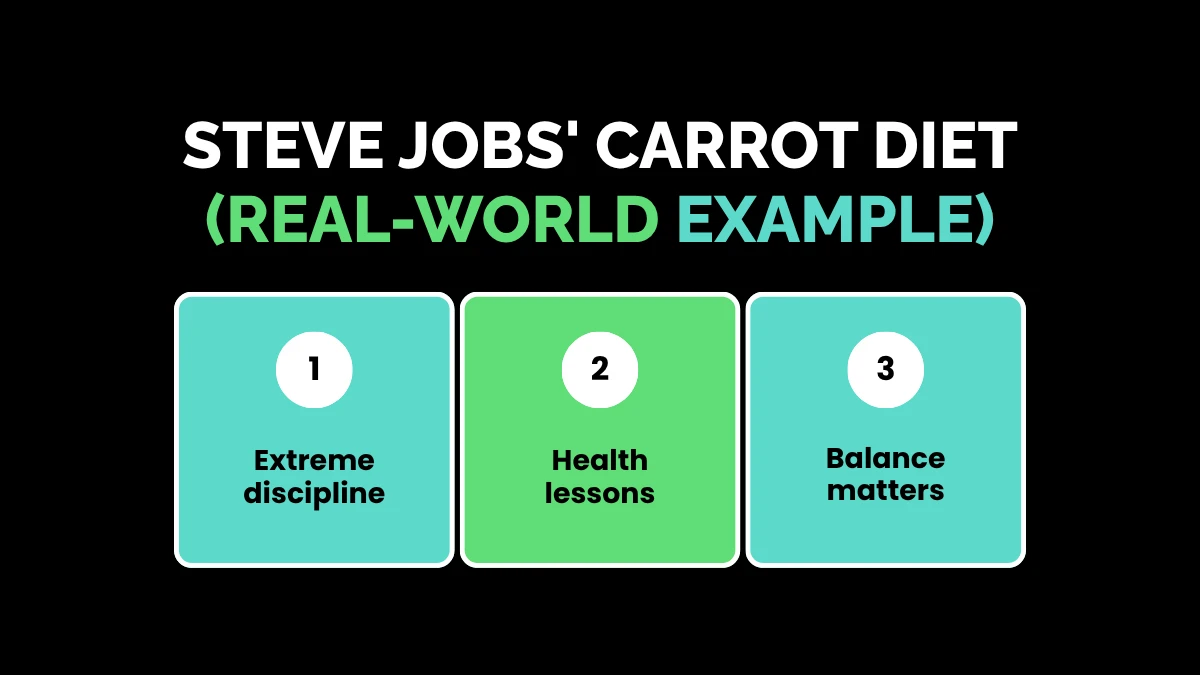
2. Steve Jobs’ Carrot Diet (Real-World Example)
Real-World Example: Steve Jobs’ Extreme Diet
One of the most famous examples of unusual billionaire behavior comes from Steve Jobs.
According to Walter Isaacson’s biography, Jobs sometimes followed highly restrictive diets, eating little more than carrots or apples for extended periods. The habit reportedly became so extreme that it contributed to carotenemia, a condition that gave his skin an orange tint.
His story demonstrates an important lesson.
Discipline is valuable, but extreme habits aren’t automatically healthy or effective.
Should You Copy This?
No.
Balanced nutrition supported by qualified medical advice is far safer than adopting restrictive eating patterns simply because a successful entrepreneur once followed them.
3. Nikola Tesla’s Polyphasic Sleep
Historical Perspective: Nikola Tesla’s Unusual Sleep Routine
The desire to maximize productive hours isn’t unique to modern billionaires.
Historical records show that Nikola Tesla experimented with polyphasic sleep, taking short rest periods instead of following a traditional nighttime schedule. He believed this allowed him to dedicate more time to invention and scientific work.
Modern sleep research doesn’t recommend this lifestyle for most people.
Even so, Tesla’s example highlights a recurring pattern among exceptional innovators: they constantly searched for ways to protect focused thinking.
Should You Copy This?
Probably not.
The valuable takeaway is protecting uninterrupted work time, not reducing healthy sleep.
4. Jay Leno’s Two-Income Rule
Another Lesson in Long-Term Thinking
Comedian and television host Jay Leno followed a simple financial rule throughout his career.
According to the research, he never spent his primary income from The Tonight Show. Instead, he lived entirely on earnings from his stand-up performances while allowing his television income to remain untouched.
This habit wasn’t about earning more.
It was about protecting long-term wealth through disciplined financial choices.
Should You Copy This?
If possible, consider saving or investing one income stream while living on another. Even applying this idea to side income can strengthen long-term financial security.
5. The Evolution of Billionaire Habits
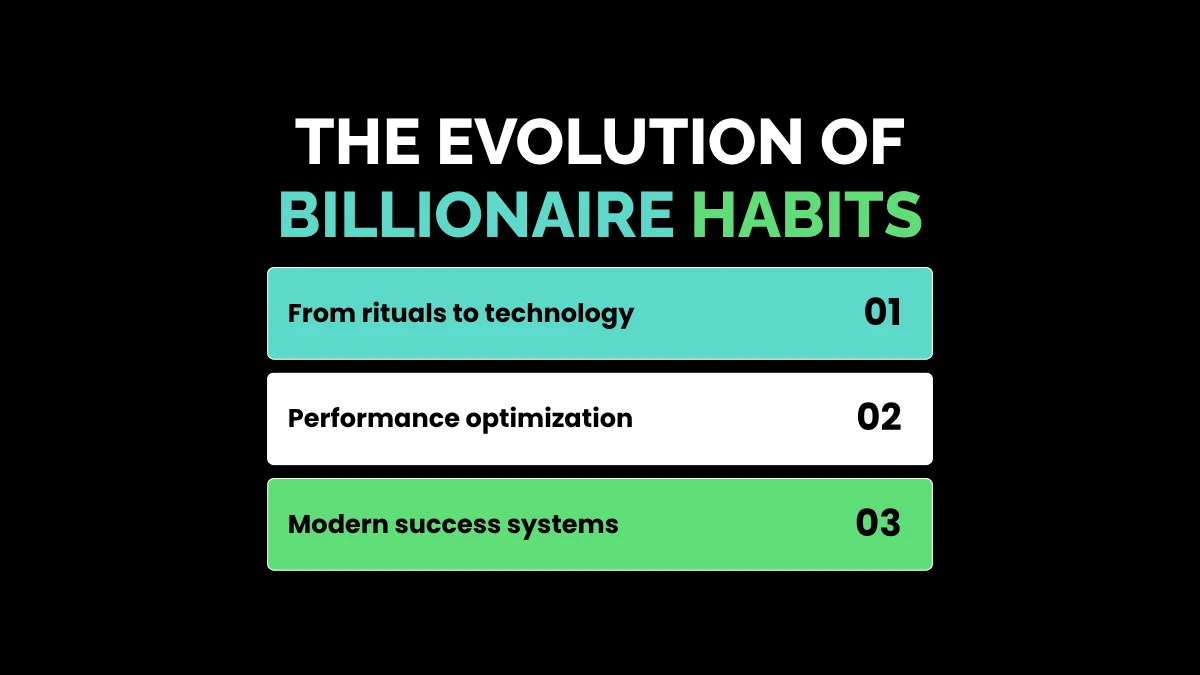
From Benjamin Franklin to AI: How High-Performance Habits Have Evolved
Unusual success habits didn’t begin in Silicon Valley.
According to your research, Benjamin Franklin experimented with environmental routines like air baths in the 18th century. During the early 20th century, Nikola Tesla tested unconventional sleep patterns to extend his productive hours.
Today’s entrepreneurs use many of the same principles, but modern technology has transformed how they’re applied.
Instead of relying only on personal intuition, executives increasingly use wearable devices, biometric sensors, and AI-driven health monitoring to optimize sleep, focus, and recovery.
The tools have changed dramatically.
The pursuit of better performance has remained remarkably consistent.
6. The Four Types of Billionaire Habits
Four Categories Behind Most Billionaire Habits
Although billionaire routines look very different on the surface, they usually fall into four broad categories.
Dietary & Biohacking
Some entrepreneurs experiment with fasting, restricted eating windows, or cold exposure to improve resilience and maintain consistent energy levels.
Cognitive Offloading
Habits such as wearing similar clothes, eating predictable meals, or standardizing everyday decisions help reduce decision fatigue and preserve mental energy.
Time & Chrono Minimalism
Highly structured calendars, micro-scheduling, and carefully protected deep-work sessions allow successful founders to focus on high-value activities.
Cognitive Environmental Conditioning
Many billionaires intentionally shape their surroundings through quiet workspaces, standing desks, natural environments, or distraction-free offices that make concentration easier.
Understanding these categories is more valuable than copying any single habit because the underlying principles remain useful regardless of lifestyle.
7. AI-Driven Executive Biohacking (2026 Trend)
The 2026 Shift Toward AI-Powered Performance
Your research highlights an important change taking place in 2026.
Executive performance is becoming increasingly data-driven rather than intuition-driven.
Instead of relying solely on personal routines, many business leaders now combine wearable technology, continuous health monitoring, and AI-powered analytics to guide decisions about sleep, recovery, nutrition, and productivity.
This doesn’t replace discipline.
It simply provides more accurate feedback about what works for each individual.
As these technologies become more affordable, habits once associated only with billionaires may gradually become common tools for professionals and entrepreneurs.
Common Myths About Billionaire Habits
Many articles exaggerate billionaire routines.
The research paints a more balanced picture.
| Myth | Reality |
| Billionaires become wealthy because they wake up early. | Early rising supports focus, but it doesn’t create wealth on its own. |
| Every billionaire follows the same routine. | Habits vary widely based on personality, industry, and lifestyle. |
| Strange habits are the secret to success. | The psychology behind the habits matters far more than the habits themselves. |
| Working longer always produces better results. | Many billionaires prioritize focused work instead of endless hours. |
| Extreme biohacking is necessary. | Most practical benefits come from consistency rather than extreme experimentation. |
Understanding these differences helps you avoid copying behaviors without understanding their purpose.
Why Copying Billionaire Routines Usually Fails
This is where many articles stop thinking critically.
Copying a billionaire’s daily schedule rarely produces billionaire results.
The reason is context.
Elon Musk’s five-minute scheduling system supports multiple global companies.
Your daily responsibilities may require a completely different approach.
Similarly, Jack Dorsey’s fasting routine reflects his personal preferences and health decisions.
That doesn’t mean it’s appropriate for everyone.
Successful habits should fit your environment, health, career stage, and responsibilities.
Copying behavior without understanding purpose often leads to frustration instead of improvement.
The better strategy is to borrow principles rather than personalities.
What Research Actually Supports
Reliable evidence points toward a few habits far more consistently than popular headlines.
According to Thomas Corley’s Rich Habits Institute, 88% of wealthy individuals spend at least 30 minutes each day learning through reading.
Research cited in your report also indicates that nearly 50% of self-made billionaires begin their day several hours before work for focused personal routines.
Executive productivity research referenced in the report suggests reducing routine decisions can preserve approximately 3–4 hours of cognitive processing each week.
The report further notes that structured 5-minute scheduling blocks may increase operational throughput by around 25% compared with traditional hourly scheduling.
These findings emphasize discipline, learning, and decision quality not flashy routines as the strongest recurring themes.
The Psychology Behind Billionaire Habits
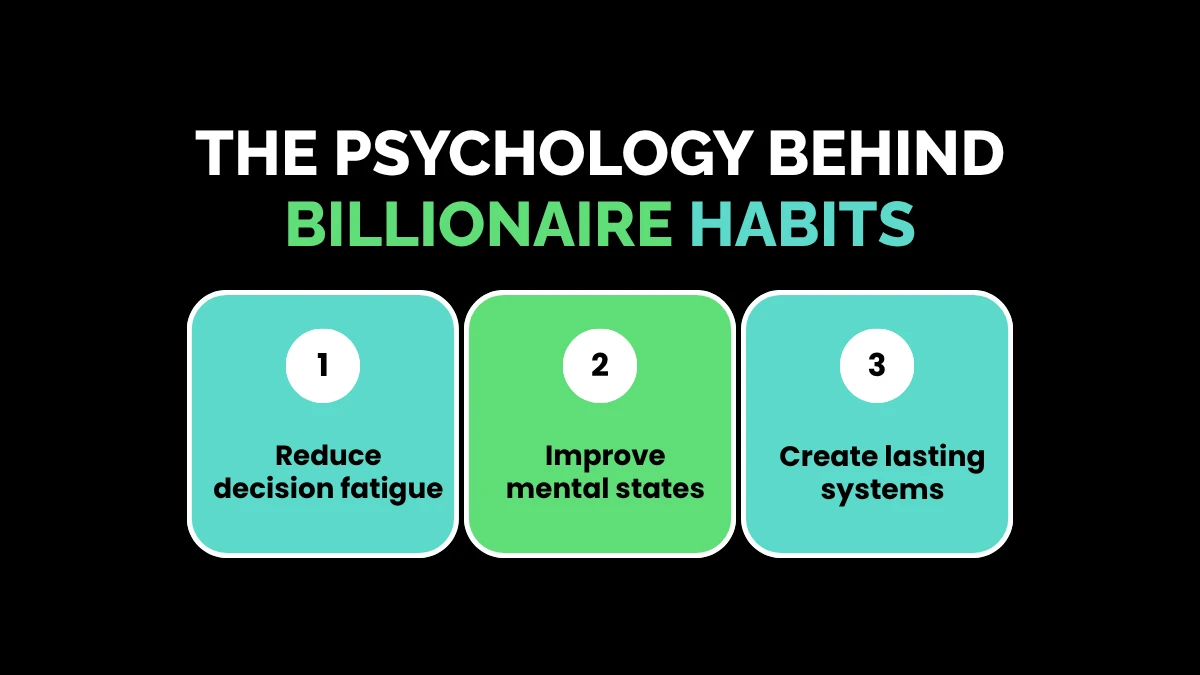
Many billionaire routines appear unusual because people focus on the behavior instead of the reason behind it.
The research identifies two recurring principles.
The first is decision fatigue elimination.
Removing repeated low-value choices preserves mental energy for strategic decisions.
The second is neurochemical state modulation, where structured routines such as exercise, environmental changes, or disciplined scheduling help create mental conditions that support focused work.
Neither principle requires expensive tools.
Both rely on consistency more than intensity.
Practical Application: Build Billionaire Habits in the Next 30 Days
Reading about successful routines is valuable.
Applying them consistently creates real change.
Week 1: Remove One Daily Decision
Choose one routine to automate.
This could be meal planning, preparing tomorrow’s clothes, or setting a fixed morning schedule.
Week 2: Create a Daily Learning Habit
Read for 30 minutes every day.
Focus on books or articles that improve your professional knowledge rather than passive entertainment.
Week 3: Protect Your Deep Work
Schedule one uninterrupted block each day.
Silence notifications and complete your highest-value work before responding to messages.
Week 4: Review and Improve
Spend one hour reviewing what worked.
Keep the habits that helped and remove those that didn’t fit your lifestyle.
Progress comes from continuous adjustment rather than perfect planning.
Conclusion
When I first started paying attention to billionaire biographies, I expected to find one magical habit that explained extraordinary success. Instead, I kept seeing the same pattern repeated in different forms: successful people built systems that protected their time, attention, and ability to make good decisions.
That’s the real lesson behind the habits of self-made billionaires. Whether it’s Warren Buffett reading for hours, Mark Zuckerberg simplifying his wardrobe, or Sara Blakely creating quiet thinking time, each routine serves a larger purpose. The habit itself isn’t the advantage the clarity and consistency it creates are.
You don’t need to wake up at 5 AM, wear the same clothes every day, or schedule every five minutes to improve your life. What matters is identifying the small routines that remove distractions and help you focus on meaningful work.
The next time you read about an unusual billionaire ritual, look beyond the headline. The behavior may be strange, but the principle behind it is often surprisingly practical.
Frequently Asked Questions
What are the habits of self-made billionaires?
The habits of self-made billionaires are daily systems that help them make better decisions, protect their attention, and improve long-term performance. According to Thomas Corley’s Rich Habits research, many successful entrepreneurs dedicate time every day to reading, planning, exercising, and reducing unnecessary decisions. These habits don’t create wealth on their own, but they build the discipline and consistency needed to achieve exceptional results.
Why do billionaires wear the same clothes every day?
Many billionaires simplify their wardrobes to reduce decision fatigue. A well-known example is Mark Zuckerberg, who often wears the same gray T-shirt and hoodie because he wants to save mental energy for more important business decisions. Research on executive productivity suggests that automating small daily choices can preserve valuable cognitive resources throughout the week.
Do strange billionaire habits actually make people rich?
Not by themselves. Strange routines such as Elon Musk’s five-minute scheduling blocks or Jack Dorsey’s fasting protocol support focus and discipline, but they are not shortcuts to wealth. The underlying principles consistent learning, strategic thinking, and effective time management—are what contribute to long-term success.
Which billionaire habits are worth copying?
The safest and most practical habits include reading every day, protecting uninterrupted work time, planning your schedule in advance, and reducing unnecessary daily decisions. Warren Buffett’s commitment to lifelong learning and Sara Blakely’s habit of setting aside quiet thinking time are excellent examples that most people can adapt. Extreme routines such as prolonged fasting or restrictive diets should not be copied without medical guidance.
How do billionaires think differently than most people?
One reason how billionaires think differently is often discussed is their focus on long-term outcomes instead of short-term distractions. Rather than reacting to every email or opportunity, they build systems that automate routine tasks and leave more mental capacity for strategic decisions. For example, Warren Buffett spends much of his day reading and analyzing businesses, while Elon Musk organizes his schedule to maximize focused work on high-impact priorities.