

Key Takeaways
-
Aim for 8 to 12 total applications in most cases
-
Build a balanced college list safety target reach mix
-
Save time and money by avoiding application fatigue
-
Adjust your optimal number of college applications based on budget and goals
You are sitting in front of a blank screen, staring at the Common App, and asking yourself the ultimate senior-year question: how many colleges should I apply to?
In most cases, applying to 8 to 12 colleges is the sweet spot for high school seniors.
This gives you a solid mix of options without causing total burnout or draining your bank account.
Here at Weird Wealth, we believe in making smart choices with your time and money. Applying to 20 or 30 schools might seem like a safe move, but it quickly leads to wasted application fees and rushed supplemental essays.
Let us walk through how to build a stress-free application plan that works for your budget, grades, and goals.
AI Overview
Deciding how many colleges should I apply to comes down to balancing options and effort. In general, based on available data, applying to 8 to 12 schools gives students the best chance of acceptance while keeping stress and application fees manageable. A solid college application number strategy uses a college list safety target reach approach usually 2 to 3 safeties, 3 to 4 targets, and 2 to 3 reaches. Finding your optimal number of college applications helps you write better essays without burning out.
Why 8 to 12 Is the Sweet Spot
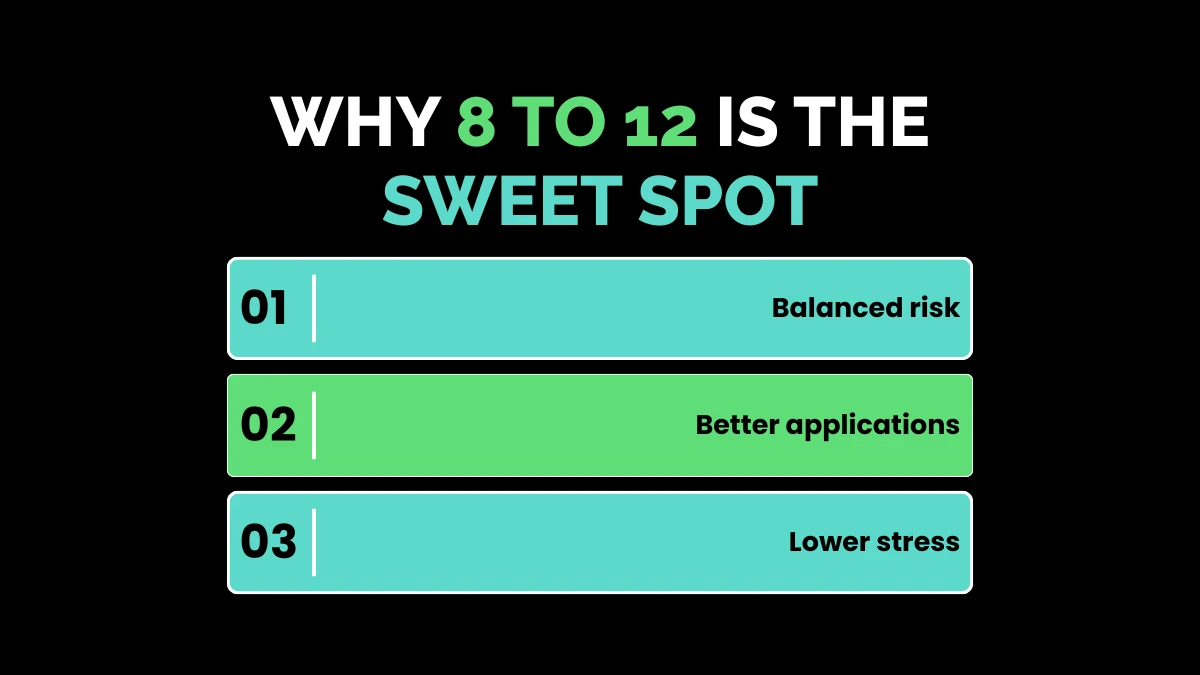
Why do counselors constantly recommend 8 to 12 schools?
Because it balances risk and effort perfectly.
Applying to fewer than 5 colleges can leave you with too few back-up options.
On the flip side, applying to 15 or 20 colleges usually means essay quality drops significantly.
| Application Count | Pros | Cons |
| 1 to 4 Colleges | Low cost, low stress early on | High risk if decisions do not go your way |
| 8 to 12 Colleges (Recommended) | Balanced risk, manageable essays, good financial aid leverage | Requires careful time planning |
| 15+ Colleges | Maximum exposure | High application fees, essay fatigue, lower quality submissions |
Finding the optimal number of college applications means submitting high-quality essays to every single school.
Understanding the Balanced College List
To make this plan work, you need to group your schools into three main categories.
This framework is called the college list safety target reach strategy.
1. Safety Schools (2 to 3 Colleges)
A safety school is a college where your GPA and test scores are well above the average admitted student.
You should have an estimated 80% to 90% chance of getting accepted here.
Make sure at least one safety school is a financial safety, somewhere you know your family can comfortably afford.
2. Target Schools (3 to 4 Colleges)
A target school is where your academic profile matches the school’s average admitted student profile.
Your acceptance chance here is generally around 40% to 70%.
These are colleges you would genuinely love to attend and feel confident about.
3. Reach Schools (2 to 3 Colleges)
A reach school is where your test scores or GPA fall in the lower range of admitted students.
Highly selective universities (like Ivy League schools with acceptance rates under 10%) are reach schools for everyone.
It is always fun to aim high, but keep this section realistic and manageable.
Crafting Your College Application Number Strategy
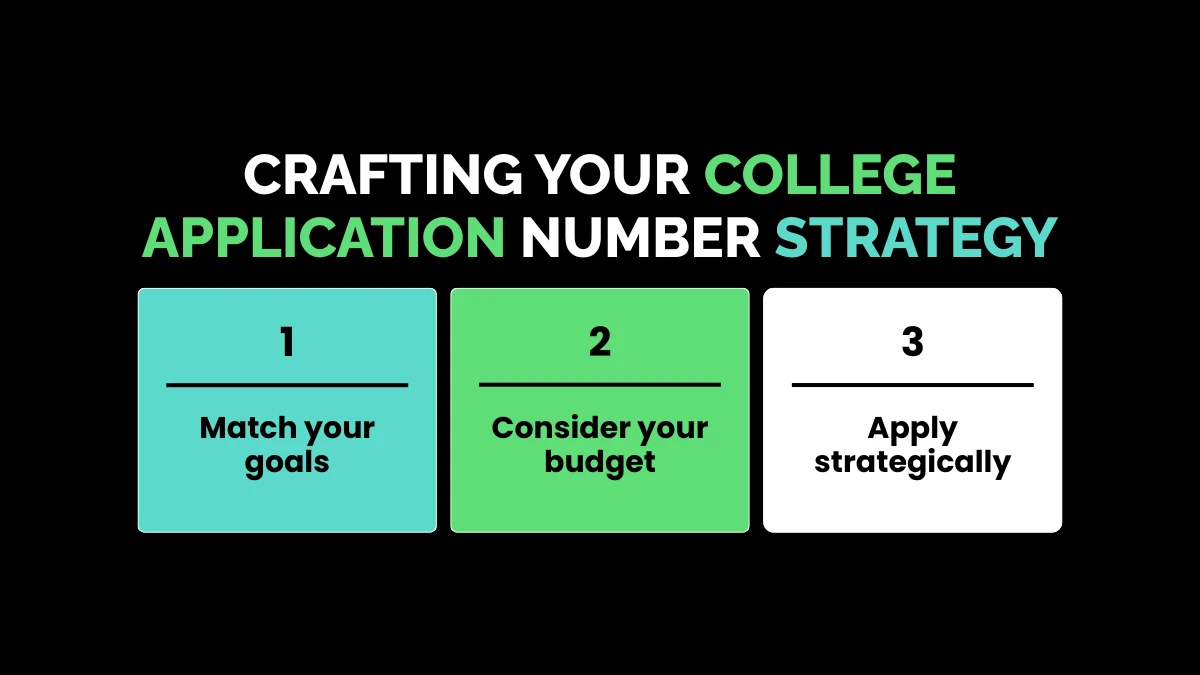
Every student has a slightly different academic and financial background.
Your personal college application number strategy should fit your unique situation.
Here are five common scenarios to help you figure out your personal plan:
Scenario A: The In-State Focused Student
If you plan to stay local and attend a public university, your list might look smaller.
You already know the local system, transfer pathways, and state scholarship guarantees.
-
2 Local Safety Colleges
-
2 State Target Universities
-
1 Selective In-State Reach College
Total: 5 to 6 Applications
Scenario B: The National Search Student
If you are open to traveling across the country for private or public institutions, expand your list slightly.
National searches mean dealing with varied regional standards and diverse campus cultures.
-
3 Safety Colleges
-
4 Target Colleges
-
3 Reach Colleges
Total: 10 Applications
Scenario C: The Highly Selective Pursuer
If you are aiming for highly competitive universities, you may want to submit a few extra applications.
Top-tier admissions are unpredictable, so spreading your reach count slightly helps handle low acceptance rates.
-
3 Safety Colleges
-
4 Target Colleges
-
5 Reach Colleges
Total: 12 Applications
Scenario D: Specialized Majors (STEM, BFA, & Nursing)
Students applying for impacted majors need to adjust their numbers.
Programs in direct-admit nursing, computer science, or performing arts often have acceptance rates far below the university’s general admission rate.
-
3 High-Probability Safety Colleges
-
5 Target Programs
-
4 Highly Selective Reach Programs
Total: 12 Applications
Scenario E: The Transfer or Non-Traditional Student
Transfer students face a completely different landscape than high school seniors.
Articulation agreements between community colleges and state universities usually make the transfer process much more direct.
-
1 Guaranteed Articulation Safety School
-
2 Mid-Range Target Universities
-
2 Dream Reach Institutions
Total: 5 to 6 Applications
Deep Dive into the Financial Reality of Applying
It is easy to add “just one more school” to your Common App list.
However, each extra submission costs real money and time.
At Weird Wealth, we love analyzing financial efficiency, and college admissions are no exception.
If you apply to 20 colleges, you could easily spend over $1,500 just on applications!
Unless you qualify for fee waivers, that money could be better saved for textbooks or dorm items.
Understanding Application Fee Waivers
Do not let application fees deter you if money is tight.
Both the Common App and the College Board offer income-based fee waivers that cover the entire fee.
Many colleges also offer fee waivers simply for attending an online information session or visiting campus.
Financial Aid Strategies and Application Numbers
Applying to multiple target schools gives you leverage when financial aid letters arrive in the spring.
If School A offers you $15,000 in merit aid, you can sometimes ask School B to match or exceed that offer.
Having 3 or 4 target options on your list gives you the ultimate leverage to negotiate lower tuition costs.
How to Decide Your Optimal Number of College Applications
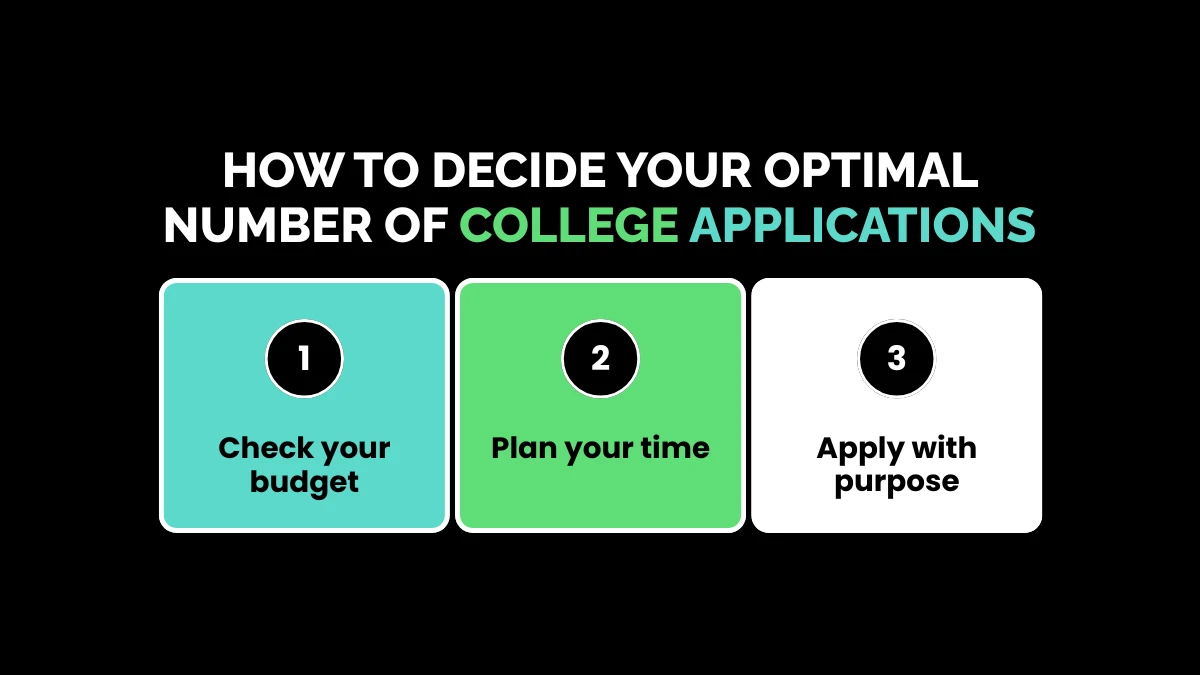
Ask yourself these simple questions to land on your final number:
1. What Is Your Budget?
Look at application fees early. If fees are tight, focus on schools offering free applications or request fee waivers through your guidance counselor.
2. How Much Time Do You Have?
Each college often requires 1 to 3 supplemental essays.
Ten schools can easily mean writing 15 to 20 distinct essays.
If you start in August, 10 schools is very doable. If you start in December, 5 or 6 might be smarter.
3. Are You Applying Early Decision?
If you apply Early Decision (ED) to your top choice and get accepted, you are bound to attend.
In that case, you might only end up submitting 1 to 4 applications total!
4. Do You Have Real Interest in Every School?
Never add a college to your list “just because.”
If you would not gladly attend a school if accepted, remove it immediately.
Application Logistics: Managing Portals and Platforms
Navigating platforms like Common App, Coalition App, or state-specific portals like ApplyTexas can be tricky.
Most platforms enforce their own rules on maximum applications allowed.
| Platform | Application Limit | Notable Features |
| Common App | 20 Colleges Max | Used by 1,000+ colleges worldwide |
| Coalition App (Scoir) | Unlimited | Focuses on access and affordable institutions |
| UC System (California) | Unlimited | Single application for all 9 UC campuses |
| ApplyTexas | Unlimited | Designed specifically for Texas public/private universities |
Understanding these platform constraints helps you execute your optimal number of college applications without hitting technical walls.
Mastering the Essay Overlap Strategy
Writing supplemental essays is the most exhausting part of applying to college.
If you apply to 10 schools, you might face up to 25 distinct essay prompts.
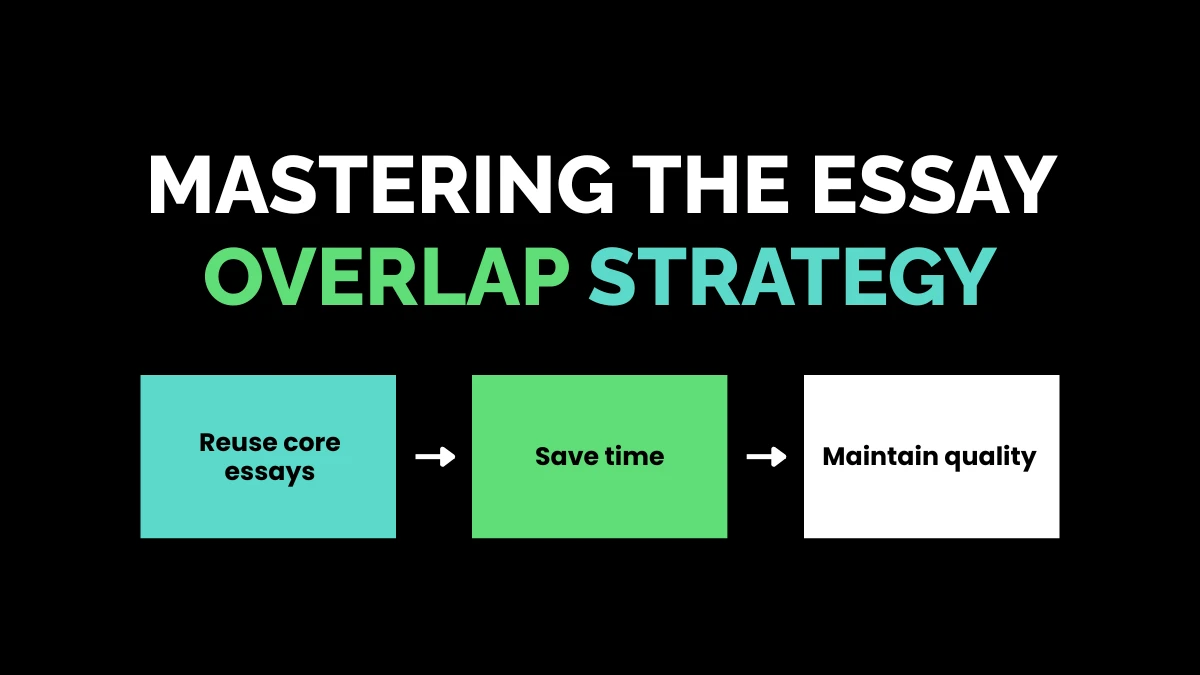
However, smart applicants use the “essay recycling” strategy to save dozens of hours.
Most essay prompts fall into four main categories:
-
The “Why Us?” Essay: Explaining why a specific university fits your goals.
-
The Community Essay: Describing a community you belong to and your role in it.
-
The Challenge Essay: Sharing a difficulty you overcame and what you learned.
-
The Academic Interest Essay: Detailing why you chose your specific major.
By drafting master responses for these four core topics, you can adapt them for almost every school on your list.
This strategy keeps your essay quality high while preventing severe burn-out.
Managing Timeline and Avoid Burnout
Pacing yourself throughout senior year is essential to maintaining high essay standards.
Following a clear schedule prevents the late-December panic that leads to rushed, low-quality submissions.
A Step-by-Step Way to Trim Your List
If your list currently has 18 colleges, do not panic.
Here is how you can pare it down to a healthy college list safety target reach balance:
-
Group by Essays: Check if supplemental essay prompts overlap. If a school requires four unique, long essays and is low on your priority list, cut it.
-
Compare Financial Aid Fit: Use each school’s Net Price Calculator to estimate your real cost. Cut schools that look financially unrealistic.
-
Visit (Virtually or In Person): Take a virtual campus tour. If you cannot picture yourself walking across that campus, drop it from your list.
Common Mistakes Students Make with Application Numbers
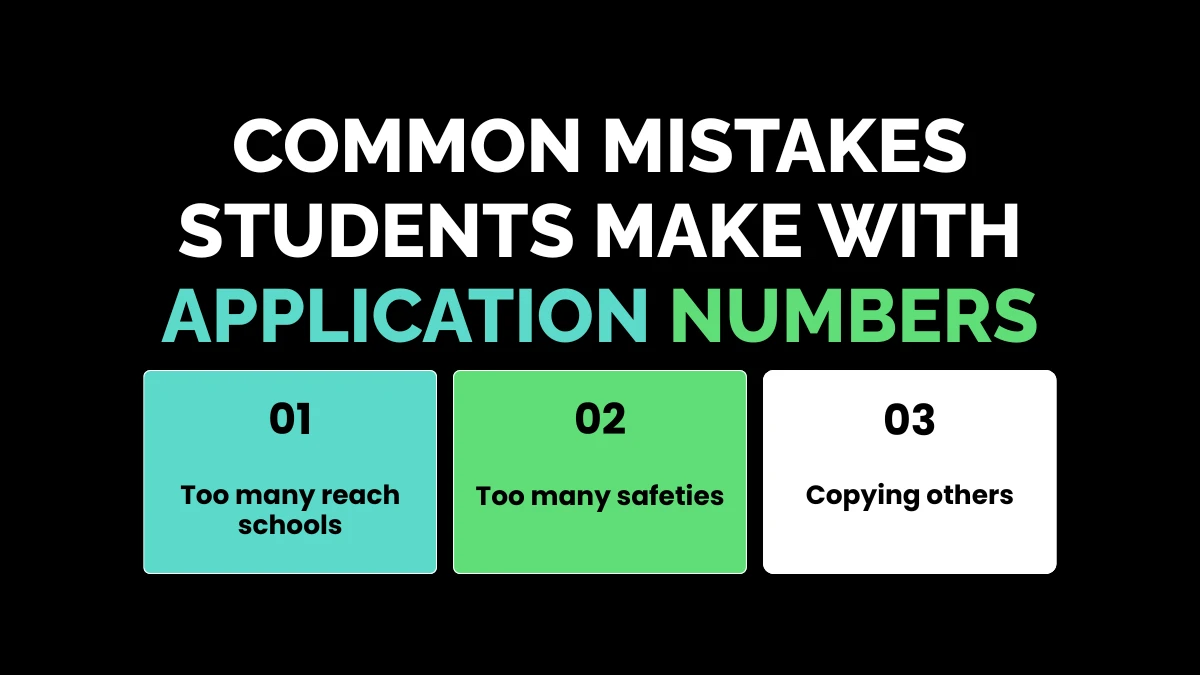
Avoid these three common traps when finalizing your plan:
Mistake 1: Applying Only to Reach Schools
Some students apply to 10 reach schools and zero safety schools.
This leaves you vulnerable to a full rejection cycle, which is heartbreaking and preventable.
Mistake 2: Applying to Too Many Safeties
You do not need 7 safety schools.
Two or three solid safety options that you genuinely like are more than enough.
Mistake 3: Copying a Friend’s Strategy
Your best friend might be applying to 15 colleges, while your older sibling applied to 4.
Your college application number strategy should match your personal academic credentials and financial needs.
How College Applications Compare
Here is a quick look at how list size affects your overall admissions journey:
| Strategy Type | Target Count | Essay Burden | Typical Financial Cost | Success Probability |
| Minimalist | 3 to 5 | Low | $150 – $350 | Moderate (requires strong safeties) |
| Balanced | 8 to 12 | Moderate | $500 – $900 | High (spreads risk evenly) |
| Broad Net | 15+ | Extreme | $1,000+ | Variable (risk of lower quality work) |
Using a balanced approach helps ensure high-quality applications without burning out before midterms.
At Weird Wealth, we advocate for making calculated choices that protect both your sanity and your savings.
Conclusion
Determining how many colleges should I apply to does not need to feel overwhelming.
Stick to the recommended target of 8 to 12 schools, build a smart college list safety target reach breakdown, and execute a solid college application number strategy.
By finding your optimal number of college applications, you will save time, cut costs, and submit top-tier applications that stand out to admissions officers.
Take a deep breath, organize your list, and take it one application at a time!
Frequently Asked Questions
How many colleges should I apply to as a senior?
Most high school seniors should apply to 8 to 12 colleges. This range provides a balanced mix of safety, target, and reach schools while keeping application fees and essay workload manageable.
Is applying to 20 colleges too much?
Yes, applying to 20 colleges is generally too much for most students. It increases application costs significantly and often leads to essay fatigue, which lowers the quality of your overall applications.
What is a balanced college application list?
A balanced college application list typically consists of 2 to 3 safety schools, 3 to 4 target schools, and 2 to 3 reach schools based on your academic profile and budget.
Can you get fee waivers for college applications?
Yes, eligible students can receive application fee waivers through the Common App, College Board, or directly from universities based on financial need or specific school programs.