

A Look at How Millionaires Spend Money Beyond Luxury Cars and Mansions
A few years ago, I was talking with a friend who believed that every millionaire spent their fortune on sports cars, designer clothes, and private islands. It’s an easy assumption to make because that’s what we usually see in movies and social media.
Then I started reading wealth reports and case studies from luxury concierge firms, auction houses, and high-net-worth research. The picture looked completely different. Many wealthy people weren’t chasing flashy purchases at all. Instead, they were spending enormous amounts of money on things most of us would never even think about.
Understanding how millionaires spend money isn’t about copying the ultra-rich. It’s about understanding what they value once money is no longer their biggest problem. Their decisions often revolve around saving time, protecting privacy, reducing daily stress, or buying assets that very few people can own.
In this article, you’ll discover ten surprisingly unusual purchases wealthy individuals make, why those decisions often have a logical purpose, and what practical lessons you can apply to your own financial habits, even if you’re nowhere near becoming a millionaire.
AI Overview
Millionaires often spend money differently than most people because their priorities change as their wealth grows. Instead of focusing only on visible luxury, many invest in privacy, convenience, rare assets, and services that protect their time and attention.
Some purchases may appear strange at first, but they usually serve a practical purpose. Whether it’s hiring a household executive, collecting prehistoric fossils, or outsourcing travel wardrobes, these spending habits reflect long-term thinking rather than impulse buying.
This article explores ten unusual spending habits backed by industry research while explaining the mindset behind each one and the financial lessons they offer.
Key Takeaways
- Millionaires frequently spend money to save time rather than perform everyday tasks themselves.
- Many unusual purchases focus on privacy, convenience, and reducing mental workload.
- Rare collectibles can function as alternative assets because of their scarcity.
- Wealthy individuals often protect assets through specialized legal ownership structures.
- Some high-risk investments are intentionally treated as opportunities to discover future winners.
- Understanding the reasoning behind these purchases is more valuable than copying the purchases themselves.
How Do Millionaires Spend Money?
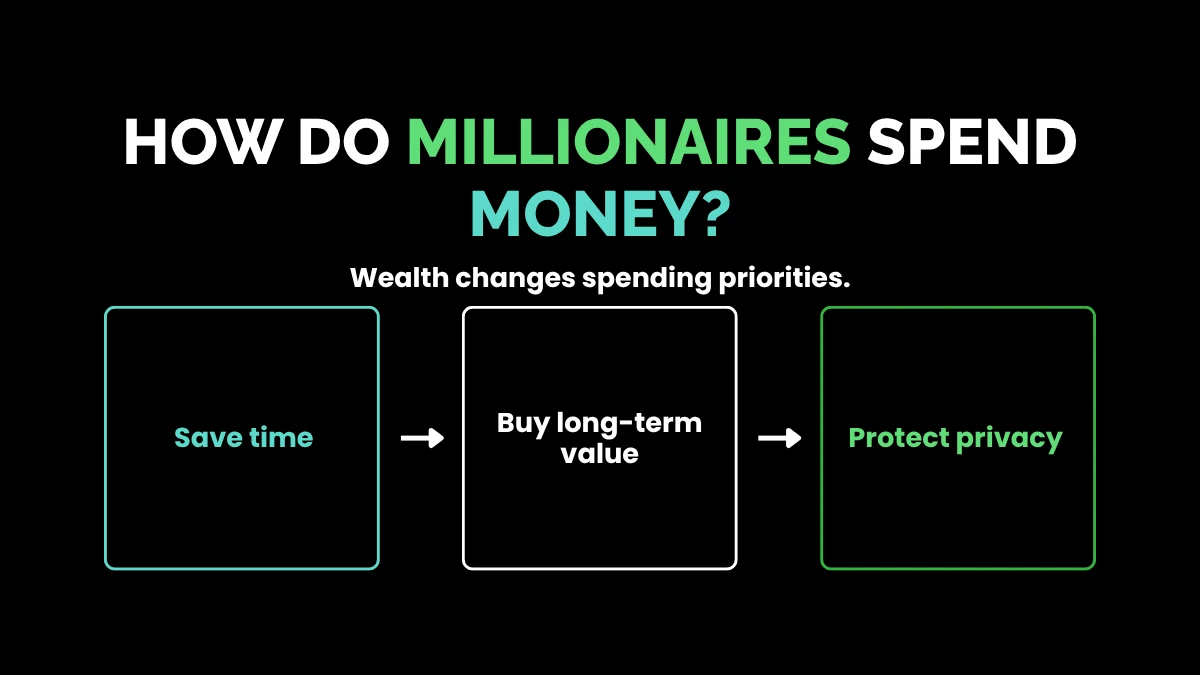
How millionaires spend money often surprises people. Rather than focusing only on luxury goods, many wealthy individuals prioritize purchases that protect their time, increase privacy, reduce daily responsibilities, preserve wealth, or provide access to unique assets that cannot easily be replicated.
Why Do Millionaires Spend Money Differently?
For most people, spending decisions are limited by income. For many millionaires, however, the challenge isn’t earning more money, it’s deciding where their attention is best spent.
Once basic financial needs disappear, time becomes the most valuable resource. That’s why many wealthy individuals willingly pay premium prices for services that eliminate everyday inconveniences.
Research highlighted throughout the luxury concierge industry shows that protecting attention has become one of the defining characteristics of modern wealth.
Instead of asking, “Can I afford this?”
Many millionaires ask, “Is this worth my time?”
That simple shift explains many of their unusual purchases.
Wealth Mindset vs. Consumer Mindset
| Average Consumer | Millionaire Mindset |
| Saves money by doing everything personally | Pays experts to save valuable time |
| Buys products | Buys systems |
| Focuses on price | Focuses on long-term value |
| Sees spending as an expense | Often sees spending as an investment |
| Prefers ownership | Sometimes prioritizes control over direct ownership |
This difference doesn’t mean every millionaire spends wisely. It simply shows that their financial decisions are often driven by opportunity cost instead of immediate savings.
10 Weird Ways Millionaires Spend Their Money
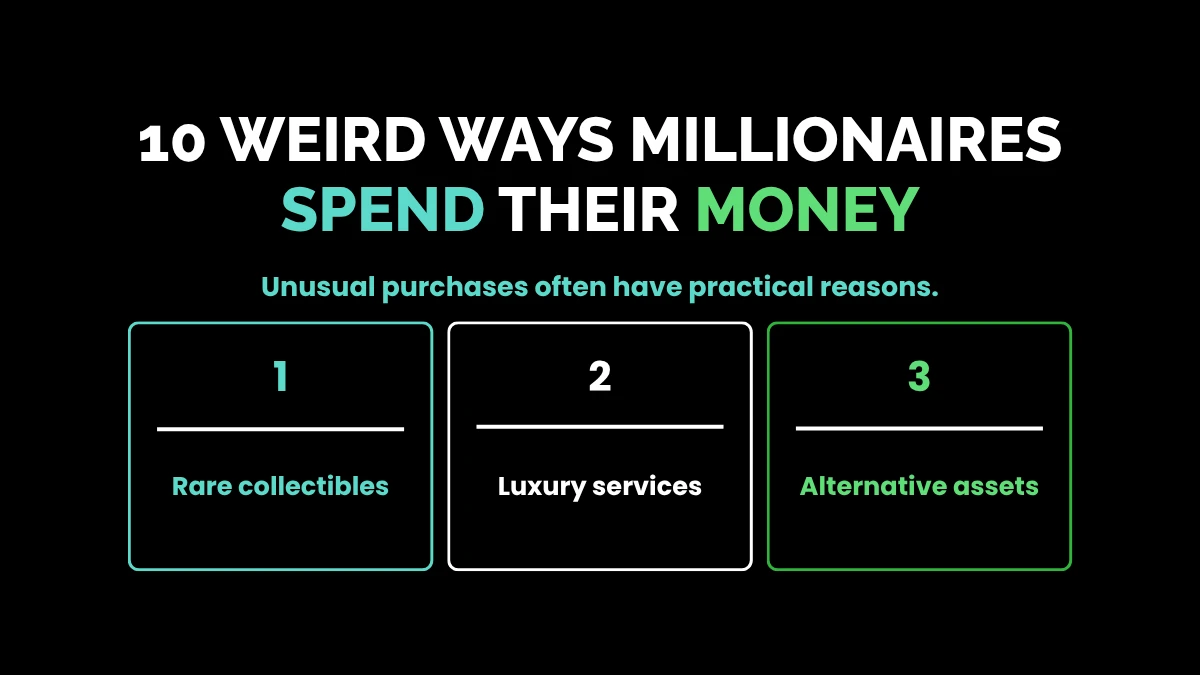
1. Hiring a Household Chief of Staff Instead of a Personal Assistant
One of the most surprising millionaire lifestyle habits isn’t buying another luxury car. It’s hiring someone whose entire job is managing every aspect of daily life.
Unlike a traditional assistant, a Household Chief of Staff coordinates estate managers, travel schedules, pilots, household employees, art collections, and service providers across multiple properties.
The goal isn’t luxury for its own sake.
It’s removing thousands of small decisions that consume mental energy.
The research describes this role as protecting the millionaire from “day-to-day logistical friction.” That allows them to focus on business, investing, or other high-value decisions instead of organizing everyday responsibilities.
Why It Makes Sense
If your time generates significant financial value, spending money to eliminate routine administrative work becomes easier to justify.
Lesson for readers: Even if you can’t hire a chief of staff, delegating repetitive tasks or automating routine work can free time for more meaningful activities.
2. Buying Dinosaur Fossils and Other Prehistoric Artifacts
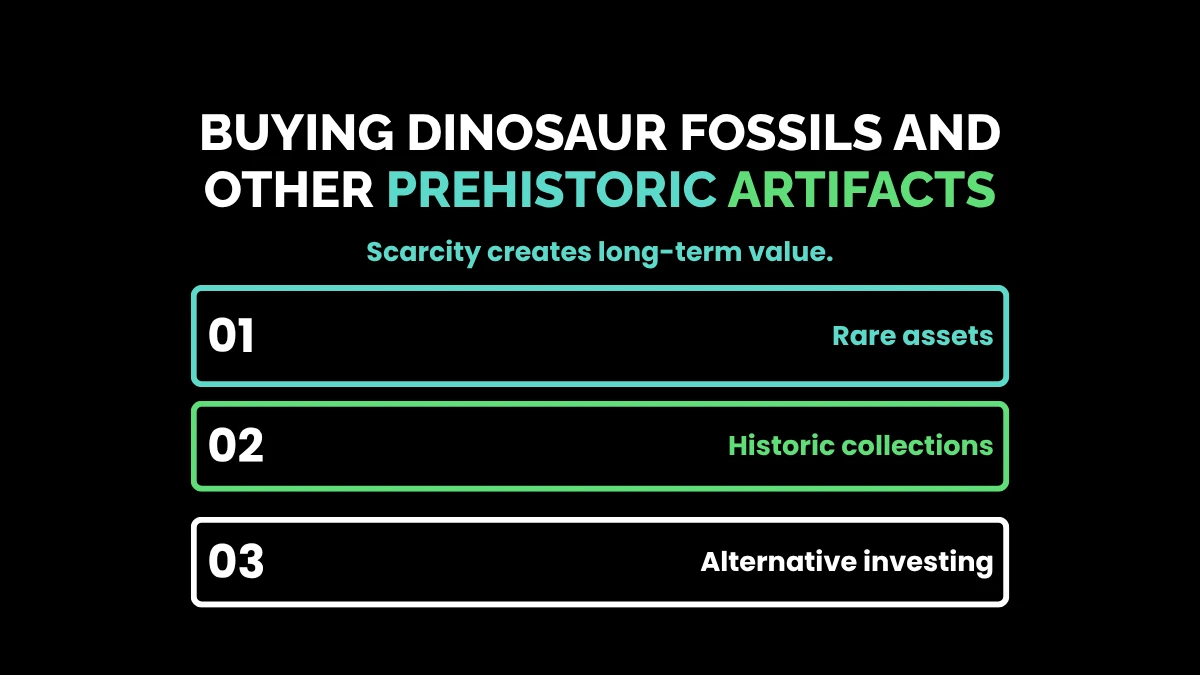
Among the most fascinating strange rich people purchases is the growing market for prehistoric fossils.
Instead of collecting paintings alone, some wealthy buyers purchase dinosaur skulls, meteorites, and ancient fossils because they represent something almost impossible to reproduce.
According to Sotheby’s and Christie’s, dinosaur fossils have become an established alternative asset class, with individual specimens selling for $250,000 to $6 million depending on rarity and condition.
Scarcity is the attraction.
Unlike luxury watches or cars that manufacturers can continue producing, prehistoric fossils are finite.
The Hidden Risk
Rare collectibles can appreciate over time, but they also carry legal risks.
The research highlights that illegally exported fossils have resulted in confiscations, even after buyers spent hundreds of thousands of dollars.
A famous example involved actor Nicolas Cage, who later surrendered a dinosaur skull after authorities determined it had been smuggled from Mongolia.
3. Cloning Beloved Pets
For many people, pets are family.
Some wealthy individuals have taken that emotional connection much further through commercial pet cloning.
According to ViaGen Pets, cloning a dog or cat typically costs between $50,000 and $85,000 depending on the procedure and preservation requirements.
While the cloned animal shares the same DNA, it doesn’t automatically develop the same personality.
Life experiences still shape behavior.
Singer Barbra Streisand famously cloned her beloved Coton de Tulear, showing how biotechnology has become part of luxury spending for emotional rather than financial reasons.
Practical Lesson
Not every unusual purchase is about status.
Sometimes it reflects how money allows people to solve deeply personal problems that most households simply cannot afford to address.
4. Buying Neighboring Homes Just to Tear Them Down
Imagine spending millions of dollars on a house…
…only to demolish it.
It sounds irrational until you understand the objective.
The research describes this practice as tactical proximity razing.
Instead of renovating the neighboring property, some wealthy homeowners purchase it to preserve privacy, eliminate future development, or maintain an uninterrupted view.
Luxury communities in Beverly Hills, Palm Beach, and London have reportedly seen increasing examples of this strategy during recent years.
From the outside, it appears wasteful.
From the owner’s perspective, the purchase protects something they consider even more valuable than money, personal space.
5. Traveling Without Packing Any Luggage
Packing is an inconvenience most travelers simply accept.
Some millionaires have eliminated it completely.
Companies specializing in wardrobe logistics photograph, catalog, climate-control, store, and ship clothing directly to hotels or private residences before the client arrives.
Rather than carrying multiple suitcases, the client simply selects outfits through a digital interface.
According to the research, Uovo has become one of the leading companies providing this type of luxury wardrobe management service after acquiring Garde Robe.
This approach reflects where millionaires spend money differently from the average traveler.
Instead of paying for bigger luggage, they pay to remove the task entirely.
Financial Insight
These services aren’t really selling clothing storage.
They’re selling convenience, consistency, and peace of mind.
Those three benefits explain many of the odd things rich people buy throughout their lives.
6. Keeping Expensive Assets Out of Their Personal Name
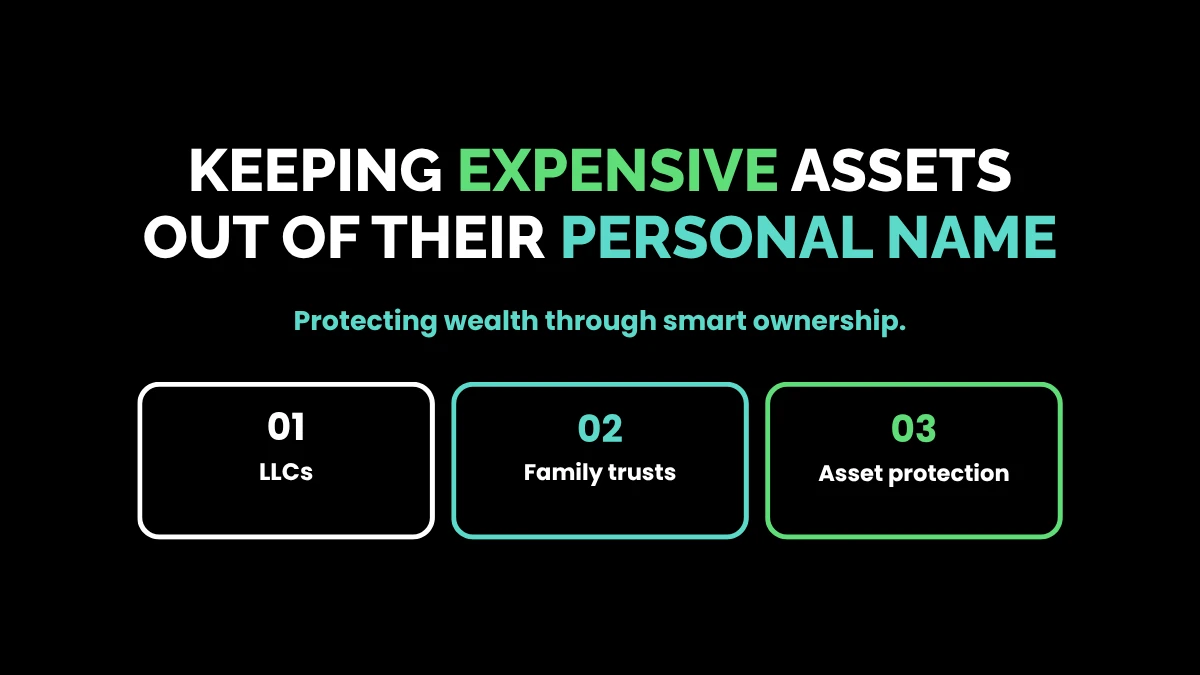
One of the least visible yet most strategic millionaire lifestyle habits is something you may never notice from the outside.
Many wealthy individuals don’t legally own their homes, luxury cars, yachts, or even aircraft in their personal names.
Instead, these assets are often held through Limited Liability Companies (LLCs), family trusts, or holding entities. The goal isn’t simply tax planning. It’s also about protecting privacy and reducing personal liability.
The research refers to this strategy as Structural Non-Ownership.
Although the millionaire controls the assets, the legal ownership sits within carefully designed business structures.
Why They Do It
Imagine owning several high-value properties spread across different countries.
Holding every asset personally can expose you to unnecessary legal risks and make ownership records easier to trace.
Using legal entities creates another layer of protection.
Future regulatory changes may increase transparency requirements, but this approach remains one of the most common wealth-protection strategies among high-net-worth families.
Practical Lesson
You don’t need millions to understand the principle.
Separating personal and business assets through appropriate legal structures is a strategy many entrepreneurs also use to reduce risk.
7. Building Indoor Snow Rooms
Most people install swimming pools.
Some millionaires install winter.
One of the most unusual examples in the research is the creation of indoor snow rooms that generate real snowfall inside private homes.
These climate-controlled spaces recreate freezing temperatures regardless of the weather outside.
The best-known example is Mukesh Ambani’s residence, Antilia, in Mumbai.
According to Architectural Digest, the 27-story property is valued between $1 billion and $2 billion and reportedly requires a staff of around 600 people to maintain a home occupied by only five family members.
The snow room is only one feature of a residence designed to create a completely customized living environment.
Why It Makes Sense
To many people, this seems excessive.
For ultra-high-net-worth individuals, however, personalization becomes another form of luxury.
Rather than adapting to their environment, they build environments that adapt to them.
8. Investing in Startups They Expect to Fail
Perhaps the biggest misconception about wealthy investors is that they only back “safe” opportunities.
Reality looks very different.
According to the Angel Capital Association, many angel investors allocate roughly 10% to 15% of their investment portfolios to extremely high-risk startups.
Research also shows that around 90% of these startups fail.
At first glance, those numbers seem alarming.
Yet the remaining successful investments can generate returns exceeding 2,000%, more than offsetting the losses across the portfolio.
The Real Strategy
Millionaires don’t expect every investment to succeed.
They expect the overall portfolio to succeed.
This mindset treats failure as part of a disciplined investment process rather than something to avoid entirely.
Common Mistake to Avoid
Many beginner investors assume every investment should be profitable.
Professional investors understand that consistent long-term success often comes from managing a portfolio instead of chasing perfect decisions.
9. Creating Libraries Filled With Books They May Never Read
One of the more surprising odd things rich people buy isn’t technology or jewelry.
It’s books.
Not necessarily to read.
Some wealthy homeowners hire specialists to design entire private libraries filled with carefully selected books that match a home’s architecture, history, or aesthetic.
The research even describes professionals who artificially age book spines so collections appear naturally built over decades.
While this may sound unusual, the purpose often extends beyond decoration.
A thoughtfully designed library communicates education, culture, and personal identity.
Financial Perspective
Unlike impulse luxury purchases, these collections become part of a property’s long-term character.
They also demonstrate that status isn’t always displayed through expensive gadgets or flashy vehicles.
Sometimes it is communicated through atmosphere.
10. Paying Millions to Protect Their Attention
When people imagine luxury spending, they often picture expensive watches or private jets.
The research suggests something different.
Many millionaires spend heavily on removing distractions from their lives.
Luxury concierge companies organize travel, household logistics, transportation, reservations, staffing, and countless everyday responsibilities before clients even think about them.
According to Grand View Research, the global concierge and lifestyle management market reached an estimated $4.2 billion, driven largely by demand from wealthy individuals outsourcing daily administration.
Instead of purchasing more possessions, they’re purchasing uninterrupted focus.
That may be the most valuable luxury of all.
Where Millionaires Spend Money vs. Where They Don’t
Understanding where millionaires spend money reveals an important pattern.
Many are willing to spend generously where they see long-term value while remaining surprisingly disciplined in areas that lose value quickly.
| Spend More On | Spend Less On |
| Time-saving services | Impulse purchases |
| Privacy and security | Trend-driven products |
| Investments | Short-lived status symbols |
| Education and expertise | Unnecessary daily luxuries |
| Rare assets | Rapidly depreciating items |
The lesson isn’t to copy every purchase.
It’s to notice how intentionally many spending decisions are made.
Self-Made vs. Inherited Millionaires
Although every wealthy person is different, spending priorities often vary depending on how wealth was accumulated.
| Self-Made Millionaires | Inherited Millionaires |
| Often prioritize business growth | More likely to preserve existing wealth |
| Comfortable with calculated risk | Greater focus on stability |
| Frequently invest in new opportunities | Often emphasize asset protection |
| Value productivity systems | May focus more on maintaining family wealth |
Neither approach is universally better.
The important takeaway is that financial background often shapes spending behavior just as much as income.
The Psychology Behind Millionaire Spending
Many unusual purchases become easier to understand once you recognize the principle of opportunity cost.
If one hour of a person’s time can generate significant financial value, spending money to avoid routine tasks becomes a rational decision.
The research repeatedly returns to the idea of attention protection.
Instead of treating money as something to save at every opportunity, man more time for meaningful work.
That’s a very different way of thinking about spending.
Millionaire Spending Myths vs. Reality
Many stereotypes about wealthy people don’t hold up when compared with actual spending patterns.
| Myth | Reality |
| Millionaires buy everything expensive. | Many spend selectively where they see long-term value. |
| Luxury always means showing off. | Privacy and convenience often matter more than visibility. |
| Rich people never lose money. | Many intentionally accept investment losses as part of portfolio strategy. |
| Every unusual purchase is wasteful. | Some purchases are designed to protect time, attention, or scarce assets. |
Looking beyond headlines gives a much clearer understanding of how wealth influences decision-making.
What Can You Learn From These Spending Habits?
Most readers will never buy a dinosaur fossil or install an indoor snow room.
That’s perfectly fine.
The valuable lesson isn’t copying millionaire purchases.
It’s understanding the thinking behind them.
You can begin asking different questions before making major purchases.
Will this save time?
Will it improve your life for years?
Does it create long-term value?
Or is it simply satisfying a temporary impulse?
Those questions cost nothing, yet they can influence your finances far more than any luxury purchase ever could.
Practical Implementation:
7 Millionaire Habits You Can Apply Today
You don’t need millions to adopt smarter spending habits.
Start with practical decisions that improve your financial life over time.
- Invest in learning before buying status symbols.
- Automate repetitive financial tasks whenever possible.
- Protect your time by outsourcing low-value work within your budget.
- Prioritize experiences and skills over short-lived trends.
- Review major purchases through the lens of long-term value.
- Build assets before increasing your lifestyle expenses.
- Treat every significant purchase as an investment in your future rather than a reward for the present.
These habits won’t make you wealthy overnight.
They will, however, encourage the kind of intentional decision-making that many successful people practice consistently.
Conclusion
Think back to the conversation I mentioned at the beginning, where someone assumed millionaires only spent their money on flashy cars and luxury vacations. After exploring the research, it’s clear that reality is far more interesting.
Learning how millionaires spend money isn’t about admiring extravagant lifestyles. It’s about recognizing that once financial survival is no longer a concern, priorities shift toward protecting time, reducing friction, preserving privacy, and owning assets that are genuinely scarce.
That doesn’t mean every unusual purchase is wise.
Some choices carry legal risks, others are highly illiquid, and many simply reflect personal preferences that don’t make sense for the average person. What matters is the thinking behind the spending, not the price tag attached to it.
The most valuable lesson isn’t that you should buy dinosaur fossils or clone your pet. It’s that intentional spending usually creates more long-term value than emotional spending. Whether your budget is $500 or $5 million, that principle never really changes.
Money changes what you can buy, but your priorities determine whether those purchases truly improve your life.
Frequently Asked Questions
How do millionaires usually spend their money?
Millionaires often spend differently from the average consumer because they value time, privacy, convenience, and long-term wealth preservation. Rather than purchasing luxury items simply for status, many invest in systems or services that reduce everyday responsibilities.
What do millionaires spend the most money on?
Although luxury purchases receive the most media attention, research suggests that many wealthy individuals spend heavily on investments, privacy, specialized services, and asset protection.
Why do wealthy people buy unusual things?
Many unusual purchases solve problems that most people never experience.
Once someone reaches significant wealth, saving an hour may become more valuable than saving a few thousand dollars. That changes the way spending decisions are made. Research also shows that rarity plays an important role. Dinosaur fossils, meteorites, and historic artifacts attract wealthy collectors because their scarcity cannot be reproduced.
Why do some millionaires buy neighboring houses?
Instead of renovating neighboring properties, some wealthy homeowners purchase them to protect privacy, preserve views, or prevent future development that could reduce the value of their primary residence. While this appears unusual, the decision reflects how privacy becomes increasingly valuable as wealth grows.
How much does pet cloning cost?
According to ViaGen Pets, commercial pet cloning generally costs between $50,000 and $85,000, depending on the species and preservation requirements. A cloned pet shares the same genetic material as the original animal, but personality is still shaped by environment and life experiences. For many wealthy owners, the decision is emotional rather than financial.
Why do millionaires invest in startups that often fail?
The Angel Capital Association explains that experienced angel investors frequently allocate around 10% to 15% of their investment portfolios to high-risk startups. Although roughly 90% of those companies may fail, the few successful investments can produce returns exceeding 2,000%, making the overall strategy profitable over time.
What is a Household Chief of Staff?
A Household Chief of Staff is much more than a personal assistant. This professional coordinates multiple estates, household employees, travel arrangements, contractors, luxury assets, and daily logistics so the client can focus on higher-value activities. The role exists primarily to reduce everyday decision-making and administrative friction.
Why do millionaires use LLCs and trusts to own assets?
Instead of holding expensive assets personally, many wealthy individuals place them inside LLCs, trusts, or holding companies to improve privacy, reduce liability exposure, and simplify long-term wealth management. Future regulations may require greater transparency, but these legal structures remain widely used.
Are all strange millionaire purchases good investments?
Some rare collectibles appreciate significantly because of scarcity, while others become difficult to sell due to limited buyer demand. The research also highlights legal risks involving illegally exported fossils and the illiquidity of highly customized luxury assets. Expensive purchases alone do not guarantee financial success.
Can ordinary people apply millionaire spending habits?
The goal is not to copy millionaire purchases but to adopt the underlying mindset. Prioritizing education, protecting your time, automating repetitive tasks, investing before upgrading your lifestyle, and making intentional purchasing decisions are habits that almost anyone can practice regardless of income.