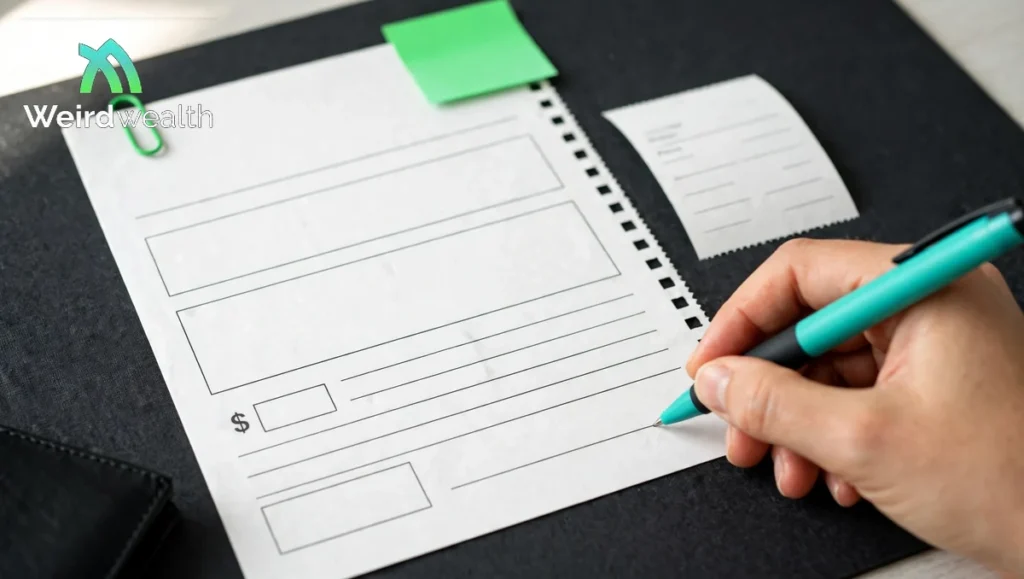
Wondering how to fill out a money order? Write the recipient’s full name, enter your name and address in the purchaser section, add a payment reference if needed, sign the designated signature line, and keep your receipt. It sounds simple, but filling in the wrong section can turn an ordinary payment into a frustrating afternoon.
Imagine you’re standing at the post office with a $750 money order in your hand.
You’re paying rent, and your landlord specifically requested a money order instead of cash.
Everything seems straightforward until you look at the form.
Pay to the order of. Purchaser. Address. Memo. Signature.
Hang on. Whose address goes where? Do you sign the front or the back? And what happens if you make a mistake?
These are reasonable questions, especially if you’ve never used a money order before.
The good news is that filling one out usually takes just a few minutes. You don’t need a complicated financial background or a bank account to understand the process.
At Weird Wealth, we’re interested in making everyday money decisions easier. And sometimes, financial confidence starts with knowing how to complete a small piece of paperwork correctly.
Key Takeaways
- Write the recipient’s full legal name in the Pay to the Order Of field.
- Enter your own name and mailing address wherever the form asks for purchaser information.
- Add an account number or payment reference when needed.
- Sign the purchaser’s signature field on the front if the money order requires it.
- Don’t sign the recipient’s endorsement section on the back.
- Keep the original purchase receipt in case you need to track, investigate, or request a replacement.
- Money order layouts vary between issuers, so follow the instructions printed on your specific form.
What Is a Money Order?
A money order is a prepaid payment instrument used to send a specified amount of money to another person or organization.
Unlike a personal check, which generally draws money from a bank account when it is processed, a money order is paid for when you purchase it.
For example, suppose you want to pay someone $500.
You visit an authorized money order seller, pay the $500 plus any applicable purchase fee, and receive a money order for that amount.
You then fill in the required information and deliver it to the recipient.
The recipient can present it for payment or deposit it, subject to the issuer’s and financial institution’s requirements.
Money orders are commonly used for rent, bills, personal payments, and situations where a recipient prefers a prepaid payment instrument.
They can also be useful for people who don’t have a conventional checking account.
However, a money order is not automatically safer in every situation. It can be lost, stolen, altered, or counterfeited, and recovery may be difficult once it has been cashed.
How to Fill Out a Money Order in 5 Easy Steps

The exact appearance of your money order depends on its issuer.
Western Union, USPS, and other providers may use different labels or layouts.
Still, most forms request similar information.
Step 1: Write the Recipient’s Full Name
Find the section labeled:
Pay to the Order Of, Pay To, or Payee.
This is where you enter the name of the person or business receiving the payment.
For example, if you’re paying rent to a company named Oakwood Property Management, write the company’s correct name as instructed.
Don’t enter your own name unless you are the intended recipient.
Double-check spelling before continuing.
An incorrect recipient name can cause problems when the money order is deposited or cashed.
If you’re unsure which name to use, confirm it with the recipient before writing.
Step 2: Enter Your Name as the Purchaser
Look for a field labeled:
Purchaser, From, Sender, or Remitter.
This section identifies the person purchasing and sending the money order.
Write your full name as required by the issuer.
For example:
Purchaser: Daniel Carter
The recipient and purchaser are different people in most ordinary transactions.
If you’re paying your landlord, your landlord or property management company is the recipient.
You’re the purchaser.
It sounds obvious once someone explains it, but this is one of the most common sources of confusion for first-time users.
Step 3: Add Your Mailing Address
Some money orders have a separate purchaser address section.
Others combine the name and address into one field.
Enter your current mailing address wherever the form requests the purchaser’s information.
If the form has a separate recipient address field, enter the recipient’s address there.
Don’t assume every field labeled Address belongs to the recipient.
Read the surrounding wording carefully.
For example, a field labeled Purchaser’s Address refers to you.
The address requirements can differ between issuers, so follow the directions printed on the form.
Step 4: Complete the Memo or Account Number Field
Many money orders include a field labeled:
Memo, Payment For, or Account Number.
This space allows you to explain what the payment is for.
Imagine a property management company receives hundreds of payments each month.
Your money order may have your name, but an apartment or account reference can help the company match the payment to the correct account.
You might write:
- November rent, Apartment 12B
- Invoice 1048
- Utility account 5678
- Security deposit
For some money orders, this section is optional.
For certain bill payments, however, the recipient may require an account number or identifying reference.
Only include information needed to process the payment. Avoid unnecessary sensitive information.
Step 5: Sign the Correct Line
Now comes the part many people worry about.
Where do you sign a money order?
If your money order has a purchaser signature line, sign that designated space on the front.
Do not sign the back unless you are the recipient endorsing the instrument according to the issuer’s instructions.
On many money orders, the back is reserved for the person receiving and cashing the payment.
For Western Union money orders, the sender is instructed to sign the front.
USPS money order designs differ, so follow the specific instructions on the postal form rather than assuming every money order has the same signature field.
Before handing over the money order, review everything you’ve written.
Example: How to Fill Out a Money Order for Rent
Let’s work through a realistic example.
Imagine you owe $850 in rent for November.
Your landlord manages the property through Oakwood Property Management.
Here’s how you might complete a money order that provides the relevant fields.
| Money order field | Example information |
| Pay to the Order Of | Oakwood Property Management |
| Purchaser | Daniel Carter |
| Purchaser’s Address | 125 Maple Street, Apt. 12B, Springfield, IL 62704 |
| Memo / Payment For | November Rent — Apt. 12B |
| Purchaser Signature | Daniel Carter |
| Money order amount | $850.00 |
<text color=”secondary” size=”sm”>This is a fictional example for educational purposes. Actual forms and address requirements vary.</text>
The most important detail is making sure the payment reaches the correct recipient and can be credited to the correct account.
If you’re paying rent, confirm the exact payee name and required payment reference with your landlord or property management company.
Also keep proof that the payment was delivered, not just proof that you purchased the money order.
Those are two different things.
How to Fill Out a Western Union Money Order
Western Union money orders have a recognizable set of fields.
According to Western Union’s published instructions, you generally need to:
- Enter the recipient’s name in the Pay to the Order Of section.
- Fill in the purchaser’s name and mailing address.
- Add a payment description or account number if necessary.
- Sign the designated space on the front.
- Keep the detachable receipt.
The Payment For/Acct. # field can help identify a bill, rental payment, or invoice.
Western Union also advises purchasers to retain the receipt because it contains information useful for tracking the money order.
A major point to remember: don’t sign the endorsement section on the back as the sender.
That area is generally intended for the recipient.
How to Fill Out a USPS Money Order
USPS money orders are available through participating U.S. Postal Service locations.
The USPS requires purchasers to complete the payee and purchaser name and address information on the money order and its customer receipt as applicable.
Some USPS designs differ from commercial money orders, including the location and presentation of customer information.
For that reason, don’t assume that a tutorial showing a Western Union form matches your USPS form exactly.
Before leaving the post office, verify:
- The dollar amount is correct.
- The payee’s name is accurately written.
- Purchaser information is completed as required.
- The customer receipt contains the necessary details.
- You have retained the receipt for your records.
USPS domestic money orders have a maximum face value of $1,000 per money order under its current published rules.
If your payment exceeds the permitted amount, ask the postal clerk how to complete it using an appropriate number of instruments.
What If You Make a Mistake on a Money Order?
This is where a little patience can save trouble.
Suppose you accidentally write the wrong recipient name.
Your first instinct might be to cross it out and write the correct one.
Don’t do that without checking with the issuer.
Alterations can cause a money order to be rejected or treated as suspicious.
Different issuers have different replacement and correction procedures.
For example, USPS provides procedures for replacing certain defective or spoiled money orders when the original instrument and matching receipt are returned.
Commercial money order issuers may require a separate request or investigation.
If you make a mistake, contact the original issuer or selling location.
Ask whether the instrument can be replaced and what documents are needed.
Avoid scribbling, using correction fluid, or attempting to conceal an error.
A clean replacement is generally preferable to an altered payment instrument.
The 30-Second Money Order Check: A Weird Wealth Framework
Here’s a simple original checklist you can use before handing over a money order.
We call it the 30-Second Money Order Check.
It focuses on five details that can prevent common mistakes.
1. Name
Is the recipient’s name correct and complete?
2. Amount
Does the money order show the exact amount you’re supposed to pay?
3. Identity
Have you filled in your purchaser name and address where required?
4. Reference
Does the recipient need an account number, apartment number, or invoice reference?
5. Receipt
Do you have the customer receipt safely stored?
These five checks take very little time, but they can prevent a surprisingly frustrating payment problem.
How Much Does a Money Order Cost?
Money orders generally involve a purchase fee in addition to the amount you want to send.
For example, if you purchase a $300 money order and the location charges a hypothetical $2 fee, you would pay $302 in total.
The recipient receives a $300 money order.
The extra $2 is the purchase fee.
Fees vary depending on the issuer, location, payment amount, and applicable rules.
USPS and Western Union publish their own policies, while individual retail agents may have different terms.
Check the exact price at the point of purchase instead of relying on an old fee chart.
Where Can You Buy a Money Order?
In the United States, money orders may be available through several types of authorized sellers.
Common options include post offices, participating financial institutions, and retail agents offering money order services.
Some Western Union locations also issue money orders.
Availability differs by branch.
Before traveling, check whether your intended location sells money orders and which payment methods it accepts.
Many sellers accept cash or qualifying debit cards, but policies vary.
Don’t assume you can purchase one with a credit card.
Can You Fill Out a Money Order Online?
Traditional paper money orders are generally purchased through authorized physical locations.
Western Union’s U.S. guidance, for example, directs customers to participating agent locations for money order purchases.
Some financial services allow digital money transfers, but those aren’t necessarily the same product as a paper money order.
If someone asks for a money order as payment, confirm whether they specifically require a physical instrument.
Don’t substitute an unrelated online transfer without the recipient’s agreement.
What Happens After You Send a Money Order?
Once you’ve completed the money order, you can give it to the intended recipient or send it using an appropriate delivery method.
If mailing it, consider a trackable service when proof of delivery matters.
The recipient then follows the applicable cashing or deposit procedures.
Keep in mind that purchasing a money order does not prove that the recipient received it. Likewise, delivery confirmation doesn’t necessarily prove that the payment was credited to the correct account. For important obligations such as rent, retain both the money order receipt and any available delivery or payment acknowledgment. Keeping clear financial records and maintaining financial transparency in relationships can also help prevent misunderstandings about shared expenses. Different generations may have different approaches to managing these responsibilities, as explored in our article on millennials, Gen Z, and baby boomers.
The Difference Between a Money Order and a Cashier’s Check
Money orders and cashier’s checks are both used for payments where ordinary personal checks may not be preferred.
But they aren’t identical.
| Feature | Money order | Cashier’s check |
| Issuer | Authorized money order provider | Bank or credit union |
| Funding | Generally prepaid | Funds obtained by issuing financial institution |
| Typical availability | Post offices and participating retail or financial locations | Banks and credit unions |
| Maximum amount | Often limited by issuer | Depends on institution and policies |
| Purchase fee | May apply | May apply |
| Fraud risk | Counterfeits are possible | Counterfeits are also possible |
| Replacement process | Depends on issuer | Depends on bank and applicable rules |
Neither payment method should be treated as automatically immune to fraud.
The appropriate choice depends on the amount, recipient requirements, fees, and your available financial services.
Money Order Scams You Should Know About

Let’s talk about an unpleasant but important reality.
Money orders can be counterfeited.
And one of the most common scams involves someone sending a fake money order for more than the amount owed.
Imagine you’re selling a used camera for $200.
A supposed buyer sends you a $700 money order.
They apologize and ask you to deposit it, then send back the extra $500.
It looks like an easy transaction.
But the money order may be counterfeit.
Even if your bank initially makes funds available, the instrument can later be returned as fraudulent. You could then owe the bank the money you withdrew or transferred. The Consumer Financial Protection Bureau explains this risk in its guide to overpayment scams involving counterfeit checks and money orders. Never send back an overpayment to an unfamiliar buyer based on the assumption that a deposited money order has cleared permanently.
How to Protect Yourself
If you receive a suspicious money order:
- Contact the issuer through its independently verified official channels.
- Ask your bank or credit union how to proceed.
- Don’t transfer money back to an unfamiliar sender.
- Don’t rely on a payment screenshot as proof.
- Check relevant security features without assuming visual inspection is enough.
- Report suspected counterfeit instruments to the appropriate authorities.
USPS provides an official money order verification system for postal money orders.
Verification procedures differ for other issuers.
What to Do If a Money Order Is Lost or Stolen
If a money order disappears before the recipient receives it, contact the issuer promptly.
You may need the receipt, serial number, purchase amount, date, and other identifying details.
Depending on the issuer and status of the instrument, you may be able to request an investigation or replacement. However, refunds aren’t always immediate or guaranteed.
For USPS money orders, the customer receipt is especially important when filing certain claims or inquiries. The USPS guide to replacing lost, stolen, or damaged money orders explains how to start an inquiry and request a replacement.
A money order that has already been cashed may be more complicated to recover.
That’s why I recommend treating the receipt like an important financial document rather than another piece of paper to throw away.
Frequently Asked Questions
How do you fill out a money order correctly?
Enter the recipient’s full name, complete your purchaser name and address, add any required payment reference, sign the designated purchaser signature line if provided, and retain the receipt.
Who is the purchaser on a money order?
The purchaser is the person who buys the money order and sends the payment. If you’re buying a money order to pay rent, you’re the purchaser.
Do you sign the front or back of a money order?
On a Western Union money order, the purchaser signs the designated area on the front. The back is generally reserved for recipient endorsement. Other issuers have different layouts, so follow your particular form’s instructions.
Do you have to put your address on a money order?
Many issuers require purchaser address information. Complete the fields requested on your form and follow the issuer’s instructions.
What do you put in the memo section of a money order?
You can enter a short payment description, apartment number, invoice number, or account reference. The field may be optional, but the recipient may require particular information to identify the payment.
Can you leave the recipient’s name blank?
It’s safer to complete the recipient information promptly and accurately. A blank or improperly completed money order creates avoidable risks if the instrument is lost or stolen.
Can you cross out a mistake on a money order?
Don’t alter a money order without instructions from its issuer. Contact the seller or issuing company to ask about correction or replacement.
How do you fill out a money order for rent?
Write the landlord’s or property management company’s correct payee name, enter your purchaser information, include the apartment or payment reference when required, and retain the receipt.
Does a money order expire?
Rules vary by issuer and jurisdiction. Some money orders may remain payable for long periods, while service charges or other conditions may apply. Check the terms printed on the instrument and with the issuer.
Final Thoughts
Filling out a money order shouldn’t feel like solving a financial puzzle.
Once you know which information belongs where, the process becomes straightforward.
Write the correct recipient name. Complete your purchaser details. Include a useful reference. Sign only where you’re supposed to sign. And please, keep that receipt.
It’s easy to overlook the little things when you’re in a hurry, but payment mistakes can create much more work than taking another minute to check the form. The same attention to detail matters when handling financial information for other tasks, such as using AI for market research to organize information, compare options, and make more informed decisions.
Disclaimer
At Weird Wealth, we spend plenty of time exploring unconventional ways to earn, save, and manage money. Yet understanding everyday financial tools is just as valuable.
Because sometimes being good with money isn’t about a clever investment or a new side hustle.
It’s about making sure the money you’ve already earned reaches the right person without unnecessary complications.