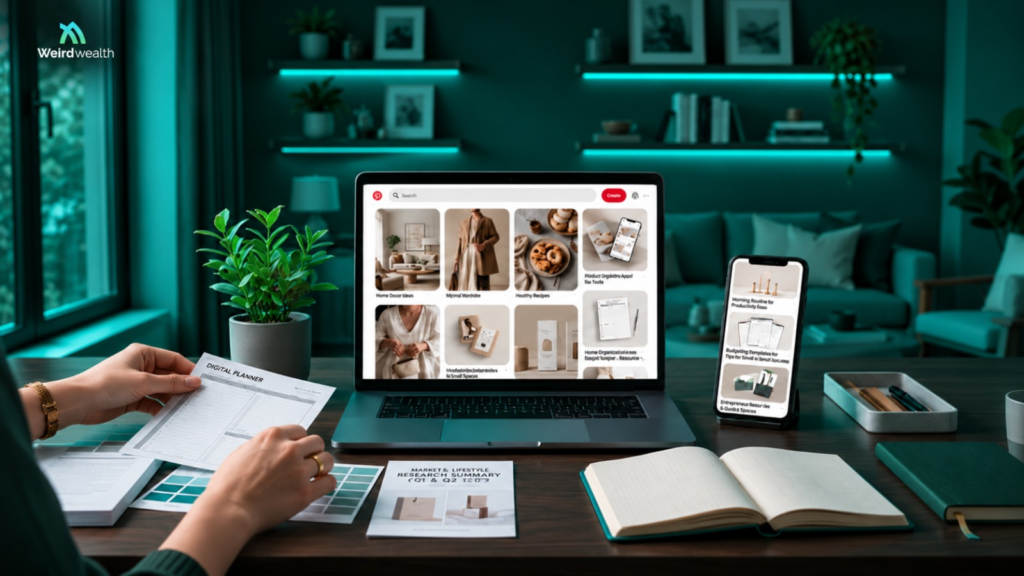
If you’re wondering how to make money on Pinterest, you can use the platform to attract visitors to a blog, promote eligible affiliate products, sell your own digital or physical products, secure brand partnerships, or find clients for a creative service. Pinterest does not automatically pay creators for views, saves, or followers. The money usually comes from a business activity connected to the content you publish.Imagine designing a beautiful home office on a modest budget.
You find a desk that fits perfectly into a small room, discover some clever storage ideas, and create a visual guide explaining how everything works together.
Then you publish that guide on your website.
You design an attractive Pin featuring the finished workspace and share it on Pinterest.
Someone searching for home office inspiration discovers your Pin, visits the article, and reads your recommendations.
Perhaps they purchase a product through a clearly disclosed affiliate link.
Maybe they buy your original workspace planning template.
Or they remember your design skills and contact you about a future project.
That’s the real opportunity.
Pinterest can connect useful content with people who are actively exploring ideas.
But a Pin is not a paycheck.
At Weird Wealth, we love internet business ideas that make sense beyond impressive screenshots. So let’s look at the actual revenue models, how to build a useful Pinterest presence, and the numbers that separate attention from income.
Key Takeaways
- Pinterest doesn’t directly facilitate payments for affiliate commissions or brand partnerships; those arrangements are handled with the relevant partners.
- A free Pinterest business account provides access to business features and analytics.
- Affiliate marketing, digital products, blogs, services, and sponsorships are possible monetization paths.
- Pinterest views and impressions don’t automatically translate into website visits, purchases, or earnings.
- Original, useful content has a stronger business purpose than publishing large numbers of repetitive promotional Pins.
- Pinterest requires commercial content and affiliate relationships to be disclosed appropriately.
- Consistent topic relevance and a good destination page matter more than chasing generic viral content.
- Monetization takes testing, patience, and a clear understanding of conversion rates and costs.
Does Pinterest Pay You for Views?
This is the first misconception worth clearing up.
Pinterest does not provide a universal payment simply because a Pin receives views.
Its official creator guidance explains that payments associated with affiliate links, product tagging, and brand partnerships are arranged directly with the relevant affiliate or brand partners.
That means a Pin with 100,000 impressions might generate no income.
Another Pin with far fewer impressions might attract several qualified buyers to a useful product.
The difference is intent.
Someone browsing attractive images may enjoy the content without purchasing anything.
Someone searching for a specific organizational template may be closer to buying.
So instead of asking how many impressions you can generate, ask what useful action your content helps someone take.
Seven Ways to Make Money on Pinterest
1. Promote Affiliate Products

Affiliate marketing allows eligible publishers or creators to earn commissions when qualifying purchases or other specified actions result from their referrals.
Imagine maintaining a blog about home organization.
You publish a detailed guide comparing different storage arrangements.
Your Pinterest content highlights useful ideas from the article.
Readers can visit the full guide, learn about the options, and follow clearly disclosed affiliate links where appropriate.
The affiliate provider determines eligibility, commission terms, attribution, and payment schedules.
Pinterest’s commercial content policy requires affiliate content to be original, useful, transparent, and free from manipulative behavior.
This isn’t permission to flood boards with repetitive affiliate links.
Best for: Creators who can explain products accurately and build trust.
Main challenge: Generating qualified traffic that results in legitimate conversions.
2. Drive Traffic to a Blog
A blog offers space for information that won’t fit into a single Pin.
For example, a Pin might introduce a guide to affordable bedroom organization.
The full article could explain measurements, material options, common mistakes, and a practical checklist.
Your website may generate income through eligible advertising, affiliate relationships, products, or services.
But Pinterest traffic doesn’t guarantee advertising approval or revenue.
The website must also provide genuine value.
A thin page containing almost nothing except monetized links is unlikely to build a durable audience.
3. Sell Digital Products
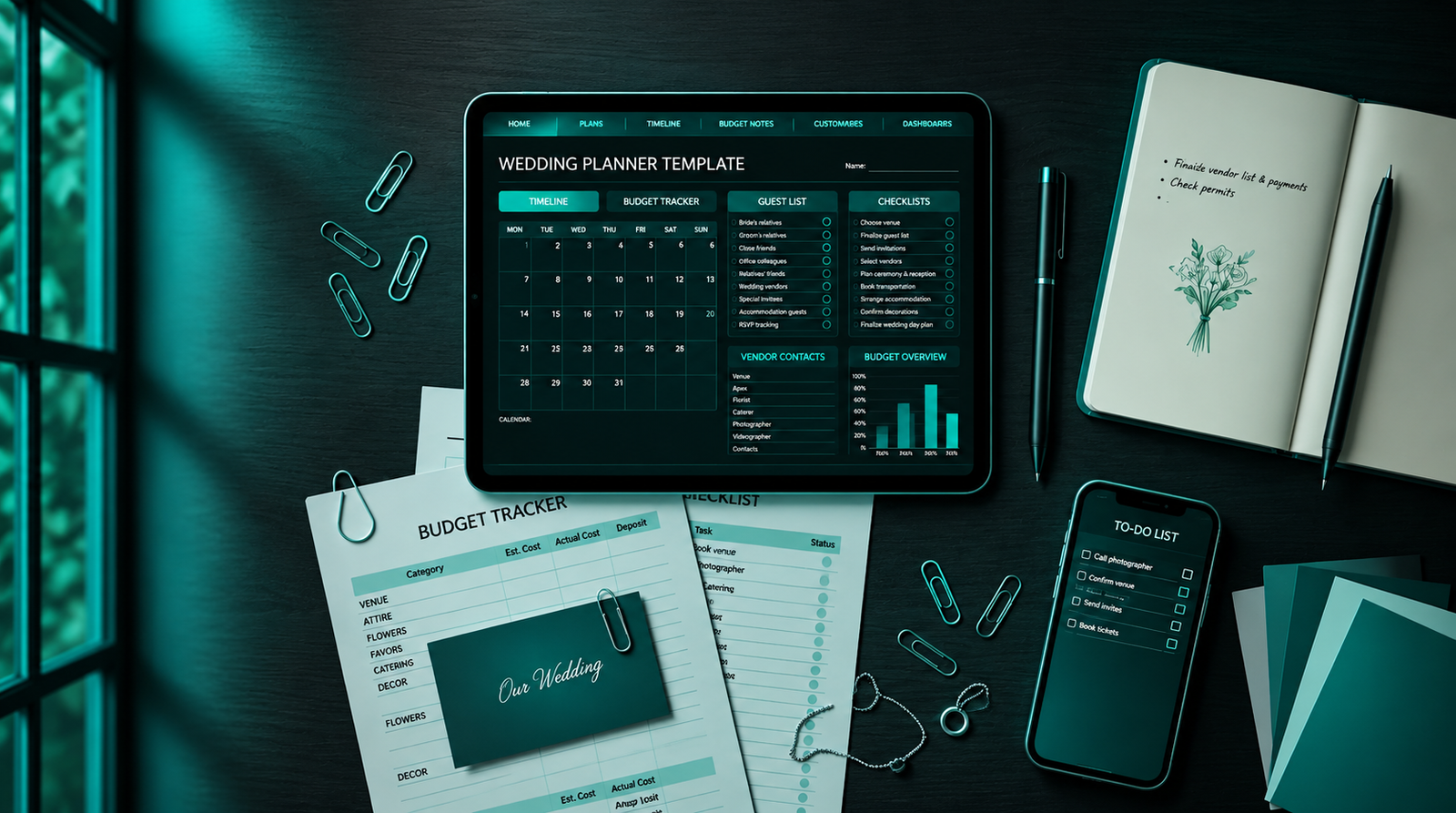
Digital products can include original planners, printable checklists, educational templates, or design files.
Suppose you create a wedding planning spreadsheet.
You publish Pins demonstrating how the template works.
Interested users visit a product page to learn about its features and price.
If they purchase, the sale generates revenue.
The appeal is that digital delivery doesn’t require physical shipping.
The challenge is persuading people that your product solves a real problem.
You’ll still need to handle refunds, product updates, customer support, and platform terms.
4. Sell Physical Products
Businesses selling suitable physical goods can use Pinterest to help customers discover products and ideas.
A furniture retailer might publish room styling examples.
A stationery shop could share desk organization photographs.
A handmade ceramics business might show how its products fit into different interiors.
The Pin introduces the idea, while the purchasing process happens through the supported shopping experience or a relevant website.
Inventory, fulfillment, returns, and customer service remain part of the business.
Pinterest doesn’t remove those responsibilities.
5. Find Clients for Creative Services

You don’t need to sell a physical or digital product.
Your portfolio itself can attract prospective customers.
Imagine offering wedding invitation design.
You create Pins showing original designs, color combinations, and typography concepts.
Someone planning a wedding discovers your work.
They visit your portfolio and inquire about a custom design.
You earn money if a legitimate service agreement results.
This can suit photographers, interior designers, graphic designers, and other professionals whose work is strongly visual.
But use genuine examples of your own work rather than presenting someone else’s designs as your portfolio.
6. Work With Brands on Sponsored Content
Brands sometimes collaborate with creators to produce promotional content.
Pinterest offers a paid partnership labeling feature for eligible creators.
Its official documentation explains that brand partnerships are arranged outside Pinterest, and creators can tag the relevant business when publishing qualifying content.
However, the ability to use a tool isn’t a guarantee of receiving sponsorship offers.
Brands may evaluate audience fit, content quality, business objectives, and campaign requirements.
Sponsored content also needs appropriate advertising disclosures.
7. Offer Pinterest Management Services

Some businesses want help organizing their Pinterest presence.
A service provider might research relevant search terms, create original Pins, organize boards, analyze performance, or manage a publishing calendar.
This can become a monthly business service.
But it requires actual platform knowledge, creative ability, and clear responsibilities.
Don’t promise guaranteed traffic or sales.
A professional service agreement should define deliverables, publishing frequency, account access, reporting, and payment.
Which Pinterest Monetization Model Is Most Suitable?
| Model | Where revenue comes from | Main challenge |
| Affiliate marketing | Eligible referral commissions | Conversions and program terms |
| Blogging | Website ads, products, or other monetization | Useful content and visitor quality |
| Digital products | Product purchases | Customer demand |
| Physical products | Product sales | Inventory and fulfillment |
| Creative services | Client contracts | Turning interest into inquiries |
| Brand partnerships | Sponsor agreements | Finding suitable partners |
| Pinterest management | Service fees | Consistent client delivery |
For beginners who already run a blog, Pinterest may function as an additional discovery channel.
For designers, it may act as a portfolio.
For sellers, it may introduce customers to products.
The correct model depends on what you’re offering—not merely whether you enjoy making attractive Pins.
How to Set Up Pinterest for Business
Pinterest provides free business accounts with analytics and other business-oriented features.
You can create a new business account or, where supported, convert an existing personal account.
Once you’ve completed setup, focus on four things.
A Clear Profile
Describe what people can expect.
A profile about small-space interior design should communicate that focus rather than listing ten unrelated money-making topics.
Relevant Boards
Organize content around subjects your audience understands.
For example, a home organization publisher might have boards focused on bedroom storage, small kitchens, and workspace ideas.
Original Pins
Create clear visuals that accurately represent your content.
The image and text should help users understand what they’ll find after clicking.
Useful Destinations
If a Pin links to an article or product, make sure the destination delivers on the promise.
Someone clicking “Small Kitchen Storage Ideas” shouldn’t land on an unrelated sales page.
How Does Pinterest SEO Work?
Pinterest has search and discovery functions.
Users look for ideas using topics, descriptions, and queries.
A useful content strategy begins with understanding what your audience is searching for.
For example:
“Small balcony garden ideas” describes a concrete interest.
“Beautiful things” is much less specific.
You can use relevant terms naturally in Pin titles, descriptions, boards, and destination content.
But keyword repetition alone doesn’t produce quality.
The visual should be relevant.
The linked resource should be helpful.
And the overall account should have a coherent subject.
Pinterest’s policies discourage artificial manipulation, spam, and low-value affiliate posting.
A sustainable strategy prioritizes useful content over volume for its own sake.
The Weird Wealth PIN Framework
Here’s our original method for evaluating whether a Pinterest content idea has a realistic path toward revenue.
We call it the PIN Framework.
P: Problem
What does the viewer want to solve?
Perhaps they’re looking for a wedding checklist or ideas for decorating a small bedroom.
If the Pin addresses no clear interest, monetization will be harder to explain.
I: Intent
What is the viewer likely to do next?
Someone searching for inspiration may want photographs.
Someone searching for a printable budget template might be interested in a downloadable product.
Understanding the difference helps you match content with the appropriate destination.
N: Next Step
What useful action can someone take after viewing your Pin?
Read a guide?
Explore a product?
Download a template?
Contact a service provider?
The next step should benefit the user rather than simply push them toward a transaction.
This framework keeps the focus on a useful customer journey.
How Much Money Can You Make on Pinterest?
There is no reliable fixed amount for each Pin or thousand impressions.
Let’s explore three hypothetical examples.
Example One: Affiliate Marketing
Suppose your Pins generate 2,000 visits to a useful product guide in one month.
Assume 2% of those visits result in qualifying purchases.
That means 40 purchases.
If your average qualifying commission is $4, the resulting commission would be:
40 × $4 = $160
These are fictional assumptions.
Actual conversion rates and commissions vary, and some referrals won’t qualify.
Example Two: Digital Products
Suppose your Pinterest activity leads to 500 relevant visitors reaching your digital product page.
If 3% purchase a $20 template, that’s 15 sales.
Gross revenue would be:
15 × $20 = $300
Transaction fees, refunds, customer support, taxes, and product-development costs reduce the final return.
Example Three: Service Inquiries
Imagine a designer receives 12 inquiries connected to Pinterest activity.
Two become customers paying $250 each.
Gross revenue is $500.
But the work must still be delivered, and some inquiries require significant unpaid communication.
The interesting lesson is that a relatively small number of qualified inquiries may be commercially valuable.
Why Impressions Are Not Income
Let’s compare two hypothetical Pins.
| Metric | Pin A | Pin B |
| Impressions | 100,000 | 20,000 |
| Outbound clicks | 500 | 800 |
| Purchases | 5 | 20 |
| Average earnings per purchase | $4 | $4 |
| Total earnings | $20 | $80 |
Pin A receives five times the impressions.
But Pin B earns four times as much under these assumptions.
Why?
Because more viewers take relevant actions.
This doesn’t mean impressions are useless.
They can help you understand distribution and awareness.
But they shouldn’t be confused with earnings.
A profitable Pinterest strategy connects discovery to a genuinely useful destination.
Can You Make Money on Pinterest Without a Website?
Potentially.
Certain affiliate arrangements, supported shopping features, and brand partnerships may not require you to operate a full website.
But eligibility depends on Pinterest rules, the affiliate program, your location, and the nature of the commercial relationship.
You can also use Pinterest as a portfolio and direct potential customers to an appropriate business contact channel.
A website can provide more control over your content, branding, and customer experience.
But it also creates responsibilities involving hosting, maintenance, privacy, and relevant legal disclosures.
Choose based on your business model rather than assuming every beginner must immediately purchase a domain.
How Long Does It Take to Earn Money on Pinterest?
There is no dependable timetable.
A creator with an established product and audience may see results more quickly than someone beginning with a new account and no content library.
Some accounts attract views without generating meaningful revenue.
Others find that their content performs better after they clarify topics and improve destination pages.
A useful first goal is to validate the path from content to customer action.
Can you create Pins that attract relevant visitors?
Does the destination help them?
Do any visitors make purchases or inquiries?
Those questions provide more useful information than expecting a particular income after thirty days.
Pinterest Affiliate Marketing Rules You Should Know
Pinterest’s commercial guidelines require transparent disclosures and prohibit manipulative affiliate behavior.
The FTC also explains that affiliate relationships should be disclosed clearly and conspicuously when a recommendation could earn the creator a commission.
A disclosure needs to be understandable to ordinary readers.
For example, a concise statement explaining that you may earn commissions from qualifying purchases is clearer than relying solely on an unfamiliar abbreviation.
Avoid copying product descriptions without adding value.
Don’t disguise commercial links.
And don’t use fake accounts to amplify your Pins.
A trustworthy recommendation should help someone choose—even if they don’t buy anything.
Five Pinterest Mistakes That Can Prevent Earnings
Publishing Without a Revenue Model
Beautiful Pins may attract attention without creating a commercial opportunity.
Decide how your content relates to a product, service, or useful destination.
Choosing Overly Broad Topics
A profile covering everything from yachts to children’s homework may struggle to communicate who it serves.
Focused content helps develop an identifiable audience.
Ignoring the Landing Page
An excellent Pin cannot compensate for a broken, misleading, or difficult-to-use website.
Posting Repetitive Promotional Content
Excessive repetitive affiliate posting can create poor user experiences and violate platform policies.
Expecting Guaranteed Returns
Pinterest distribution, traffic, and sales depend on many factors.
No fixed number of Pins guarantees income.
A 30-Day Pinterest Income Experiment
Week One: Choose Your Niche
Select a subject connected to a real product, service, or existing website.
Identify specific questions people want answered.
Week Two: Prepare Useful Content
Create several original resources or product pages.
Make sure they genuinely solve the problems promised by your Pins.
Week Three: Publish Relevant Pins
Create clear visuals and accurate descriptions.
Link to appropriate destinations, and include commercial disclosures where necessary.
Week Four: Review Performance
Look at impressions, outbound clicks, relevant inquiries, conversions, and costs.
Identify which topics attract the most useful engagement.
Refine your content based on what you learn.
A month of testing won’t prove that an account can generate dependable income.
But it can help reveal whether your idea has a plausible commercial path.
Frequently Asked Questions
How do beginners make money on Pinterest?
Beginners can explore affiliate marketing, digital products, blogs, product sales, and creative services. The first step is choosing something useful to offer and creating relevant content.
Does Pinterest pay you for views?
No. Pinterest doesn’t automatically pay creators for Pin views or impressions.
How many followers do you need to make money on Pinterest?
There is no universal follower count guaranteeing income. Commercial results depend on the monetization method, eligibility, audience interest, and conversions.
Can you make $1,000 a month on Pinterest?
It’s possible through an effective business model, but it’s not guaranteed. Reaching that amount requires enough profitable sales, commissions, sponsorships, or service contracts.
Can you make money on Pinterest without showing your face?
Yes. Original product photography, graphics, tutorials, and other useful visuals can support certain business models without featuring the creator’s face.
Is Pinterest affiliate marketing allowed?
Pinterest permits affiliate content subject to its rules, including originality, transparency, and restrictions on manipulative behavior. Individual affiliate programs may impose additional terms.
Is Pinterest passive income?
Not entirely. Creating content, maintaining websites or products, reviewing analytics, and serving customers require work.
Do you need a business account?
A business account provides analytics and access to relevant creator and business features. Pinterest says eligible creators need a business profile to access its paid partnership tools.
Final Thoughts
Pinterest is an interesting platform because it begins with curiosity.
Someone wants to decorate a room.
Plan a celebration.
Find a recipe.
Organize their finances.
Or discover a product that solves a small problem.
Your opportunity is to contribute something genuinely helpful to that search.
Not simply post an attractive picture and hope money appears.
At Weird Wealth, we believe the strongest online businesses are built around an honest exchange of value.
Give people useful information.
Help them make better choices.
Offer something worth paying for.
And measure whether the business actually works.
Pinterest can help people discover your work, but the real money comes from the value waiting on the other side of the Pin.
That’s where a beautiful image becomes the beginning of a meaningful business.