
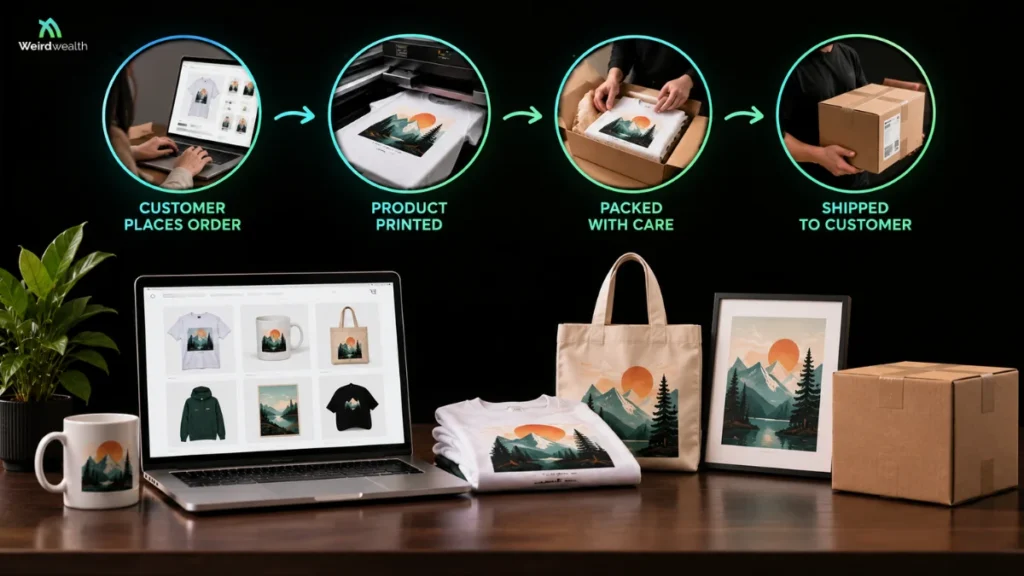
Print on demand’s genuinely changed how a lot of people think about starting an online product business. Instead of buying hundreds of shirts, mugs, posters, or whatever else before you even know if they’ll actually sell, you get to create designs first and have the products made only after a customer’s already placed an order.
That said, you still need a clear niche, products people actually want, strong branding, pricing that makes sense, and a customer experience that genuinely feels trustworthy. This guide from Weird Wealth breaks down how print on demand actually works and what it really takes to approach it without any illusions.
What Actually Is Print on Demand?
Print on demand, usually just called POD, is a business model where nothing gets made until a customer actually orders it. You create or license a design, pick which products you want to sell, and connect your store to a production partner who handles the rest.
When someone buys something, that order gets sent over to your POD provider. From there, they print the design, pack it up, and ship it straight to the customer. You typically don’t have to keep any physical inventory at home, and you’re definitely not managing the printing yourself. Shopify actually describes this as a model where sellers focus on design, branding, marketing, and the customer experience, while a supplier quietly handles the production and fulfillment side of things.
Worth remembering though, the supplier’s still charging you for production and fulfillment. And on top of that, you’ve got platform fees, payment processing, marketing, and whatever other business costs show up along the way.
Key Takeaways
- Print on demand means products only get made once someone actually orders them.
- You cut down on upfront inventory risk, sure, but the business costs don’t disappear entirely.
- Picking a focused niche makes design and marketing decisions a lot easier down the line.
- Original designs and proper commercial rights aren’t optional, they’re essential.
- Always research your suppliers, and order samples yourself whenever you can.
- Work out the full cost before you ever set a selling price, not after.
- Good customer service still matters, even when a supplier’s handling all the fulfillment.
- Check marketplace rules regularly, including anything around production partner disclosures.
- Long term success really comes down to product value, branding, marketing, and actual customer demand, not just uploading design after design and hoping something sticks.
How Does Print on Demand Work?
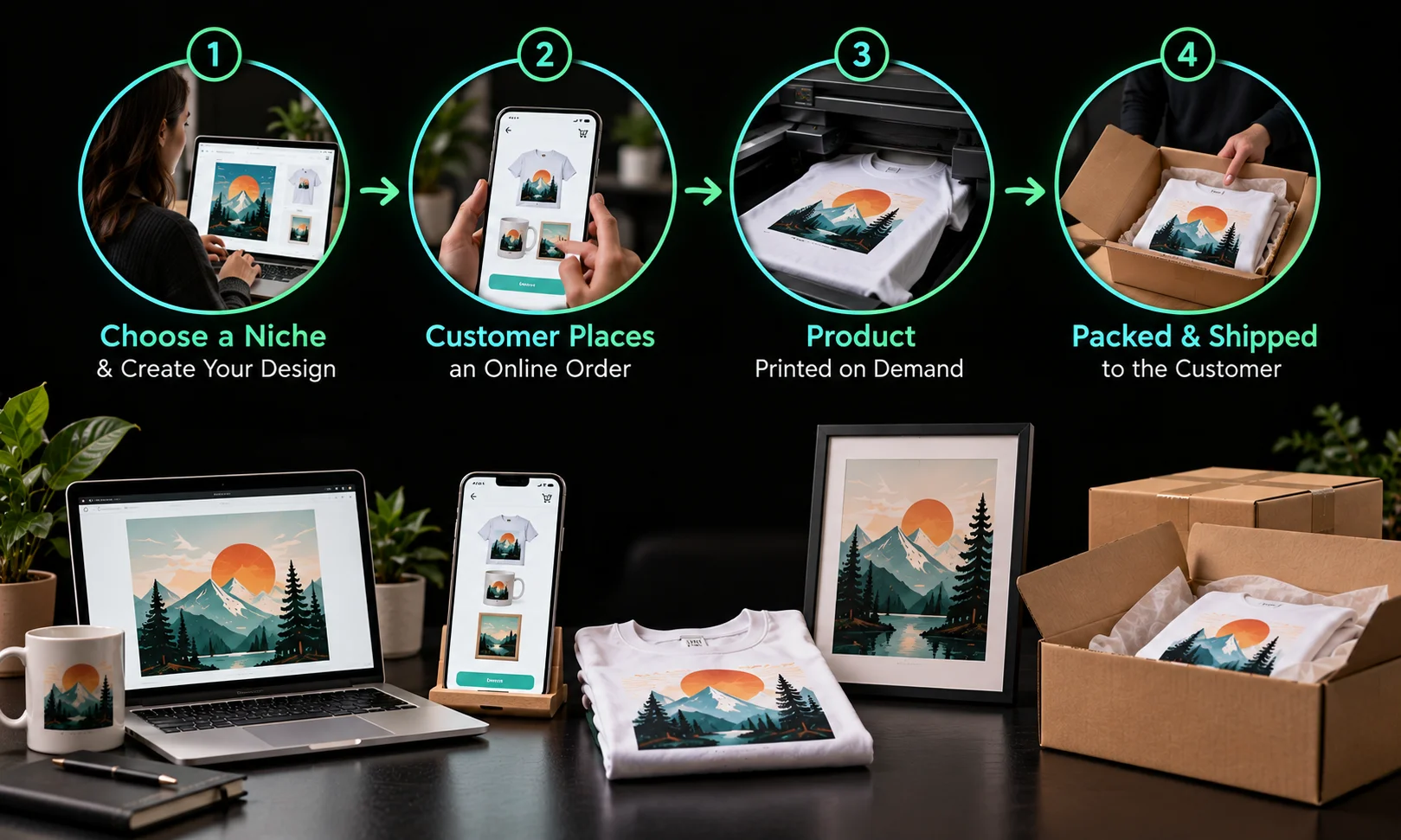
1. Pick a Specific Niche
Not everyone. That’s the trap most people fall into right away. Go narrow instead. Hobbies. Professions. Pets. Sports. A specific kind of humor, even. Doesn’t matter what, just pick something.
Why? Because once you know who you’re actually talking to, everything gets simpler. Design gets simpler. Marketing gets simpler. You stop asking “what should I print” and start asking something way more useful. What would this exact group actually want on their wall, or their shirt, or their mug.
2. Create Original Designs
This is a big part of why someone picks you over the next guy selling almost the same thing.
Doesn’t need to be complicated. Simple beats busy most of the time, especially when it’s aimed at one specific audience instead of trying to please everybody.
One thing though. If you’re grabbing artwork, fonts, photos, anything that’s not yours, check you actually have rights to use it commercially. And just skip protected logos or characters entirely. Doesn’t matter how popular they are right now. Not worth the legal trouble.
3. Choose Your Products
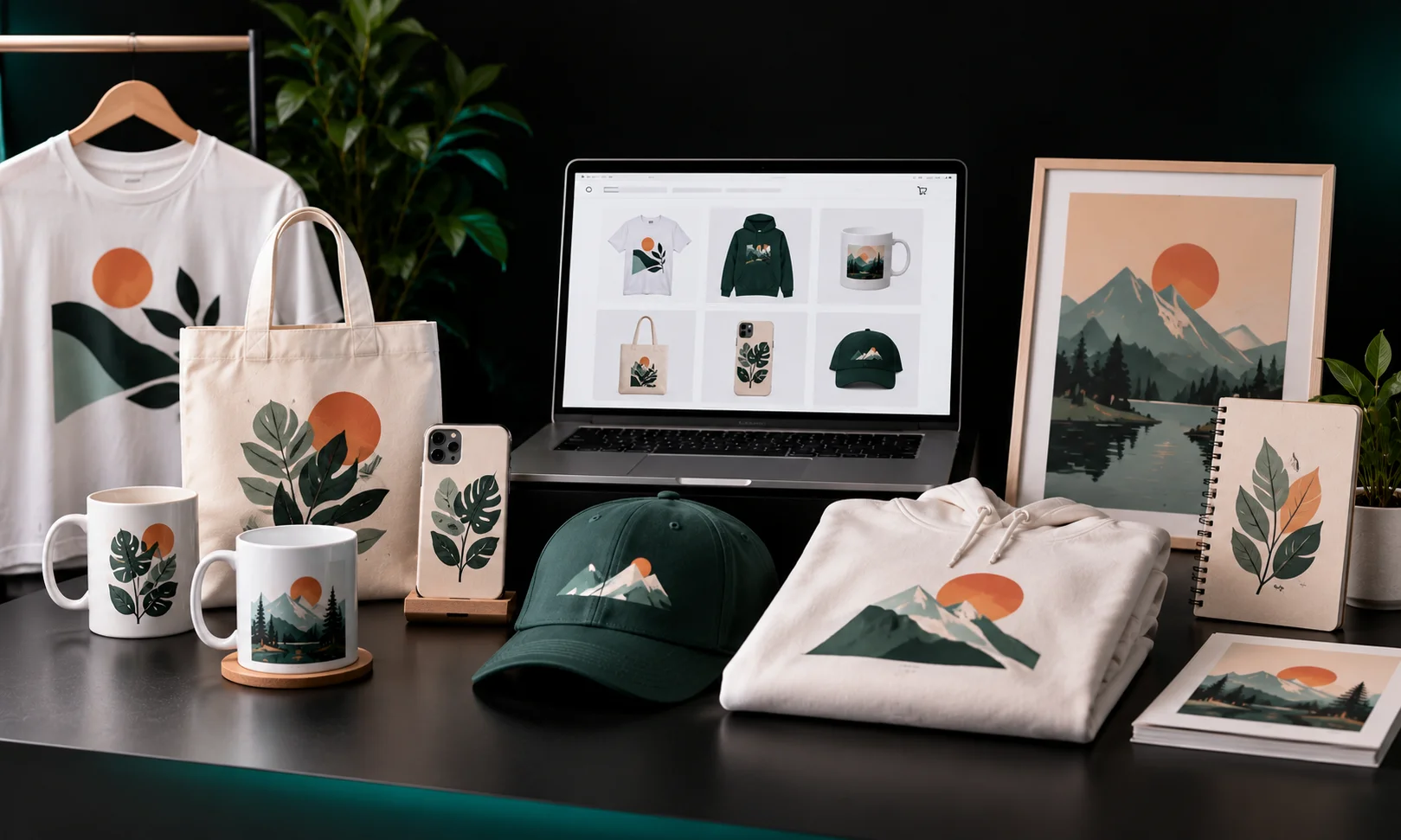
Clothing, mugs, stationery, wall art, home stuff- there’s a lot to pick from. Start small though. A tight handful of products that make sense together beats dumping thirty random unrelated items into your store on day one.
4. Set Up Your Store and Supplier
Your store’s where customers actually find your products and place orders. Your POD provider handles everything physical after that: the printing, packing, and shipping.
Before you commit to any supplier, look into their product quality, printing methods, which regions they ship to, delivery timelines, return policies, integrations, and base costs. Ordering a few samples yourself is genuinely one of the smartest moves you can make, so you actually know what you’re selling before a customer sees it first.
5. Actually Market the Brand
A great design doesn’t just bring people to your store on its own. You still need an actual plan for reaching the people who’d want it.
Search focused product pages, social media, email marketing, working with creators, and paid ads can all play a real part here, depending on your niche and budget.
Why Do People Choose Print on Demand?
The biggest attraction is lower inventory risk. Traditional product businesses may need to purchase stock before they know how much will sell. With POD, products can be produced after orders arrive.
It can also be easier to test ideas. You can publish a limited collection, observe customer response, and improve your range without being stuck with a large quantity of unsold inventory.
Another advantage is flexibility. A small team or solo creator can manage the brand, while a fulfillment partner takes care of printing and shipping. This lets the owner spend more time on designs, marketing, customer support, and product research.
What Are the Main Challenges?
Print on demand removes some traditional business problems, but it does not remove business risk.
Lower Profit Margins
Because a third party produces and fulfills each order, your cost per product can be higher than buying products in bulk. Your selling price must leave enough room for production, platform fees, payment processing, marketing, refunds, and other expenses.
Quality and Fulfillment Depend on Your Supplier
Customers see your brand when something arrives at their door, even if another company printed and shipped it. A poor print, damaged item, or delayed shipment can affect your reputation.
That is why samples, supplier research, and clear customer communication matter.
Designs Need a Reason to Exist
Uploading hundreds of generic designs is not a strong strategy. Customers need a reason to notice your product.
How to Make Print on Demand More Profitable
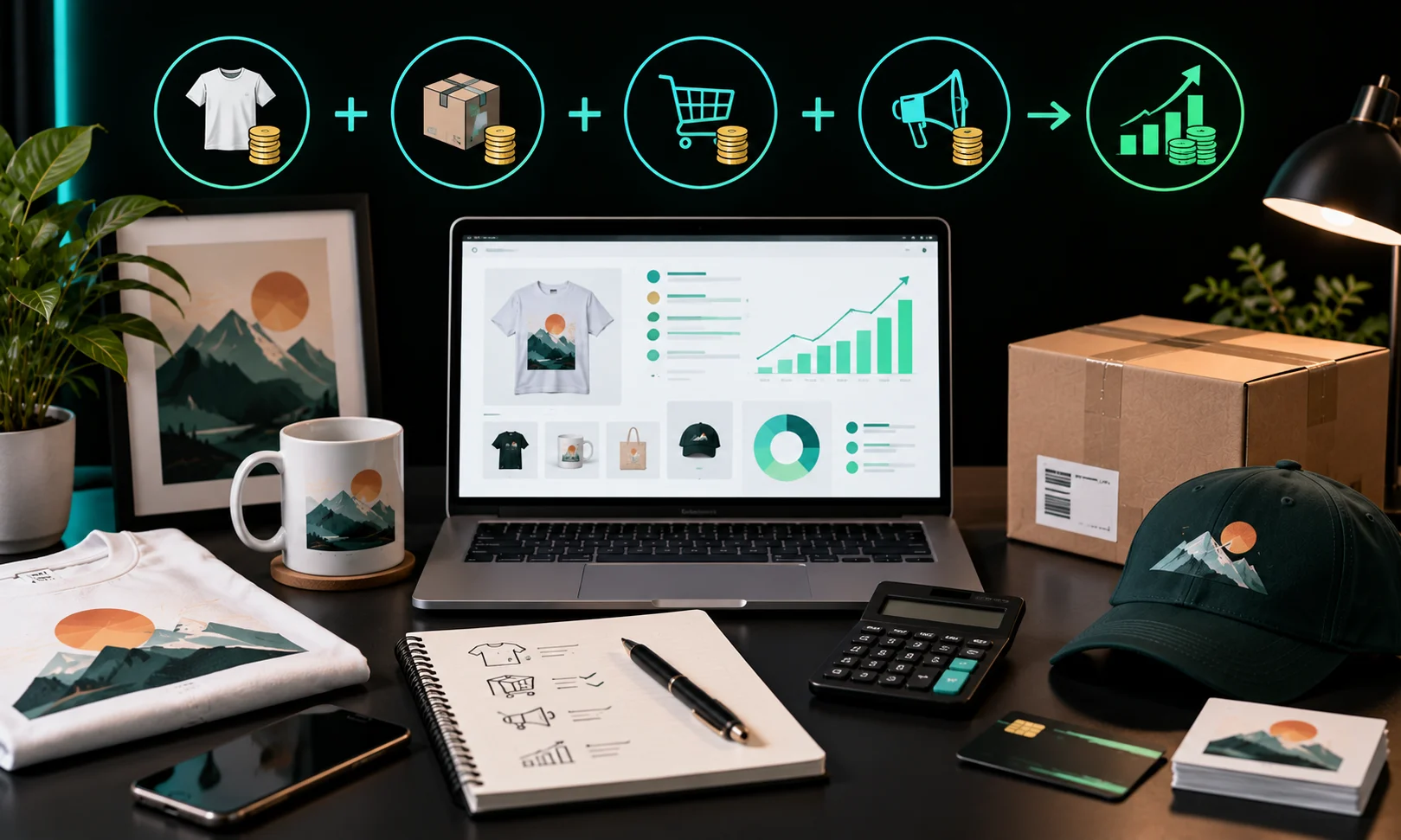
Profit starts with the numbers, not just the design. Before listing a product, calculate your expected selling price and subtract the product cost, fulfillment charges, marketplace or store fees, payment costs, and planned advertising expense. The remaining amount is not automatically pure profit because taxes, refunds, discounts, software, and other costs may still apply.
Pricing should also match the value of the product and the expectations of your target audience. Shopify recommends considering market pricing while accounting for supplier costs and the value of customization.
You should also watch which products and designs receive attention. If one collection attracts more clicks or sales, learn from that response rather than continuing to produce everything equally.
Print on Demand and Etsy
Etsy can be one possible sales channel for original POD products, but sellers need to follow its current rules. Etsy’s seller policy says listings must accurately represent how an item was made and who was involved. If a seller works with a production partner, that partner must be disclosed in relevant listings.
Do not present a third-party-produced product as though you personally manufactured it if that is not the case. Always check the marketplace’s current policies before listing products.
How to Build Trust
A print on demand article or store worth reading, or trusting, needs to actually show real experience, real expertise, real authority, and genuine trustworthiness, not just recycle the same generic advice everyone else is already saying.
For Weird Wealth, that means actually explaining the model clearly, being honest about the costs and risks involved, steering clear of income promises nobody could realistically back up, and separating practical guidance from stuff that’s really just assumption dressed up as fact. Product pages need to hold up too, with accurate descriptions, real sizing info, honest shipping expectations, and clear return details wherever that applies.
Google’s own guidance leans heavily on people first content, clear authorship, genuinely useful original information, and presentation you can actually trust. They’ve also said E-E-A-T is a useful way to think about content quality overall, with trust standing out as probably the most important piece of that whole equation.
Final Thought
Print on demand’s best thought of as a flexible way to test and build an actual product brand, not some shortcut to instant income. The tech can handle a lot of the production and fulfillment side, sure, but at the end of the day, customers still decide whether your ideas are worth their money.
Start small. Actually understand your audience. Create products that have a clear purpose behind them. Check your numbers carefully; don’t just guess. And keep improving based on how real customers actually respond, not what you assume they’ll like.
That whole approach gives print on demand a much stronger foundation to actually grow sustainably. It also helps you build something around real customer needs instead of chasing whatever trend’s popular this week. Keep your brand message consistent. Review how things are performing regularly. And cut products that stop making sense for your audience as time goes on.
Over time, useful feedback ends up guiding better designs, smarter product choices, and a tighter, more focused store overall. The goal was never to have the biggest catalog out there. It’s building a small collection people actually remember and trust.
Frequently Asked Questions
Is print on demand still worth doing?
It can be, if you’ve got a clear niche, genuinely strong product ideas, and a realistic marketing plan behind you. It’s not guaranteed income though, and the competition out there can be pretty brutal.
Can I actually start with barely any money?
You can get going with relatively low upfront inventory costs, since products usually only get made after someone orders. That said, you’ll probably still spend on store fees, samples, design tools, marketing, and the usual business expenses that pop up.
Do I need to actually be a good designer for this?
Not really. You need ideas customers actually value more than you need advanced design skills. You can create simple designs yourself, or work with a designer, just make sure you’ve actually got the rights to use whatever gets made commercially.
What kinds of products tend to do well?
The usual suspects, T-shirts, hoodies, mugs, posters, tote bags, hats, phone cases, notebooks, and other customizable stuff people like to personalize.
How much can you actually make doing this?
There’s no fixed number here, honestly. It all comes down to your selling price, what the product and fulfillment actually cost, fees, marketing spend, how many orders you’re getting, refunds, and whether customers actually want what you’re selling.
Is this actually passive income?
Not really, no. Fulfillment can run on autopilot, sure, but research, design, branding, marketing, customer support, pricing, and just managing the store still take real, ongoing work.