

Key Takeaways
-
Instant property transfer without probate delay
-
Works for joint bank accounts and real estate
-
Beats standard wills in legal priority
-
Automatic ownership rights for surviving owners
Introduction
Have you ever wondered what actually happens to your joint bank account or shared home if something unexpectedly happens to your co-owner?
It is a common question that leaves many families feeling totally confused and anxious.
The good news is that the legal mechanism handling this situation is surprisingly straightforward once you break it down.
The right of survivorship is a legal arrangement that automatically passes full ownership of an asset directly to the surviving co-owner when one owner passes away.
This arrangement completely bypasses the costly and lengthy court probate process.
Whether you share a basic checking account with your spouse or co-own real estate with a partner, understanding this rule gives you total peace of mind.
Here at Weird Wealth, we love sharing simple financial strategies that protect your family, save money, and cut through confusing legal jargon.
Let us dive right into how this powerful asset rule works in daily life.
AI Overview
The right of survivorship gives joint owners automatic full ownership of an asset if the co-owner dies. It applies to bank accounts and property, bypassing probate court entirely. This rule overrides instructions in a traditional will, making asset transfer seamless, fast, and stress-free for surviving family members or business partners in most cases.
What Is the Right of Survivorship?
To get started, let us look closely at a clear right of survivorship definition to see how it operates in real-life estate scenarios.
In basic terms, a right of survivorship definition centers on automatic legal transfer between two or more joint property owners.
When you co-own an asset under this title, every owner holds an undivided equal share in the whole property while living.
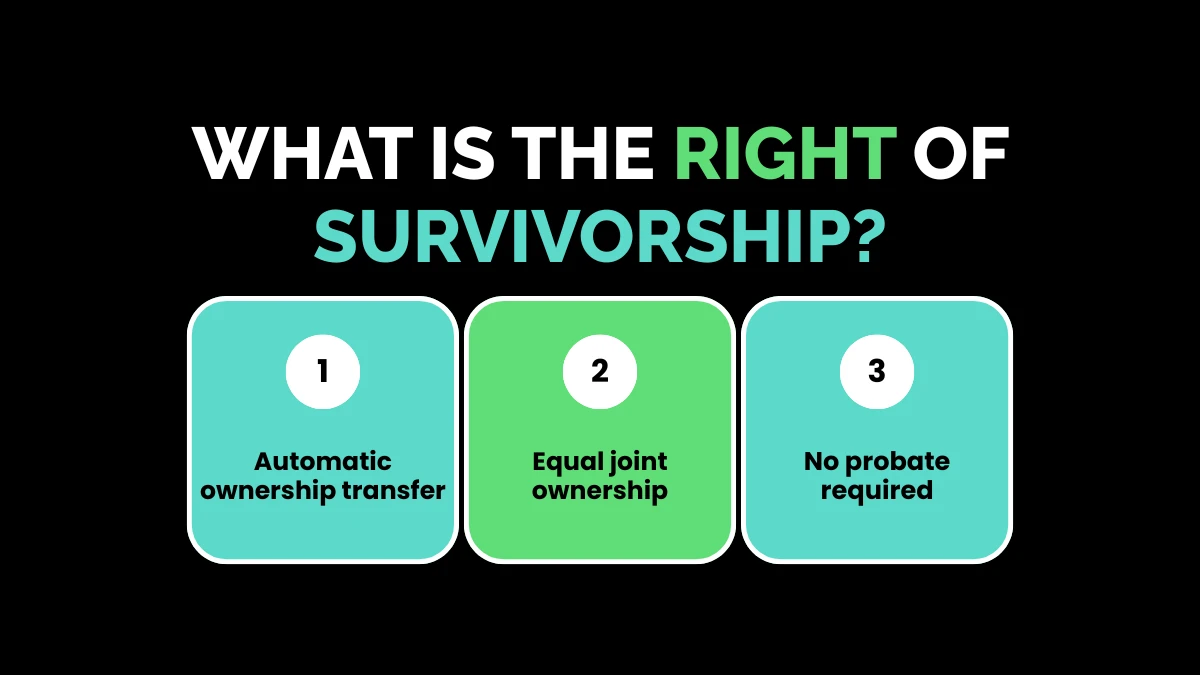
When one owner dies, their financial share does not go to their heirs or get processed through an estate executor.
Instead, their ownership interest simply dissolves automatically on death.
The remaining surviving owner instantly becomes the sole owner of the entire account or property.
| Ownership Status | Living Owners | After First Owner Passes |
| Joint Tenancy | Equal 50/50 shared access | 100% sole owner automatically |
| Legal Status | Active co-owners | Immediate single owner |
| Court Intervention | None needed | None needed |
Because the ownership shift happens instantly at the moment of death, the asset never becomes part of the deceased person’s formal estate.
That means probate judges, court administrators, and estate lawyers do not get involved in transferring the title.
It is one of the cleanest legal tools available for seamless asset transfers.
How Joint Account Survivorship Rights Work
Setting up a shared checking or savings account with a family member is very common today.
However, many people open these accounts without fully grasping how joint account survivorship rights protect their money behind the scenes.
When you establish joint account survivorship rights at your financial institution, both account holders have full equal rights to deposit and withdraw money.
If one partner dies, the surviving account holder keeps uninterrupted access to every dollar in that account.
What Happens at the Bank?
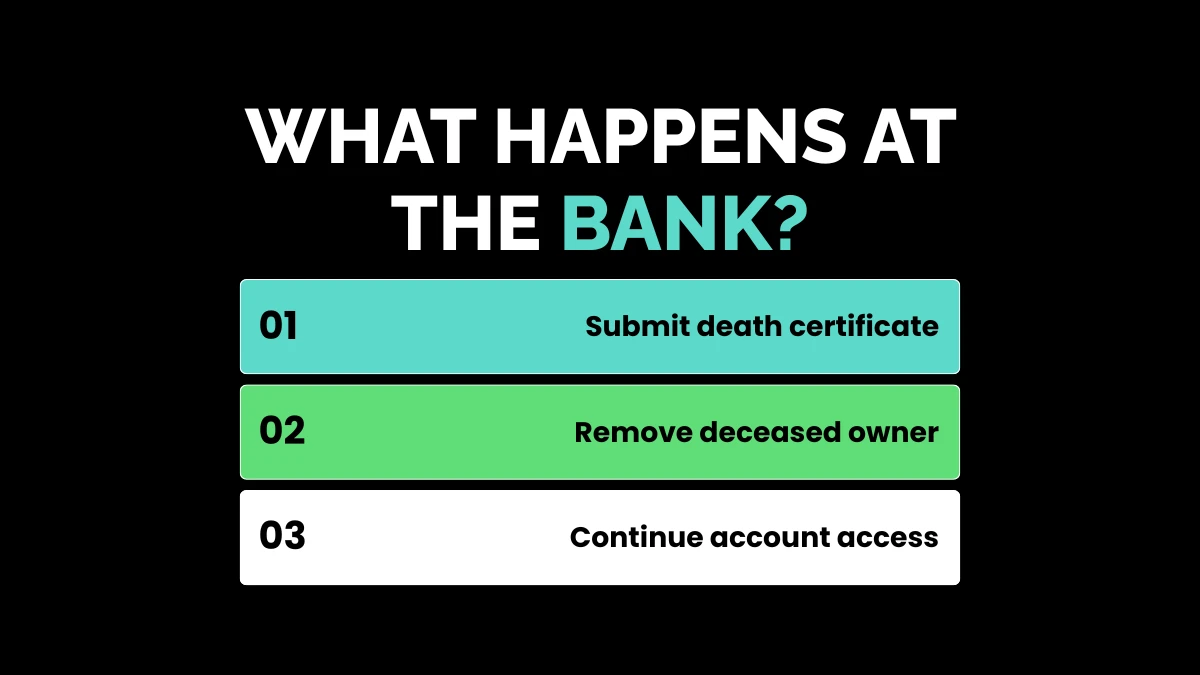
The real-world process at your local bank branch could not be simpler for the surviving co-owner.
The survivor visits the bank and submits an official certified copy of the death certificate.
The bank officer verifies the document and removes the deceased individual’s name from the master account records.
| Step | Action Required | Result |
| 1. Notification | Present death certificate to the bank | Bank verifies official records |
| 2. Name Removal | Bank updates title registration | Deceased name removed from account |
| 3. Account Access | Survivor assumes 100% control | Uninterrupted access to all funds |
There is no waiting period, no court fee, and no legal freeze placed on your checking or savings balance.
Your daily household bills, mortgage payments, and urgent funeral expenses can be paid without any financial delay or court paperwork.
Right of Survivorship vs Beneficiary: Key Differences
People frequently mix up these two popular estate planning methods when organizing their accounts.
While both options allow your funds to skip the probate court process, they operate under completely different legal mechanics.
Understanding right of survivorship vs beneficiary options helps you decide which title arrangement fits your personal financial goals.
The fundamental contrast in right of survivorship vs beneficiary setups comes down to lifetime control versus future inheritance.
A co-owner with survivorship privileges possesses full legal access to the funds right now while you are alive.
Conversely, a designated beneficiary has zero legal rights or access to your balance until after you pass away.
| Key Feature | Right of Survivorship | Designated Beneficiary (POD / TOD) |
| Lifetime Access | Immediate shared ownership rights | Zero access during account owner’s life |
| Control Balance | Shared equal withdrawal rights | Owner retains 100% single control |
| Debt Liability | Exposed to co-owner’s personal debts | Protected from beneficiary’s creditors |
| Primary Purpose | Married couples and joint property owners | Single account owners naming heirs |
| Will Override | Always overrides instructions in a will | Overrides will if properly registered |
If you want your spouse to co-manage money today, joint account survivorship rights make total sense.
However, if you want full control over your money today while ensuring your adult child inherits it later, a beneficiary designation is usually wiser.
At Weird Wealth, we always encourage people to analyze these key differences before adding anyone as a joint owner.
Real Estate and Property Survivorship Rights
Real estate represents the most valuable purchase most families will ever make during their lifetime.
Applying a proper right of survivorship definition to property deeds helps prevent massive family disagreements later on.

To hold physical property with automatic transfer rights, your deed must be specifically recorded at your county clerk office.
The standard legal title used for real estate is Joint Tenancy with Right of Survivorship, commonly abbreviated as JTWROS.
| Property Title Type | Transfer Method | Requires Probate Court? |
| Joint Tenancy (JTWROS) | Passes directly to surviving co-owner | No |
| Tenancy in Common (TIC) | Passes to deceased owner’s legal heirs | Yes |
| Tenancy by Entirety (TBE) | Passes to surviving spouse with debt shield | No |
Joint Tenancy vs. Tenants in Common
If you buy a home as Tenants in Common, each owner holds a distinct percentage share of the property.
When a Tenant in Common dies, their property share passes to their personal heirs through a will or court probate.
It does not transfer to the surviving co-owner unless explicitly stated in a probated will.
By contrast, Joint Tenancy ensures the property transfers instantly to the surviving owner without court involvement.
Married couples often use Tenancy by the Entirety, which functions like joint tenancy while adding special creditor protections for spouses.
How Survivorship Rights Override a Will
Here is a critical legal rule that surprises almost everyone who begins estate planning.
An active right of survivorship agreement completely overrides any instructions written inside a personal will or trust.
Suppose you write a formal will stating that your half of a joint bank account should go directly to your favorite charity.
If that bank account is registered with joint account survivorship rights alongside your brother, your brother receives 100% of the money.
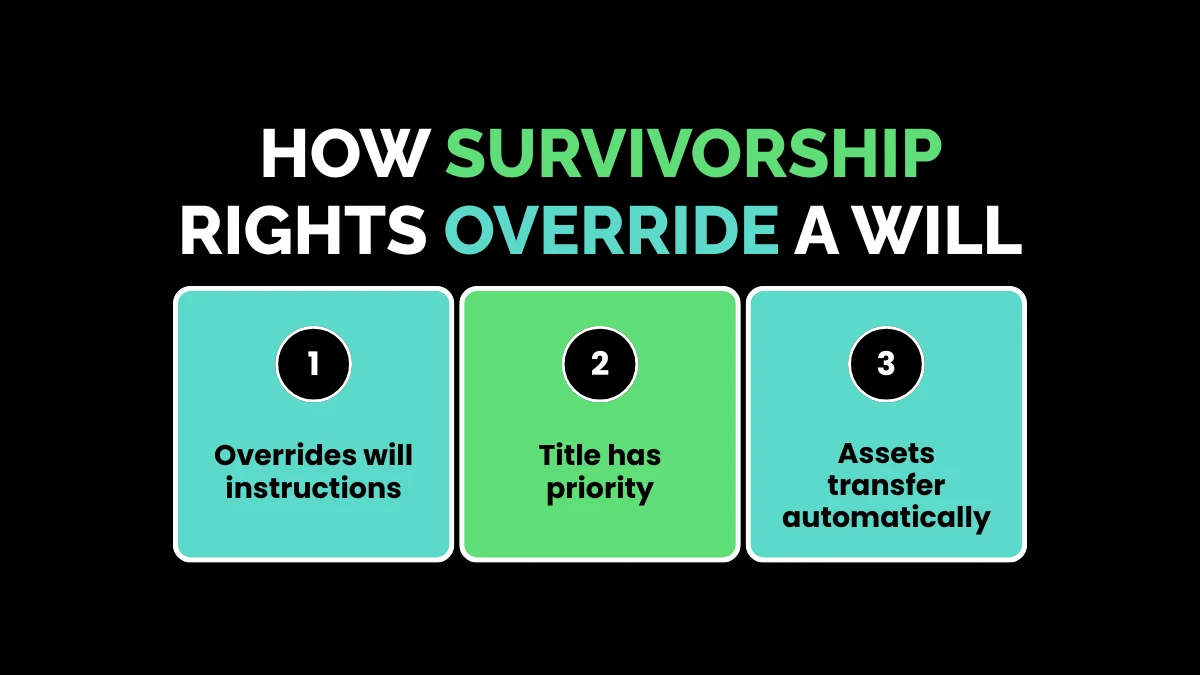
The explicit directions in your written will are completely ignored under state law.
This legal priority exists because contract titles take precedence over general testamentary estate documents.
That is why keeping your property deeds, bank cards, and estate documents aligned is so essential for avoiding family disputes.
Advantages and Disadvantages of Survivorship Rights
Before updating your deeds or bank accounts, you should carefully weigh the pros and cons of this setup.
Major Advantages
-
Avoids Probate Court: Saves thousands of dollars in legal costs and court filing fees.
-
Rapid Transfer: Funds and property titles transfer quickly upon presenting a death certificate.
-
Privacy Protection: Asset transfers remain private and are not published in public probate records.
-
Minimal Cost: Easy to set up directly at your bank or when recording a real estate deed.
Potential Risks and Drawbacks
-
Loss of Sole Control: You cannot remove a co-owner from an account or deed without their written consent.
-
Creditor Risk: If your co-owner faces a lawsuit, bankruptcy, or divorce, your joint assets could be frozen.
-
Accidental Disinheritance: Assets go exclusively to the surviving co-owner, leaving other relatives without recourse.
We at Weird Wealth recommend evaluating these risks thoroughly so you do not accidentally expose your hard-earned funds to outside claims.
Real-Life Examples and Scenarios

To help bring these concepts to life, let us examine a couple of everyday real-world examples.
Scenario 1: The Married Couple’s Home
Sarah and Mark bought their home together as joint tenants with right of survivorship.
When Mark unexpectedly passed away, Sarah took his death certificate to the local county clerk office.
The clerk recorded the certificate and updated the land records to reflect Sarah as the 100% sole homeowner.
Sarah avoided months of probate delays and thousands of dollars in legal representation fees during a difficult grieving period.
Scenario 2: The Aging Parent and Child
David added his eldest son, James, to his primary checking account to help pay monthly household bills.
David assumed the funds would be split equally among his three children according to his written will upon his death.
However, because the account carried joint account survivorship rights, James legally inherited the full balance.
David’s other two children received nothing from that account because survivorship laws override instructions in a written will.
This real-world mistake illustrates why fully understanding the right of survivorship vs beneficiary distinction is so important.
Common Tax Traps and Mistakes to Avoid
While avoiding probate is a major benefit, adding co-owners haphazardly can create unexpected financial problems.
Here are the most frequent financial mistakes people make with survivorship setups:
| Mistake | Financial Risk | Smart Alternative |
| Adding children to deeds | Triggers potential gift taxes and loss of step-up tax basis | Use a transfer-on-death deed or revocable trust |
| Exposing assets to co-owner debt | Creditors can place liens on joint property | Keep assets separate and use beneficiary tags |
| Assuming all joint accounts match | Some banks default to non-survivorship accounts | Confirm exact account title wording with your bank |
| Ignoring gift tax limits | Adding a non-spouse co-owner to property is a taxable gift | Consult a tax professional before signing deeds |
Adding an adult child to a real estate deed might seem like a quick, free probate fix today.
However, doing so can strip away valuable capital gains tax savings known as the stepped-up cost basis.
Always speak with a qualified tax advisor or estate attorney before modifying property ownership deeds.
How to Set Up Right of Survivorship Correctly
If you decide that this setup fits your estate strategy, implementing it is quite straightforward.
For bank accounts, schedule a brief meeting with a representative at your financial institution.
Request to review your current account title paperwork to verify it explicitly includes survivorship language.

If you are opening a new shared account, ensure the contract specifies joint tenancy with survivorship rights.
For real estate, contact a real estate attorney or title company to review your existing property deed.
They will draft a new deed containing the necessary legal language for county recording.
Double-checking these details today ensures your wishes are executed smoothly down the road.
Conclusion
The right of survivorship is an incredible tool for transferring bank accounts and real estate quickly and cleanly.
By allowing assets to bypass probate court, it saves your loved ones immense stress, time, and expensive legal fees.
However, because survivorship rights override your will and expose your assets to co-owner liability, you must use them carefully.
Take a moment this week to review your bank accounts, investment titles, and property deeds.
A quick review today ensures your hard-earned assets pass smoothly to the right people tomorrow!
Frequently Asked Questions
What is the simple right of survivorship definition?
It is a legal rule where a deceased owner’s share of an asset automatically transfers directly to the surviving co-owner without court intervention.
Does right of survivorship override a written will?
Yes, survivorship rights automatically take legal priority over any conflicting instructions written inside a traditional will or trust document.
How does right of survivorship vs beneficiary differ?
Survivorship grants immediate co-ownership while living, whereas a beneficiary only inherits the asset after the primary owner passes away.
Can a joint account holder withdraw all the money?
Yes, any legal joint account holder generally has full legal access to withdraw funds from the shared account at any time.