

A few years ago, I came across a headline about a billionaire buying another luxury yacht. It barely caught my attention because that’s exactly what most of us expect the ultra-rich to spend their money on.
But as I dug deeper into how the world’s wealthiest people actually preserve and grow their fortunes, I realized the real story wasn’t about yachts or mansions;
It was about assets so unusual that most people never even consider them investments.
Some billionaires own dinosaur fossils worth millions of dollars.
Others invest in whiskey barrels that won’t be opened for decades, entire islands for complete privacy, or royalty rights that generate income every time a song is streamed. These aren’t random purchases. They’re carefully chosen assets that often combine exclusivity, long-term value, and wealth preservation.
If you’ve ever wondered about the weirdest assets owned by the ultra-wealthy, you’re about to discover that many of these unusual possessions aren’t just extravagant;
They’re surprisingly strategic.
In this article, we’ll explore 20 of the most fascinating assets owned by billionaires, why they buy them, whether they’re investments or status symbols, and what these purchases reveal about how the ultra-rich think differently about building and protecting wealth.
AI Overview
The weirdest assets owned by the ultra-wealthy range from private islands and dinosaur fossils to whiskey barrels, entertainment royalties, and even wireless spectrum licenses.
While these possessions may seem eccentric at first glance, many serve practical purposes such as diversifying investment portfolios, preserving wealth, generating passive income, or securing exclusive ownership of scarce assets.
This guide explores 20 remarkable examples, explains why billionaires buy them, identifies notable owners where publicly documented, and examines whether each asset is a smart investment, a luxury purchase, or a combination of both.
Key Takeaways
- The ultra-wealthy invest in far more than stocks, real estate, and businesses.
- Many unusual assets appreciate because of scarcity and long-term demand.
- Some assets generate passive income, while others are purchased primarily for prestige or privacy.
- Billionaires often use alternative assets to diversify and protect their wealth.
- Understanding these investments offers valuable insight into how the world’s wealthiest individuals think about money.
What Are the Weirdest Assets Owned by the Ultra-Wealthy?
The weirdest assets owned by the ultra-wealthy include private islands, dinosaur fossils, historic castles, whiskey barrels, sports teams, entertainment royalty rights, data-center land, luxury bunkers, and carbon credits.
While many appear unconventional, these assets often provide long-term appreciation, portfolio diversification, privacy, or passive income, making them valuable additions to billionaire investment strategies.
| Asset Type | Primary Purpose |
| Private Islands | Privacy and exclusivity |
| Dinosaur Fossils | Scarcity and collectible value |
| Whiskey Barrels | Alternative investment |
| Sports Teams | Long-term appreciation |
| Entertainment Royalties | Passive income |
| Historic Castles | Legacy and prestige |
Why Billionaires Buy Weird Assets
At first glance, owning a dinosaur skeleton or investing in whiskey barrels may sound like an expensive hobby. In reality, these purchases often reflect carefully planned financial strategies.
Traditional investments such as stocks and bonds remain important, but many ultra-high-net-worth individuals also allocate part of their portfolios to rare and unconventional assets.
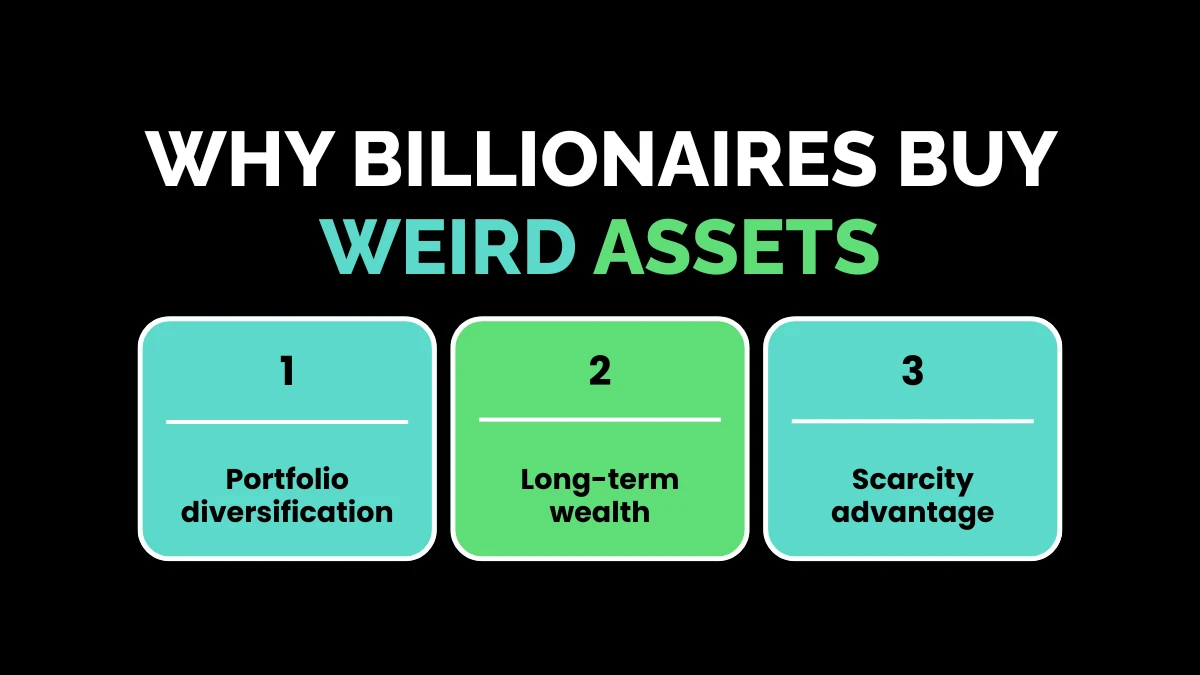
These investments can reduce risk through diversification while offering opportunities that conventional markets cannot.
Some assets are chosen because their scarcity increases value over time. Others generate recurring income through royalties or licensing agreements. Certain purchases provide privacy, while others preserve family wealth for future generations or become part of a lasting legacy.
In many cases, the ultra-rich aren’t simply buying unusual possessions, they’re acquiring assets that few people can access, making them even more valuable as demand continues to grow.
Why Billionaires Buy Weird Assets
1. Private Islands
For many billionaires, a private island is more than the ultimate vacation destination, it’s an investment in privacy, security, and exclusivity. Unlike luxury homes that can be replicated, islands are naturally scarce, making them highly desirable over time.
Notable owners such as Richard Branson and Larry Ellison have invested heavily in private islands, using them for both personal retreats and luxury tourism ventures. While maintenance costs are substantial, prime islands can appreciate significantly because supply is limited.
Investment or Status Symbol? Both. They offer long-term value while representing one of the world’s most exclusive assets.
2. Dinosaur Fossils
Buying a 70-million-year-old dinosaur skeleton might sound like something reserved for museums, yet several billionaires compete aggressively for these prehistoric treasures.
Rare fossils have become valuable collectibles because each specimen is unique. Some buyers display them in private galleries, while others consider them long-term investments due to increasing scarcity.
In recent years, complete dinosaur skeletons have sold for tens of millions of dollars at international auctions, demonstrating the growing demand among elite collectors.
Investment or Status Symbol? Primarily an investment collectible with significant prestige.
3. Entire Towns
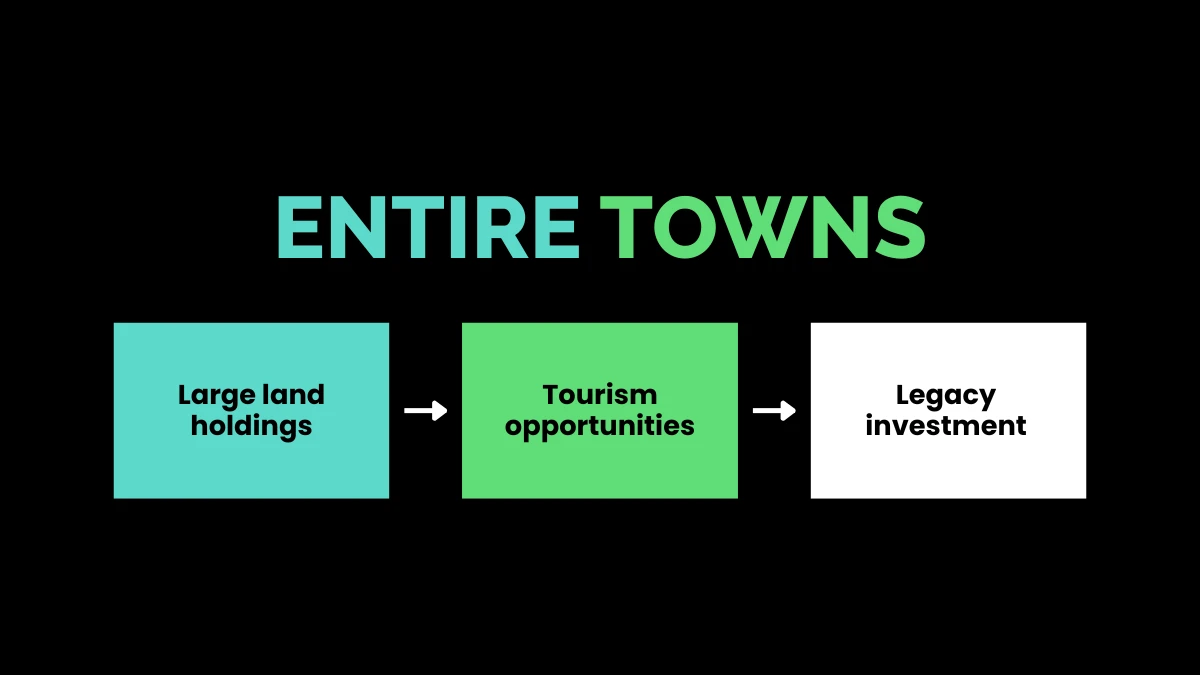
Instead of purchasing a mansion, some ultra-wealthy individuals buy entire towns.
These acquisitions may include residential buildings, commercial properties, infrastructure, and surrounding land. Investors often restore historic communities, develop tourism, or preserve culturally significant locations.
Owning an entire town also provides opportunities for long-term real estate appreciation while giving owners exceptional control over future development.
Investment or Status Symbol? Mainly an investment, with historical and legacy value.
4. Professional Sports Teams
Owning a professional sports franchise is no longer just about passion for the game. It has become one of the most sought-after alternative assets among billionaires.
Teams benefit from broadcasting rights, sponsorships, merchandise sales, and steadily increasing franchise valuations. Because the number of professional teams is limited, demand consistently exceeds supply whenever ownership opportunities arise.
For many wealthy investors, sports franchises combine prestige with strong long-term financial growth.
Investment or Status Symbol? A high-value investment that also carries global prestige.
5. Rare Manuscripts
Historic manuscripts written by influential scientists, authors, and political leaders have become prized possessions among elite collectors.
Documents connected to figures such as Leonardo da Vinci, Isaac Newton, or Albert Einstein often command extraordinary prices because they represent irreplaceable pieces of human history.
Beyond their cultural significance, these manuscripts frequently appreciate as museums, collectors, and institutions compete for ownership.
Investment or Status Symbol? Long-term collectible investment with historical importance.
6. Whiskey Barrels
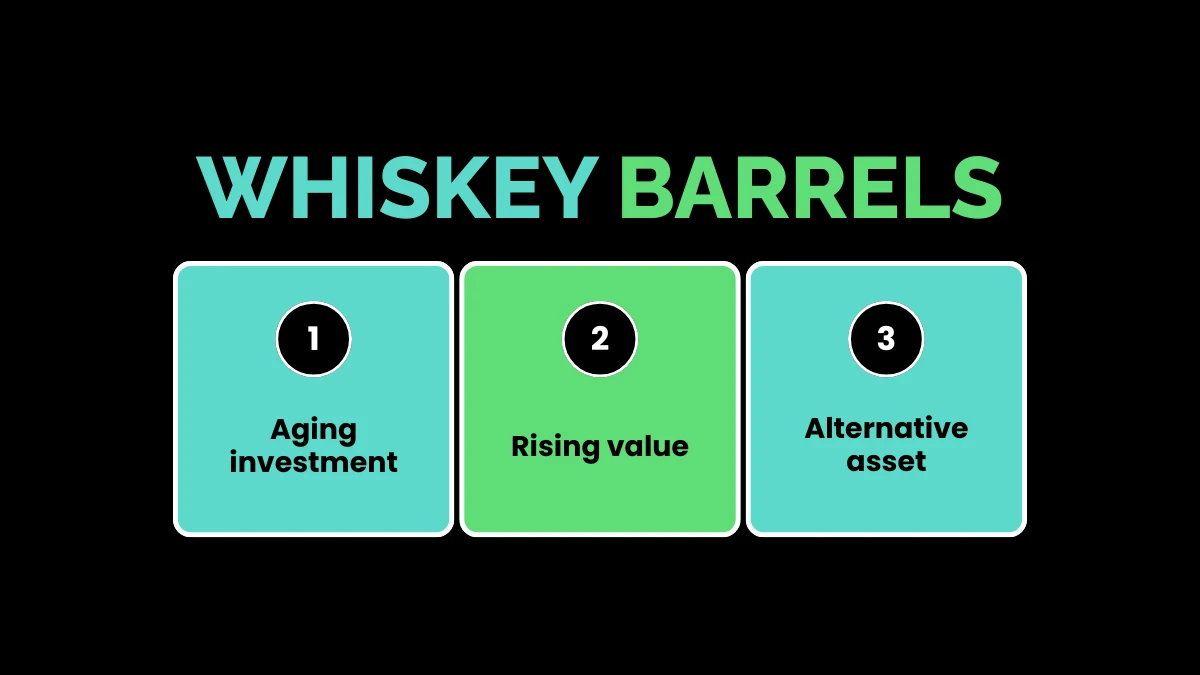
Rather than buying bottled whiskey, some wealthy investors purchase entire aging barrels that continue increasing in value while stored in distilleries.
Premium whiskey becomes rarer as it ages, and global demand for collectible spirits has pushed barrel prices significantly higher over the past decade.
Unlike traditional investments, whiskey barrels combine scarcity with growing consumer demand, making them an increasingly popular alternative asset.
Investment or Status Symbol? Primarily an alternative investment capable of generating attractive long-term returns.
7. Carbon Credits
Carbon credits may not look glamorous, but they’ve become an increasingly important asset for environmentally focused investors and family offices.
As governments strengthen emissions regulations, businesses purchase carbon credits to offset their environmental impact. This growing demand has transformed carbon markets into an emerging investment opportunity.
Many wealthy investors view carbon credits as both financially attractive and aligned with sustainability goals.
Investment or Status Symbol? Primarily an investment driven by environmental policy and market demand.
8. Historic Castles
Owning a centuries-old castle is one of the most unusual forms of luxury real estate.
Many billionaires purchase castles not simply as residences but as heritage properties that can be restored, preserved, or converted into luxury hotels and event venues.
Although maintenance costs can be enormous, iconic castles often hold lasting historical and cultural value that few modern properties can match.
Investment or Status Symbol? A combination of legacy investment, historical preservation, and prestige.
9. Private Submarines
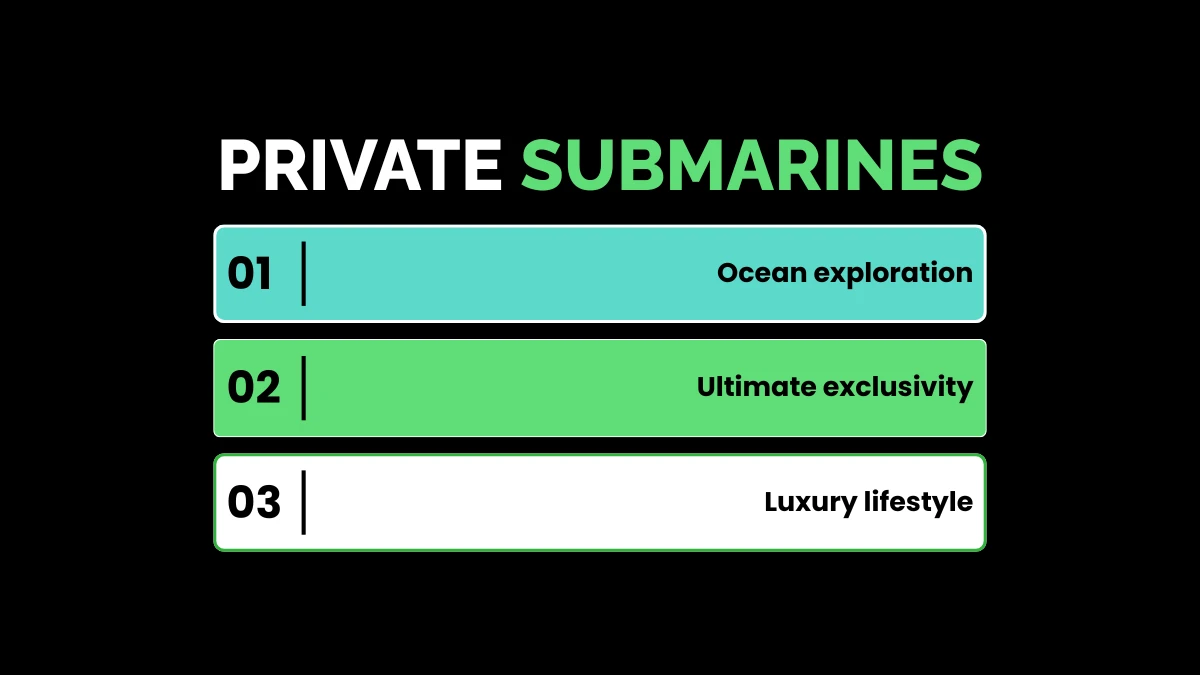
For individuals who already own superyachts, private submarines provide an entirely different level of exploration and privacy.
These vessels allow owners to explore deep-sea environments, conduct marine research, or simply enjoy experiences unavailable to most people.
Because they’re highly specialized and extremely rare, private submarines remain one of the least common luxury assets in the world.
Investment or Status Symbol? Primarily a luxury asset purchased for exclusivity and personal exploration.
10. Luxury Survival Bunkers
Modern luxury bunkers have evolved far beyond simple emergency shelters.
Many feature private cinemas, medical facilities, swimming pools, advanced air filtration systems, and years’ worth of food supplies. Growing concerns about geopolitical instability and natural disasters have increased interest in these properties among the ultra-rich.
For some billionaires, these bunkers represent peace of mind as much as financial investment.
Investment or Status Symbol? Mainly a security-focused asset with growing strategic value.
11. Moon Rock Collections
Authentic lunar material is among the rarest assets on Earth. While government-owned moon rocks are generally not available for private ownership, a small number of legally acquired lunar meteorites and Apollo-era memorabilia have found their way into private collections.
Because of their rarity and historical significance, these items can command extraordinary prices at auction.
Investment or Status Symbol? Primarily a rare collectible with exceptional scarcity.
12. Data Center Land
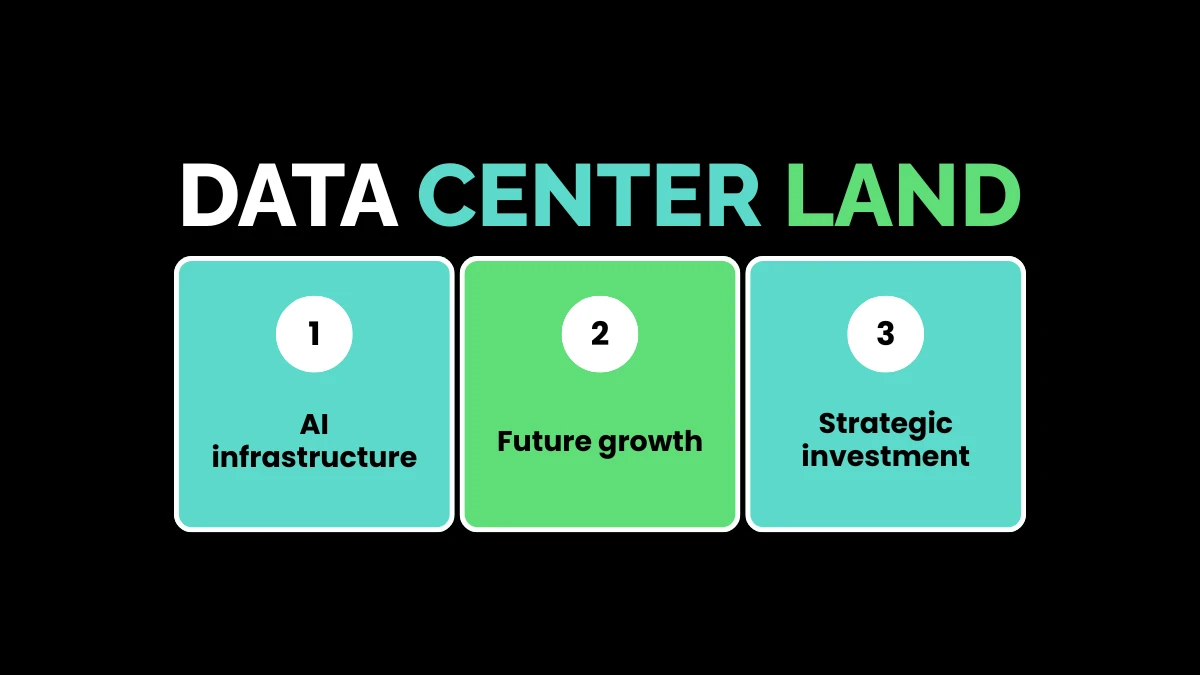
As artificial intelligence, cloud computing, and digital services continue to expand, land suitable for data centers has become one of the fastest-growing alternative assets.
Major investors acquire strategically located land with access to reliable electricity, fiber-optic networks, and water resources, making these properties increasingly valuable as global demand for computing infrastructure rises.
Unlike traditional commercial real estate, data center land benefits from long-term technological growth.
Investment or Status Symbol? A strategic investment with strong future demand.
13. Entertainment Royalty Rights
Some billionaires invest in music catalogs, movie royalties, and publishing rights instead of creating entertainment themselves.
These assets generate recurring income whenever a song is streamed, a film is licensed, or copyrighted material is used commercially. Since royalties can produce cash flow for decades, they have become an attractive source of passive income.
As digital streaming continues to grow, entertainment rights remain one of the most reliable alternative assets.
Investment or Status Symbol? A long-term income-generating investment.
14. Wireless Spectrum Licenses
Wireless spectrum licenses are invisible assets, yet they are among the most valuable resources in the modern digital economy.
Telecommunications companies rely on licensed spectrum to operate mobile networks, and demand continues to increase with the expansion of 5G and future wireless technologies.
For sophisticated investors, these licenses represent scarce digital infrastructure with significant long-term value.
Investment or Status Symbol? A high-value infrastructure investment.
15. Superyachts
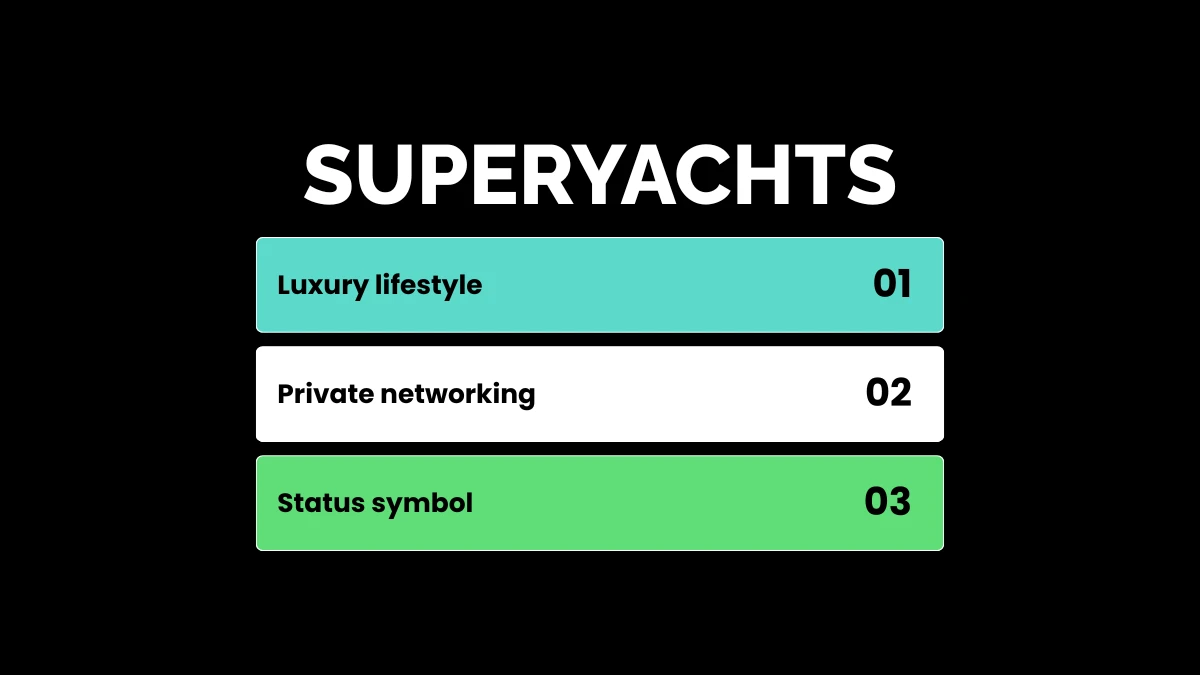
Superyachts remain one of the most recognizable symbols of extreme wealth.
Although they rarely appreciate like traditional investments, they often function as floating residences, entertainment venues, and networking spaces where business relationships are built in complete privacy.
Operating costs can reach millions of dollars annually, making ownership practical only for the world’s wealthiest individuals.
Investment or Status Symbol? Primarily a luxury status symbol with limited investment potential.
16. Exotic Car Collections
Classic Ferraris, Bugattis, McLarens, and other limited-production vehicles have become highly desirable investment assets.
Unlike ordinary cars that depreciate, rare collector vehicles often increase in value because production numbers are fixed and demand from collectors continues to rise.
Many billionaires maintain climate-controlled garages that function more like private museums than parking spaces.
Investment or Status Symbol? Both. Exceptional models can deliver strong long-term appreciation.
17. Fine Art Masterpieces
Paintings by artists such as Pablo Picasso, Claude Monet, and Vincent van Gogh have become important components of many billionaire portfolios.
Besides their cultural significance, blue-chip artworks have historically preserved value during periods of economic uncertainty. They are also portable assets that can be transferred across generations.
For many wealthy collectors, fine art represents both financial security and personal passion.
Investment or Status Symbol? A premium investment with significant cultural prestige.
18. Racehorse Breeding Farms
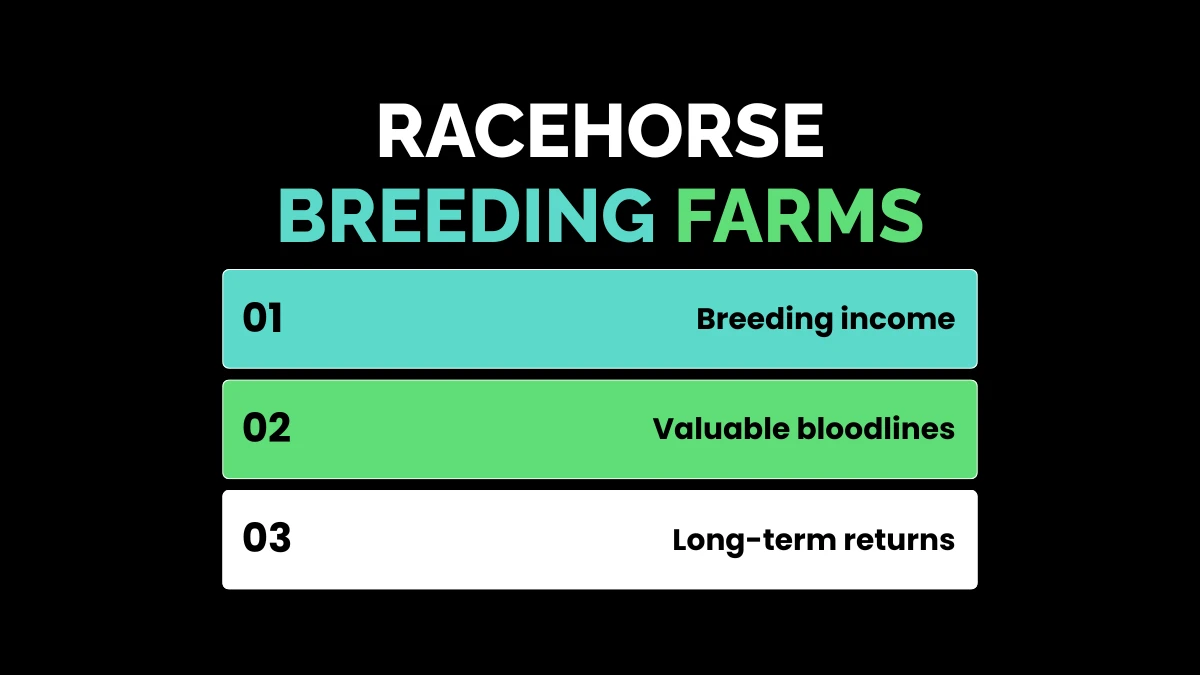
Owning championship racehorses is only one part of the business. Many wealthy investors purchase breeding farms capable of producing future generations of valuable thoroughbreds.
Successful bloodlines can generate substantial income through breeding rights, international sales, and racing success, making equestrian investments attractive despite their risks.
Investment or Status Symbol? A specialized investment driven by genetics, reputation, and long-term breeding value.
19. Luxury Train Cars
Private railway carriages offer a unique blend of history, luxury, and exclusivity.
Some collectors restore vintage train cars with modern amenities, using them for private travel or luxury tourism experiences. Because only a limited number of historic railcars remain, restored examples have become highly collectible.
Investment or Status Symbol? Mostly a prestige asset with niche investment appeal.
20. Boat Marinas
Instead of purchasing individual yachts, some wealthy investors acquire the marinas where those yachts are docked.
Marinas generate recurring revenue through docking fees, maintenance services, storage, fuel sales, and tourism. As global yacht ownership continues to grow, well-located marinas have become attractive income-producing assets.
Unlike many luxury purchases, marinas combine exclusivity with predictable cash flow and long-term appreciation.
Investment or Status Symbol? A commercial investment with consistent income potential.
Which Weird Assets Are Actually Good Investments?
Not every unusual asset performs the same financially. Some are purchased mainly for prestige, while others generate income or appreciate significantly over time.
| Asset | Investment Potential | Liquidity | Primary Purpose |
| Data Center Land | High | Medium | Long-term growth |
| Entertainment Royalty Rights | High | Medium | Passive income |
| Sports Teams | High | Low | Appreciation |
| Boat Marinas | High | Medium | Income generation |
| Whiskey Barrels | Medium-High | Medium | Alternative investment |
| Fine Art | Medium-High | Low | Wealth preservation |
| Private Islands | Medium | Low | Privacy and exclusivity |
| Superyachts | Low | Low | Luxury lifestyle |
The strongest long-term investments generally produce income, benefit from increasing demand, or represent assets with limited supply. By contrast, purchases such as superyachts and private submarines are often driven more by lifestyle and exclusivity than financial returns.
What These Assets Reveal About How the Ultra Wealthy Build Wealth
The biggest lesson isn’t that billionaires buy unusual things; it’s why they buy them.
Most of these assets share one or more important characteristics: scarcity, long-term appreciation, recurring income, or strategic diversification. Rather than concentrating wealth in a single asset class, the ultra-rich spread their investments across businesses, real estate, collectibles, intellectual property, and alternative assets.
This approach helps reduce risk while creating opportunities that aren’t directly tied to stock market performance.
Just as importantly, many of these purchases reflect a long-term mindset. Billionaires often acquire assets they expect to hold for decades, allowing scarcity and demand to increase their value over time.
Can Ordinary Investors Buy Similar Assets?
Although buying a private island or a professional sports team isn’t realistic for most people, the underlying investment principles are surprisingly accessible.
Today, investors can gain exposure to alternative assets through fractional ownership platforms, royalty investment opportunities, collectible markets, and specialized investment funds.
Before investing, it’s important to understand liquidity, maintenance costs, insurance requirements, and market demand. Many alternative assets require patience because they may take years to appreciate or may not be easy to sell quickly.
The key lesson is not to copy billionaire purchases but to understand why these assets appeal to sophisticated investors. Scarcity, diversification, and long-term thinking can benefit portfolios of almost any size.
Conclusion
When people imagine billionaire wealth, they usually picture private jets, luxury mansions, or superyachts. But as we’ve seen, the weirdest assets owned by the ultra-wealthy go far beyond traditional symbols of success.
From dinosaur fossils and whiskey barrels to entertainment royalty rights and data center land, these unconventional investments reveal a different way of thinking about wealth.
The world’s richest individuals aren’t simply buying expensive possessions, they’re acquiring scarce assets that can preserve value, generate income, or strengthen long-term portfolios.
That brings us back to the idea we started with. What first looked like a collection of strange purchases turns out to be a carefully planned strategy. Behind every unusual asset is a purpose, whether it’s diversification, privacy, legacy, or future growth.
Most people may never own a private island or a professional sports franchise, but the lesson is still valuable. Looking beyond conventional investments, understanding the power of scarcity, and thinking with a long-term perspective are principles that investors at every level can apply.
The assets may be extraordinary, but the mindset behind them is what truly sets the ultra-wealthy apart.
FAQs About Weirdest Assets Owned by Billionaires
What are the weirdest assets owned by the ultra-wealthy?
Some of the weirdest assets owned by the ultra-wealthy include private islands, dinosaur fossils, entire towns, whiskey barrels, entertainment royalty rights, wireless spectrum licenses, luxury bunkers, professional sports teams, historic castles, and data center land. While these assets may seem unusual, many are chosen for their scarcity, investment potential, or ability to preserve wealth over the long term.
Why do billionaires invest in unusual assets?
Billionaires invest in unusual assets to diversify their portfolios, reduce dependence on traditional markets, preserve wealth, and gain access to exclusive opportunities. Many of these assets are difficult to replicate or replace, making them valuable over time due to their rarity and limited supply.
Which strange billionaire assets generate passive income?
Several unconventional assets can produce recurring income. Entertainment royalty rights generate earnings whenever music or films are licensed or streamed. Boat marinas earn revenue from docking fees and maintenance services, while sports franchises generate income through broadcasting rights, sponsorships, ticket sales, and merchandise. These assets combine long-term appreciation with steady cash flow.
Are unusual billionaire assets good investments?
Some are excellent investments, while others are primarily luxury purchases. Data center land, entertainment royalties, sports teams, and select collectibles have shown strong long-term growth potential. In contrast, assets such as superyachts and private submarines usually involve high maintenance costs and are purchased more for lifestyle and exclusivity than financial returns.
What is the most expensive unusual asset owned by a billionaire?
The answer depends on the individual owner, but private islands, professional sports teams, fine art masterpieces, and historic castles often rank among the most expensive unconventional assets. Some sports franchises and world-famous artworks are valued at several billion dollars, making them some of the largest alternative investments in private portfolios.
Do these assets increase in value over time?
Many of them do. Assets with limited supply, such as fine art, rare manuscripts, dinosaur fossils, and sports franchises, have historically appreciated because demand continues to rise while availability remains fixed. However, appreciation is never guaranteed, and market conditions can significantly influence future values.
Can ordinary investors buy similar assets?
Although purchasing a private island or an entire town is beyond the reach of most investors, there are accessible alternatives. Fractional ownership platforms, collectible investment funds, royalty marketplaces, and specialized real estate investments allow individuals to gain exposure to alternative assets with far lower capital requirements.
Why do billionaires diversify into alternative assets?
Alternative assets help reduce portfolio risk because they often perform differently from traditional investments like stocks and bonds. By spreading wealth across real estate, collectibles, intellectual property, infrastructure, and private businesses, billionaires create more resilient portfolios that are better positioned to withstand economic uncertainty.