
Key Takeaways
-
Gross annual total: Around $87,360 before taxes.
-
Monthly income: Roughly $7,280 gross payout.
-
Take-home estimate: Usually between $5,500 and $6,200 monthly.
-
Financial status: Well above the national average wage.
Imagine sitting across from a friend at a local coffee shop. You’re catching up, talking about career moves, and they mention a new job offer. It pays $42 an hour. Sounds pretty great, right? But your brain immediately starts doing the math. You start wondering, 42 an hour is how much a year exactly?
It is the classic riddle of the hourly wage. We see the hourly rate and instantly want to convert it into a big, clear annual number. Well, if you work a standard full-time schedule, that hourly rate translates to a gross annual salary of $87,360 before uncle sam takes his cut.
But as we all know, the gross number is only half the story. To truly understand what this money looks like in real life, we need to peel back the layers. We need to look at taxes, monthly budgets, and what actually lands in your bank account.
Here at Weird Wealth, we love breaking down these numbers so you can plan your financial future with total confidence.
AI Overview
If you work a standard 40-hour workweek for 52 weeks, earning $42 an hour results in a gross yearly salary of $87,360. This amount sits comfortably above the median household income in the United States. However, your actual 42/hr take home pay will be lower due to federal, state, and local taxes, alongside workplace benefits like health insurance or retirement contributions.
The Base Math: Calculating the Annual Salary
Let’s look at how we get to that big annual number. The math is actually pretty straightforward when you look at a traditional work year.
In most corporate and hourly jobs, a standard full-time schedule means working 40 hours a week. There are 52 weeks in a calendar year. When you multiply those weekly hours by the total weeks in a year, you get exactly 2,080 working hours.
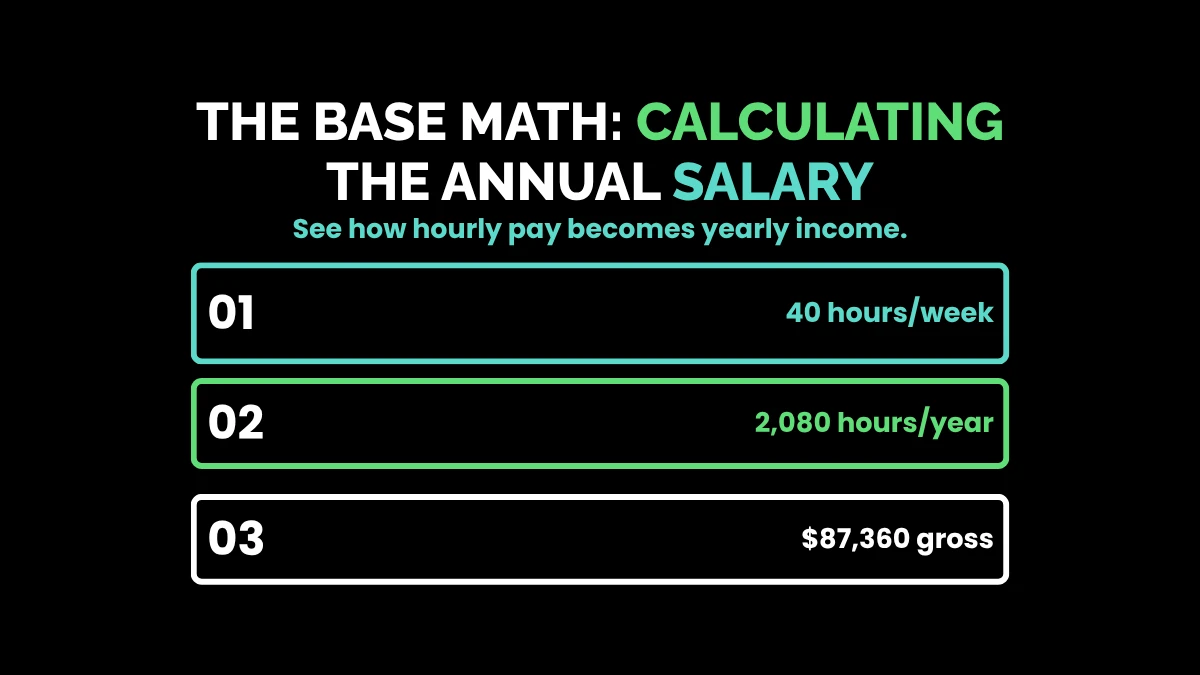
Taking those 2,080 total yearly hours and multiplying them by your $42 hourly rate gives you a solid 42 dollars an hour yearly salary of $87,360. Of course, this assumes you work every single week of the year without taking unpaid time off. If your position offers paid time off (PTO), your year-end number stays exactly the same.
But what if you work part-time? Or what if you manage to get a few hours of overtime each week? The numbers can shift quite a bit based on your actual schedule.
Part-Time vs. Overtime Calculations
Not everyone works a clean 40-hour week. Let’s look at how a 42 dollars an hour yearly salary changes if you work part-time at 20 hours a week, or if you log consistent overtime.
In many hourly roles, overtime pays “time and a half.” This means any hour worked past the 40-hour mark earns you $63 an hour instead of $42.
| Work Schedule | Weekly Hours | Estimated Annual Gross Income |
| Part-Time | 20 hours | $43,680 |
| Standard Full-Time | 40 hours | $87,360 |
| Overtime Light | 45 hours (5 hours OT) | $100,100 |
| Heavy Overtime | 50 hours (10 hours OT) | $112,840 |
As you can see, adding just a few hours of overtime pushes your earnings past the six-figure mark. It shows how quickly an hourly rate can scale if the hours are available.
The Reality Check: Taxes and Take-Home Pay
Gross income looks amazing on paper. It is the number you put on apartment applications or brag about to your parents. But your actual 42/hr take home pay is the number that truly matters for your daily life.
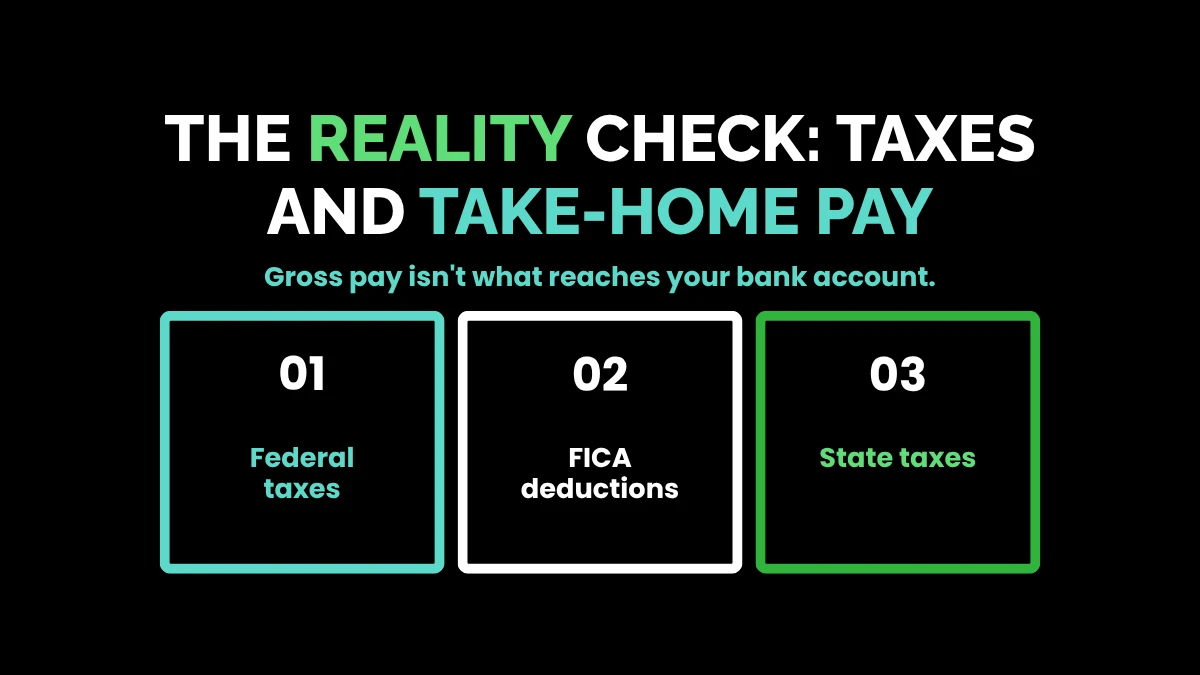
When your paycheck hits your account, it has already been through the tax meat grinder. Federal income tax, FICA taxes (Social Security and Medicare), and state taxes all take a bite.
Because tax brackets vary wildly depending on where you live and your filing status, we have to look at estimates based on general historical data.
Estimated Tax Breakdown Example
Let’s look at a general estimate for a single filer working full-time. In most cases, you can expect roughly 20% to 25% of your income to vanish into taxes and standard deductions.
-
Gross Income: $87,360
-
Estimated Federal Income Tax: ~$10,500
-
Estimated FICA Taxes: ~$6,683
-
Estimated State Income Tax (Average State): ~$3,500
-
Estimated Total Tax Annual Burden: ~$20,683
After subtracting those estimated taxes, your annual 42/hr take home pay drops to roughly $66,677.
This means your actual cash in hand is around $5,556 per month. If you live in a state with no income tax like Texas or Florida, that monthly number will be higher. If you live in a high-tax state like California or New York, it will be lower.
Breaking It Down: Monthly, Weekly, and Daily
To build a realistic budget, you need to know how this money flows into your life on a smaller scale. Looking at a huge annual number can make it hard to figure out what you can actually afford on grocery day.
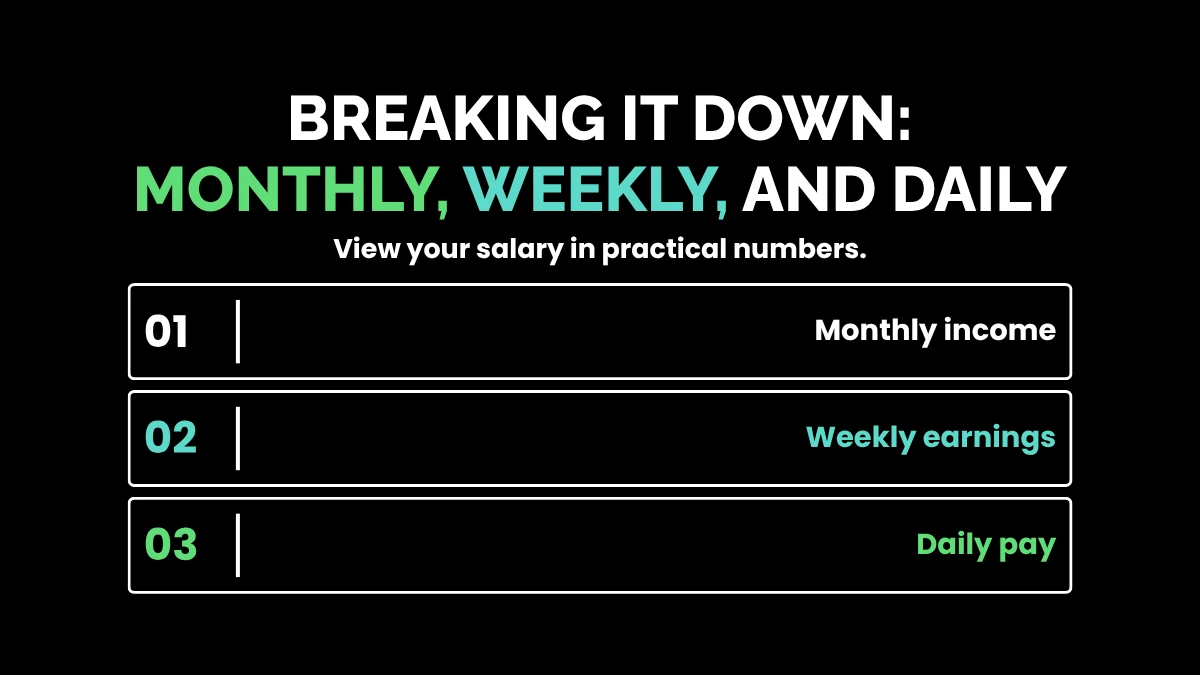
Let’s break down that $87,360 gross salary into bite-sized timeframes.
The Paycheck Calendar
-
Monthly Gross: $7,280
-
Bi-Weekly Gross (Every 2 weeks): $3,360
-
Weekly Gross: $1,680
-
Daily Gross (8-hour day): $336
If you get paid bi-weekly, which is incredibly common, you will receive 26 paychecks a year. Most months you will get two paychecks. But two months out of the year, you will get a “magic” third paycheck.
What the Budget Looks Like
When you translate these numbers to your daily routine, a 42/hr take home pay gives you plenty of breathing room.
At roughly $5,500 a month in net income, you can comfortably follow the popular 50/30/20 budget rule. This means spending 50% on needs, 30% on wants, and saving 20%.
| Budget Category | Percentage | Monthly Dollar Amount |
| Needs (Rent, Groceries, Insurance, Utilities) | 50% | $2,750 |
| Wants (Dining out, Hobbies, Travel, Shopping) | 30% | $1,650 |
| Savings (Emergency fund, Retirement, Investments) | 20% | $1,100 |
Seeing the breakdown this way shows that you don’t need to live like a monk to build wealth. You can pay your bills, have some fun, and still invest a massive chunk of money every single month.
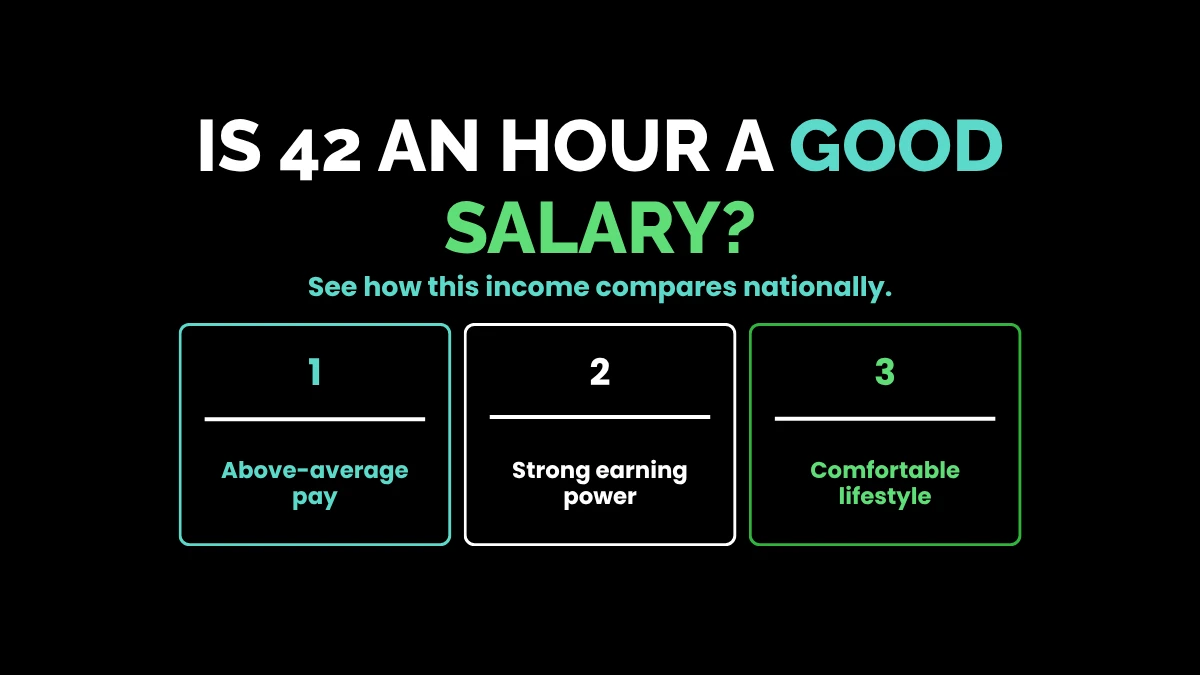
Is 42 an Hour a Good Salary?
Now for the big question you are probably asking yourself: is 42 an hour a good salary in today’s economy?
The short answer is yes, absolutely. Based on available data, the median individual income for full-time workers in the United States hovers around $59,000 a year. Earning over $87,000 puts you significantly ahead of the average worker.
However, whether a salary feels “good” is deeply relative. It depends entirely on your lifestyle, your debt levels, and your zip code.
The Geographic Factor
If you are living in a mid-sized Midwestern city, this salary makes you downright affluent. You can easily afford a beautiful apartment, drive a nice car, and save for a house down payment without sweating.
On the flip side, if you are trying to live in the heart of San Francisco, Manhattan, or Honolulu, things change. High housing costs and steep local taxes will eat into your funds quickly. In those areas, is 42 an hour a good salary? It is still decent, but you will definitely need to watch your housing budget to avoid living paycheck to paycheck.
Family Dynamics and Lifestyle
Your living situation also plays a massive role in how far this money goes.
If you are single with no kids and minimal student loans, you will likely feel incredibly comfortable. You will have plenty of disposable income to travel or fund your hobbies.
If you are the sole provider for a family of four, that $87,360 has to stretch much further. It is still a manageable income, but luxuries will need to be planned out carefully. Here at WeirdWealth, we always remind people that cash flow management matters just as much as the hourly rate itself.
How to Maximize a $42 an Hour Income
Landing a job that pays this rate is a fantastic milestone. But earning the money is only the first step. What you choose to do with it determines your long-term financial freedom.
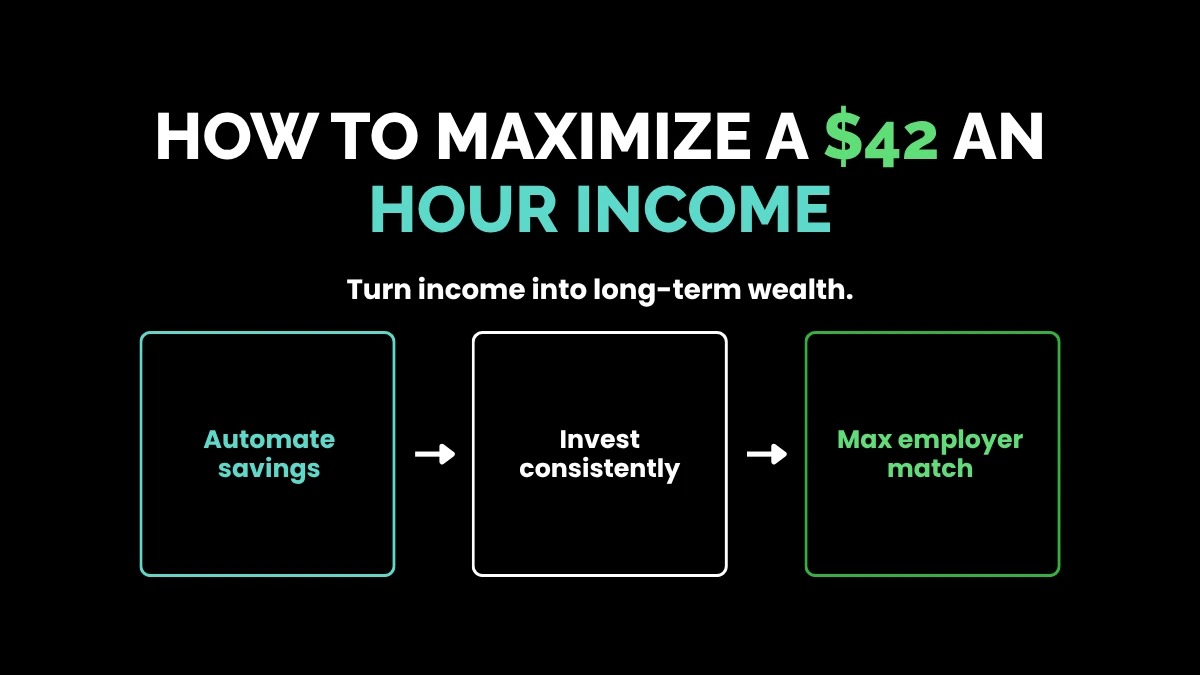
If you want to turn this hourly wage into true, lasting security, you need a proactive plan.
Smart Money Strategies
-
Automate your savings: Set up your payroll to automatically send 10% to 20% of your paycheck directly into a high-yield savings account or investment account before you even see it.
-
Max out the employer match: If your company offers a 401k match, contribute enough to get the full amount because it is literally free money.
By staying intentional with your spending, a 42 dollars an hour yearly salary can easily become the launchpad for early retirement or buying your dream property.
Final Thoughts
When you look at the question 42 an hour is how much a year, the raw number is $87,360. It is a fantastic wage that provides safety, comfort, and the ability to build a great financial foundation.
Just remember to account for taxes when planning your budget, and keep your local cost of living in mind. If you manage the money wisely, this hourly rate will give you all the financial freedom you are looking for.
Frequently Asked Questions
Can I buy a house making $42 an hour?
Yes, in most cases you can comfortably afford a home. With an annual gross income of $87,360, a standard mortgage lender will generally approve you for a home priced between $250,000 and $320,000, depending on your current debt and down payment size.
How much is $42 an hour monthly after taxes?
While it depends on your specific state, your monthly take-home pay will estimated be around $5,400 to $5,800 after standard federal, state, and FICA tax deductions are removed.
What kind of jobs pay $42 an hour?
You can find this wage in several fields. Registered nurses, experienced dental hygienists, web developers, commercial electricians, and mid-level corporate managers commonly earn a 42 dollars an hour yearly salary.
Is 42 an hour considered middle class?
Yes, this income falls squarely into the upper-middle-class tier for an individual filer in the vast majority of American cities and towns.