

Key Takeaways
- Drop monthly payments with rate-and-term options
- Tap built-up equity using cash-out refinancing
- Fast-track mortgage payoff with 15-year terms
- Skip heavy paperwork using streamline government programs
Ever wondered if your current home loan is quietly draining your monthly budget?
Choosing the best refinance options can instantly free up cash, lower interest rates, or help you pay off your home years faster.
With the right mortgage refinance options, swapping out your current loan for better terms is straightforward.
Let’s break down the 15 top home loan refinancing options so you can find the best mortgage refinance for your goals.
AI Overview
Finding the best refinance options depends on whether you want lower monthly payments, cash from home equity, or a shorter loan term. Homeowners can pick from conventional loans, government-backed streamlines, cash-out refis, or flexible equity lines. At Weird Wealth, we simplify mortgage refinancing options for homeowners so you can compare top choices, avoid hidden fees, and save thousands over the life of your mortgage.
Understanding Your Mortgage Refinancing Options
Refinancing a home loan simply means replacing your existing mortgage with a new one that has better terms.
Before picking a route, you need to know what you want to achieve.
Are you trying to cut your rate, drop private mortgage insurance, or grab cash for home repairs?
Here at Weird Wealth, we like to keep financial decisions simple, realistic, and stress-free.
When you look at refinancing a home loan, you are essentially rewriting your contract with a mortgage lender.
You take out a new loan, use it to clear your original debt, and begin making payments under a set of fresh conditions.
This financial move can alter your interest rate, monthly obligation, loan length, or even the type of interest you pay.
In most cases, homeowners make this choice when broader market conditions shift or when their personal credit standing improves.
It is always smart to weigh your long-term plans against the immediate upfront costs of making a switch.
If you plan to stay in your property for several years, even a small reduction in your interest rate can pay off big.
On the flip side, if you plan to move soon, closing fees might swallow up your short-term monthly savings.
Understanding every angle ensures you select home loan refinancing options that put real cash back into your pocket.
15 Best Refinance Options for Homeowners
1. 30-Year Fixed-Rate Refinance
The standard choice for maximum stability. It stretches your loan over three decades, keeping monthly payments predictable and low.
This option protects you against rate hikes and offers room in your monthly budget for other investments.
2. 15-Year Fixed-Rate Refinance
Perfect if you want to pay off your home in half the time.
It comes with lower interest rates but higher monthly payments, allowing you to build equity rapidly and save thousands in overall interest.
3. Rate-and-Term Refinance
This changes your interest rate, your loan duration, or both without touching your loan principal.
It is ideal for lowering monthly costs or converting a volatile adjustable rate into a dependable fixed schedule.
4. Cash-Out Refinance
Allows you to take out a new loan for more than you owe and keep the difference in cash.
It works great for funding home renovations, consolidating high-interest credit card debt, or covering major life expenses.
5. Cash-In Refinance
You pay a chunk of money toward your mortgage principal during the refinance process.
This lowers your total loan balance, helps secure a better rate, and can cancel mortgage insurance by boosting your equity stance.
6. FHA Streamline Refinance
Made for homeowners with an existing FHA loan.
It requires minimal paperwork, no full appraisal in most cases, and offers less strict credit checks to help you lower rates fast.
7. VA Interest Rate Reduction Refinance Loan (IRRRL)
Exclusively for military personnel, veterans, and surviving spouses holding VA loans.
It provides low rates with fast processing, zero appraisal requirements, and very low out-of-pocket setup costs.
8. USDA Streamlined Assist Refinance
Designed for low-to-moderate-income rural homeowners holding USDA loans.
It lets you refinance with no home appraisal, no strict debt-to-income checks, and flexible credit guidelines.
9. Jumbo Loan Refinance
Targeted at high-value properties that exceed standard conforming loan limits.
It helps secure competitive interest rates on massive loan balances, though lenders generally require stellar credit and low debt.
10. Adjustable-Rate Mortgage (ARM) to Fixed-Rate
Swaps an unpredictable adjustable-rate mortgage for a locked-in fixed interest rate.
This shields you from sudden market spikes and stabilizes your housing expenses for the remaining life of your loan.
11. Short-Term ARM Refinance (5/1 or 7/1 ARM)
Offers a lower introductory rate for an initial 5 or 7 years before adjusting annually.
It is an excellent strategy if you plan to relocate or refinance again before the variable rate kicks in.
12. HELOC (Home Equity Line of Credit)
Acts like a revolving credit card backed by your home equity.
You borrow only what you need as expenses arise, making it a flexible alternative to standard cash-out refinancing.
13. Home Equity Loan
A second mortgage that pays out a single lump sum at a fixed interest rate.
It lets you access cash while keeping your original main mortgage completely untouched, preserving a low primary rate.
14. Reverse Mortgage Refinance (for Seniors)
Converts accumulated home equity into tax-free cash for homeowners aged 62 and older.
It eliminates monthly mortgage payments entirely, paying out via lump sums, line of credit, or monthly installments.
15. No-Closing-Cost Refinance
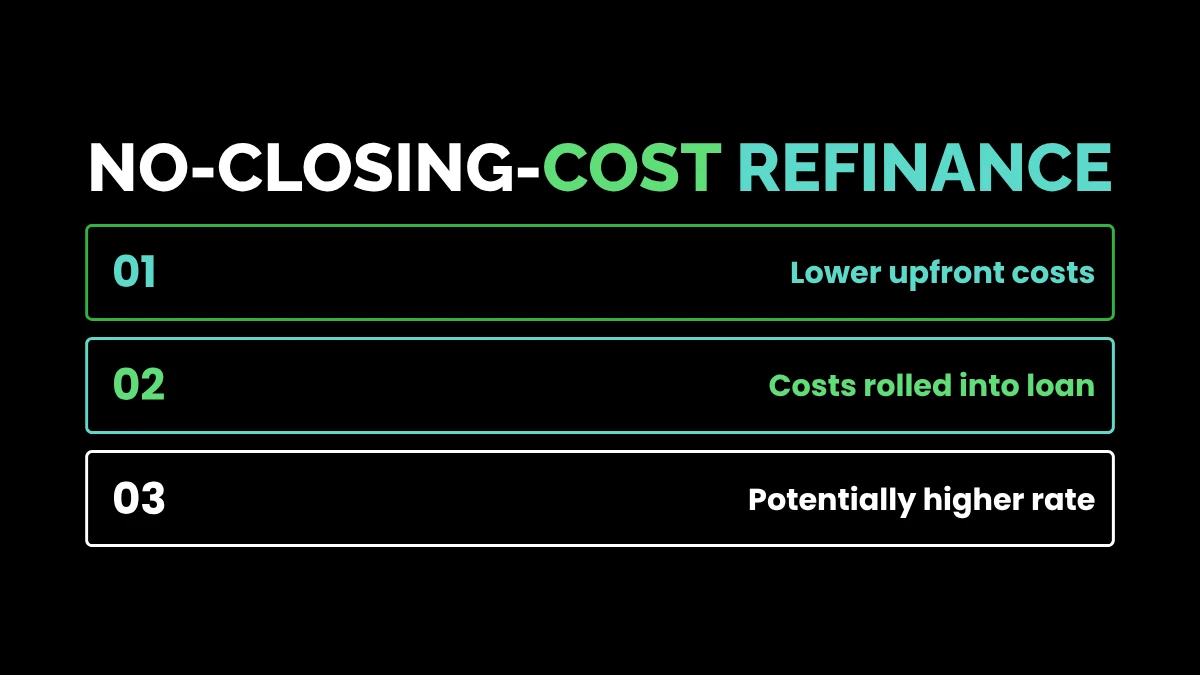
Rolls closing costs directly into your total loan balance or trades them for a slightly higher interest rate.
This saves upfront cash today while still helping you secure a better deal than your current loan.
Comparing the Best Mortgage Refinance Options
| Refinance Option | Primary Benefit | Best Suited For | Credit Requirement |
| 30-Year Fixed | Lowest fixed monthly payment | Long-term budget stability | Standard (620+) |
| 15-Year Fixed | Lower rates, faster payoff | Rapid equity growth | Moderate (620+) |
| Cash-Out Refi | Pulls cash out of home equity | Large expenses or consolidation | Standard (620+) |
| FHA Streamline | Fast approval, less paperwork | Current FHA borrowers | Flexible (580+) |
| VA IRRRL | Low rates, no appraisal | Veterans and service members | Very flexible |
| Jumbo Refinance | Lowers rates on large loans | High-value property owners | Strict (700+) |
| No-Closing-Cost | Zero upfront cash out-of-pocket | Cash-conscious borrowers | Standard (620+) |
Deep Dive into Government-Backed Mortgage Refinancing Options
Government programs provide some of the best mortgage refinance avenues available for eligible homeowners.
These options are specifically structured to offer safety, low costs, and relaxed qualification guidelines.
If you currently hold an FHA, VA, or USDA loan, government streamline options remove traditional hurdles like full home appraisals or tedious income verification steps.
For instance, the FHA Streamline program helps borrowers who might have tight debt ratios or reduced home values.
Since the federal government guarantees these loans, lenders take on far less risk.
That reduced risk translates directly into lower interest rates and reduced closing requirements for you.
Similarly, the VA IRRRL remains an incredible tool for active service members and military veterans.
It allows you to lock in lower interest rates with almost zero administrative headaches.
In most instances, you do not even need to pay out-of-pocket costs at closing because expenses can be rolled directly into the new balance.
At Weird Wealth, we always advise military families and rural homeowners to explore these government-backed programs first before looking into private conventional refi choices.
Conventional vs. Government Home Loan Refinancing Options
Deciding between conventional and government-backed refinancing options comes down to your credit profile and current mortgage structure.
Conventional loans are not insured by a federal agency, meaning lenders enforce stricter standards regarding credit scores and equity levels.
However, if you have at least 20% equity in your property, a conventional refinance allows you to cancel private mortgage insurance completely.
This step alone can instantly trim hundreds of dollars off your monthly housing expenses.
Government-backed options, while easier to qualify for, often carry ongoing mortgage insurance fees or guarantee charges.
For example, FHA loans usually require an upfront mortgage insurance premium along with an annual fee that lasts for the life of the loan.
If you have built up substantial equity, switching from an FHA loan to a conventional rate-and-term refinance is often the single most effective way to eliminate extra costs.
Evaluating where you stand today in terms of equity makes choosing between these two paths clear and simple.
How Cash-Out Refinancing Works for Homeowners
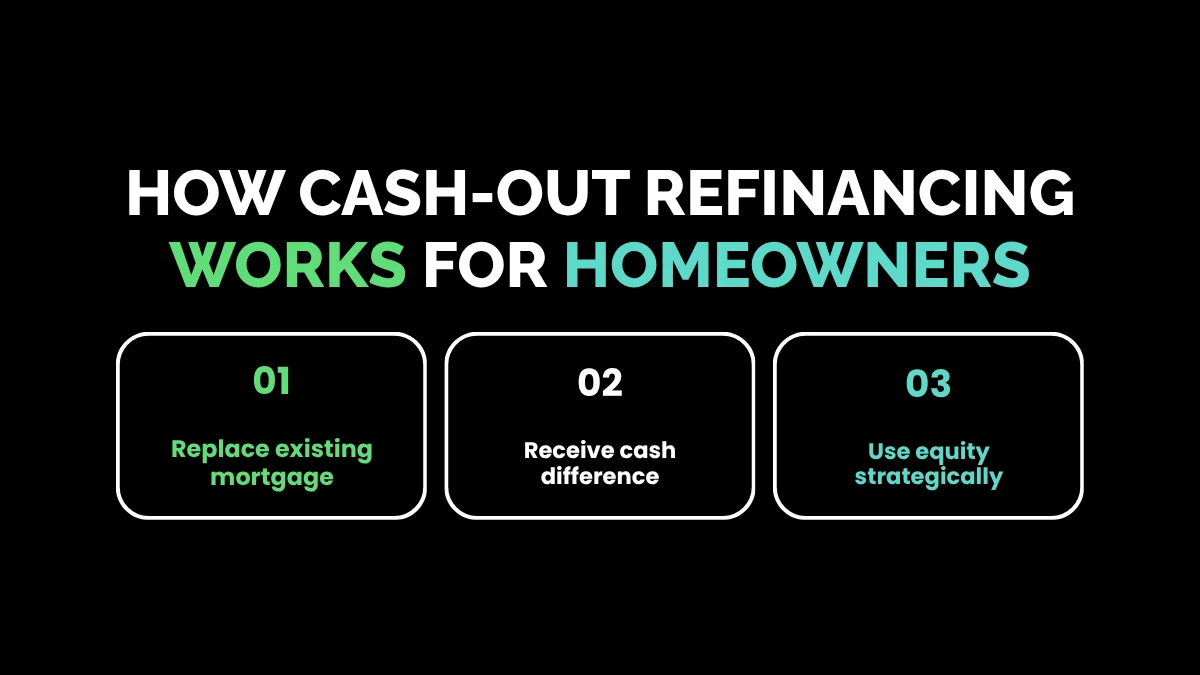
A cash-out refinance turns your home equity into actual cash you can use right away.
When property values rise or when you pay down your mortgage balance, your home equity grows.
Through this method, you replace your existing mortgage with a new, larger loan balance.
The lender pays off your original mortgage balance and hands you the remaining difference in a lump sum.
Many homeowners use cash-out proceeds to tackle high-interest debt like credit cards or personal loans.
Because mortgage rates are generally far lower than credit card interest rates, this strategy can cut overall monthly debt payments significantly.
Others use the extra funds to invest in major home upgrades like kitchen remodels, roof replacements, or solar additions.
These improvements enhance your daily living space while simultaneously boosting the total market value of your property.
However, taking cash out means increasing your principal balance, which can raise your monthly obligation or extend your repayment timeline.
It is vital to use these funds strategically on value-generating projects rather than short-term discretionary spending.
Keeping a clear financial goal prevents you from eroding the long-term equity you worked so hard to build.
Understanding Closing Costs in Mortgage Refinancing
Every homeowner considering mortgage refinancing options for homeowners must account for closing costs.
Refinancing a loan is essentially taking out a fresh mortgage, which involves processing fees, administrative charges, and legal checks.
Typically, closing costs range between 2% and 6% of your overall loan balance based on available lender data.
Common closing fees include:
- Appraisal fees: Paid to an independent appraiser to confirm the current market value of your property.
- Origination fees: Charged by the lender to cover processing, underwriting, and establishing the new loan.
- Title search and insurance fees: Paid to verify that your property title is free of liens or ownership disputes.
- Credit report fees: A small charge for pulling and evaluating your credit history during application.
To minimize out-of-pocket costs, some homeowners opt for a no-closing-cost refinance.
In this setup, the lender covers the upfront costs in exchange for charging a slightly higher interest rate, or they roll those costs into your principal balance.
While this eliminates immediate cash needs, it slightly increases your monthly payment or overall interest expenses.
Calculating your break-even point, the exact month where your total savings equal your closing costs, helps you judge if paying upfront or rolling costs in makes sense.
How to Choose the Right Home Loan Refinancing Option
Picking the right path doesn’t have to be overwhelming.
At Weird Wealth, we recommend focusing on three main questions:
- What is your immediate goal? If you need lower monthly expenses, look into a rate-and-term 30-year fixed loan. If you need lump-sum funds, check out cash-out refinancing.
- How long will you stay in the home? Ensure your total monthly savings will cover your closing costs before you plan to move.
- What does your financial profile look like? Your credit score and current home equity will narrow down which mortgage refinance options fit best.
Evaluating your options with a simple break-even calculation gives you total clarity before signing any contract.
Divide your total closing costs by your monthly savings to find out how many months it will take to break even.
If you plan to stay in the home past that break-even mark, refinancing is usually a smart, profit-generating move.
Conclusion
Finding the best refinance options boils down to matching your personal financial goals with the right loan terms.
Whether you want to cut monthly expenses, shorten your payoff timeline, or unlock equity for big upgrades, exploring mortgage refinance options for homeowners gives you control over your financial future.
Take time to compare rates, review closing costs, and make the choice that builds your long-term wealth.
Frequently Asked Questions
When is refinancing a home loan worth it?
Refinancing a home loan generally makes sense if you can lower your interest rate, reduce monthly payments, cancel mortgage insurance, or safely access cash.
What credit score is needed for the best mortgage refinance?
In most cases, a credit score of 620 gets you approved, but scores above 740 unlock the lowest rates.
How much does it cost to refinance a mortgage?
Closing costs typically run between 2% and 6% of your total loan balance based on available lender data.
Can you refinance with no equity in your home?
Yes, government streamline programs like FHA Streamline or VA IRRRL generally allow refinancing even with low or zero home equity.