
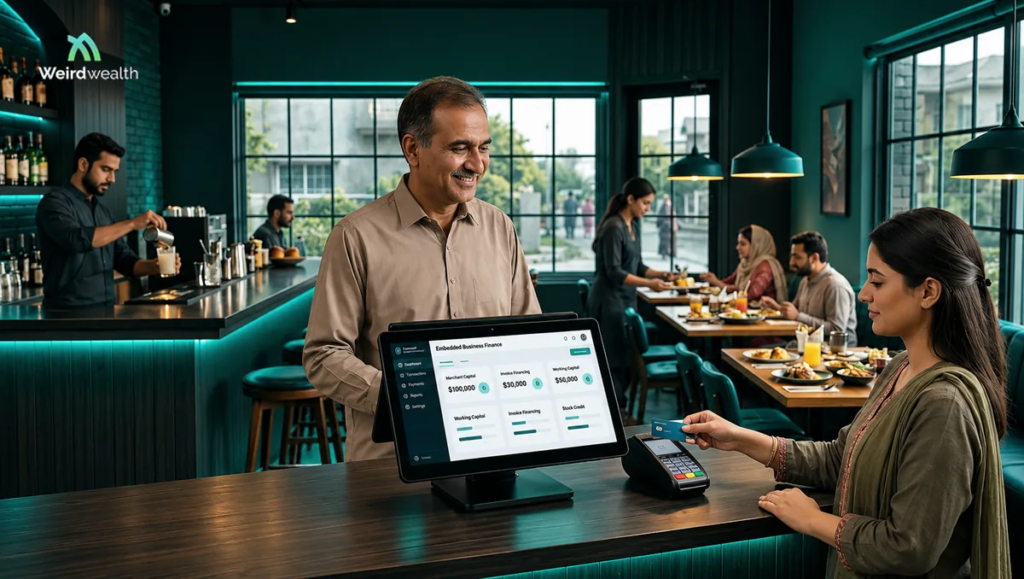
Embedded finance companies help businesses offer financial services directly inside their existing apps, websites, and software platforms. Instead of sending customers to a separate banking or payment provider, a business can integrate payments, financial accounts, card issuing, lending, or insurance into the experience customers already use.
Imagine running software for 5,000 independent restaurants. Your platform already helps owners manage reservations, track orders, and understand their sales. Every morning, restaurant managers open your dashboard to see how business is going. But when they need to receive payments, transfer money to suppliers, or apply for working capital, they may have to leave your software and use a separate financial service.
What if some of those functions could happen directly inside your platform? A restaurant owner could receive customer payments, access eligible financing options, and manage certain business expenses without constantly switching applications. That’s the promise of embedded finance. But there’s something important hiding behind the convenience.
The software company showing the financial product isn’t necessarily the licensed institution providing it. There may be payment processors, technology providers, regulated banks, lenders, and compliance partners operating behind the interface. At Weird Wealth, we believe understanding these relationships is essential for anyone building a business around financial technology.
Let’s explore ten embedded finance companies, what they actually provide, and how to evaluate the benefits and risks.
Key Takeaways
- Embedded finance brings financial products into nonfinancial applications and business platforms.
- Common services include payment processing, business accounts, card issuing, lending, and insurance.
- Stripe, Adyen, Marqeta, Unit, Synctera, Plaid, and other providers serve different parts of the infrastructure.
- Not every embedded finance company is a bank or directly lends money.
- Some platforms partner with regulated financial institutions to deliver particular services.
- Businesses may earn payment-related fees, service revenue, or contractual revenue shares.
- Integration costs, compliance responsibilities, fraud, reconciliation, and vendor dependence affect profitability.
- Choosing the right provider begins with identifying the financial problem the customer needs solved.
What Is an Embedded Finance Company?
An embedded finance company supplies technology, infrastructure, or regulated financial capabilities that allow another business to incorporate financial services into its product. PwC defines embedded finance as integrating banking and other financial services into platforms operated by nonfinancial companies. For example, a software company might allow customers to accept payments directly through its dashboard.
An online marketplace could distribute seller earnings. A business management platform might present eligible financing offers. The user interacts primarily with the original company, while specialist financial providers support the service behind the scenes. But the exact structure varies. Some embedded finance companies provide software and APIs.
Others are regulated payment institutions. Certain companies work with sponsor banks. And some products involve several separate organizations. The word embedded describes the customer experience. It doesn’t eliminate the financial and legal responsibilities behind it.
How Does Embedded Finance Work?
Let’s follow a hypothetical payment. A customer purchases a $100 product through a marketplace. The marketplace uses an embedded payments provider. The provider processes the payment and supports the relevant settlement and payout workflow. The marketplace may collect an agreed platform fee, while the seller receives the balance after applicable charges. The customer doesn’t necessarily need to open a separate payment application. But several important questions remain.
Who processes the payment?
Who manages refunds?
Who verifies the seller?
Who handles a dispute?
And who is responsible if the money doesn’t reach its intended destination?
A responsible business needs clear answers before launching.
The Five Main Types of Embedded Finance
| Category | What it enables | Example use |
| Embedded payments | Accepting, routing, and distributing payments | Marketplace seller payouts |
| Embedded banking | Financial accounts and money movement | Business accounts inside software |
| Embedded card issuing | Branded or program-specific cards | Employee expense cards |
| Embedded lending | Financing within an existing platform | Working capital for eligible merchants |
| Embedded insurance | Insurance offered during another transaction | Eligible protection during checkout |
Financial data connectivity is another important supporting category. It may not itself provide a bank account or loan, but it helps authorized applications access relevant account information.
10 Embedded Finance Companies Worth Understanding
These providers illustrate different business models. They’re not ranked by overall quality.
1. Stripe: Payments for Platforms and Marketplaces

Stripe is a major financial technology provider offering payment infrastructure. Its Stripe Connect product supports payment acceptance, onboarding, payment routing, and payouts for platforms and marketplaces. A software business can use Connect to manage transactions involving customers and participating sellers. Stripe also offers additional financial infrastructure products.
However, the exact features, financial responsibilities, and pricing depend on the selected integration. Best fit: Businesses prioritizing embedded payment flows and marketplace payouts.
2. Adyen: Payments, Accounts, Cards, and Capital
Adyen offers embedded financial products designed for platforms. Its official documentation describes services including business accounts, card issuing, capital, and payouts. For example, a platform serving small businesses might allow eligible users to receive payments, transfer funds, and use business cards within a connected environment.
The availability of particular products depends on geography and eligibility. Best fit: Platforms looking to combine payment processing with additional financial services.
3. Marqeta: Modern Card Issuing
Marqeta specializes in card issuing technology. Its platform enables businesses to build card programs using configurable infrastructure. Potential uses include expense management, business purchasing, and other approved card applications. But issuing a card is not the same as becoming a bank. A card program may involve regulated issuing institutions, payment networks, processors, and program managers. Best fit: Businesses developing specialized virtual or physical card experiences.
4. Unit: Embedded Banking Infrastructure

Unit provides banking-as-a-service infrastructure for eligible U.S. software companies. Its offering is associated with financial accounts, cards, payments, and other banking-related functionality through partner arrangements. A software platform might use this type of infrastructure to offer business financial services without developing every technical component internally. The structure and responsibilities of the underlying bank relationships remain essential.
Best fit: U.S.-focused platforms evaluating embedded account and banking functionality.
5. Synctera: Connecting Fintechs and Banking Partners
Synctera offers technology supporting relationships between financial technology businesses and regulated banks. Its positioning includes account and card-related infrastructure alongside oversight and operational capabilities. This reflects a central challenge in embedded banking. The technology needs to work, but the involved institutions also need to maintain records, manage risks, and meet applicable requirements.
Best fit: Fintech programs that need infrastructure aligned with partner-bank operations.
6. Treasury Prime: Bank-Connected Financial Infrastructure
Treasury Prime provides technology connecting financial institutions and businesses developing embedded financial products. Its approach emphasizes bank relationships and financial infrastructure integration. For software companies, the appeal may be the ability to access banking capabilities through established technology interfaces.
However, implementation still depends on bank participation, product eligibility, and contractual responsibilities. Best fit: Businesses evaluating direct relationships with participating banks and banking infrastructure.
7. Plaid: Financial Data Connectivity

Plaid occupies a different position. Its technology helps authorized users connect financial accounts to applications.
Plaid Link supports account linking and access to supported financial data products. This can be useful for account verification, financial information, and certain payment-related workflows. But Plaid is not automatically the institution holding money or providing a loan merely because an application uses its technology. Best fit: Applications needing authorized financial account connections and related information.
8. Airwallex: Business Payments and Global Money Movement
Airwallex provides financial infrastructure associated with business payments, accounts, and international transactions. Cross-border businesses may want to collect payments and manage transactions involving multiple currencies or markets. But coverage, account features, licensing, and available services vary by region. Best fit: Businesses evaluating global payment and money movement capabilities.
9. Parafin: Embedded Business Financing
Parafin operates in the embedded capital category. Its model involves financing made available to eligible businesses through partner platforms. Imagine a merchant management service whose users sometimes need funding to buy equipment or manage inventory. Embedded financing can place an offer within the platform’s existing customer journey. But borrowing creates repayment obligations, and offers depend on underwriting and program terms.
Best fit: Platforms with eligible merchant populations interested in business financing.
10. Cover Genius: Embedded Protection and Insurance
Cover Genius provides technology for distributing protection and insurance products within other customer experiences. For example, a travel platform might offer an eligible insurance product during booking. This is different from processing a payment or opening a bank account.
Insurance involves underwriting, policy terms, exclusions, claims handling, and applicable regulation. Best fit: Businesses wanting suitable insurance or protection products within a relevant purchasing journey.
Comparing Embedded Finance Providers
| Company | Main specialization | Business need |
| Stripe | Platform payments and payouts | Marketplace transactions |
| Adyen | Payments and financial products | Connected financial services |
| Marqeta | Card issuing | Custom card programs |
| Unit | Banking-as-a-service | Embedded accounts and payments |
| Synctera | Bank-fintech infrastructure | Banking program integration |
| Treasury Prime | Bank-connected technology | Financial infrastructure |
| Plaid | Account connectivity | Financial data and verification |
| Airwallex | International financial infrastructure | Global payments |
| Parafin | Embedded capital | Merchant financing |
| Cover Genius | Embedded insurance | Transaction-related protection |
The companies solve different problems.
Comparing them as though they all sell identical products would be misleading. A marketplace needing payment splits should not automatically choose a card issuing specialist. A company requiring account verification may need a data connectivity provider rather than a banking platform.
How Do Embedded Finance Companies Make Money?
Business models differ.mSome charge per transaction. Others charge account-related fees, implementation fees, monthly platform fees, or amounts associated with particular services. Revenue-sharing arrangements may also apply. Consider a hypothetical software company serving 1,000 merchants. Suppose 400 merchants actively use its integrated payments service.
Each processes $8,000 monthly.
Total monthly processed volume would be:
400 × $8,000 = $3.2 million
If the software company receives a hypothetical net contractual revenue share equal to 0.15% of that processed volume, its monthly share would be: $3.2 million × 0.0015 = $4,800 But that is not necessarily profit. Integration, customer service, fraud losses, chargebacks, administration, legal work, and other costs may affect the economics.
Also, not every provider offers such an arrangement. This example illustrates how a revenue model might work, not a guaranteed commercial offer.
Embedded Finance vs. Banking-as-a-Service
These terms overlap but aren’t identical. Embedded finance describes the integration of financial services into another product. Banking-as-a-service, commonly shortened to BaaS, usually describes infrastructure arrangements that allow nonbanks to offer bank-connected services through regulated partners.
A company may use BaaS to provide embedded account functionality. But an ordinary embedded checkout payment doesn’t necessarily require the same banking-as-a-service arrangement. The distinction matters because responsibilities differ.
The Federal Reserve, FDIC, and OCC have explained that certain third-party arrangements can introduce risks involving customer records, operations, data privacy, and financial crime controls. The involvement of an outside technology company does not eliminate a regulated bank’s obligations.
What Are the Risks of Embedded Finance?
Regulatory Complexity
Payments, deposits, lending, and insurance are regulated differently. The legal structure matters more than the marketing label.
Vendor Dependence
If a critical provider experiences an outage, participating businesses may lose access to essential functions.
Customer Data
Embedded products can involve sensitive financial information. Appropriate permissions, privacy safeguards, and security controls are essential.
Reconciliation Problems
Money movement and account records must align. A beautiful dashboard doesn’t compensate for missing or inaccurate financial entries.
Fraud and Disputes
Financial transactions attract fraudulent activity. Responsibilities for monitoring, refunds, chargebacks, and complaints must be clearly assigned.
Customer Confusion
A user may believe the software brand itself holds their money when another institution actually provides the financial service. Clear disclosures are essential.
The Weird Wealth EMBED Framework
Here’s an original framework for evaluating embedded finance companies. We call it the EMBED Framework.
E — End-User Need
What specific problem will the financial product solve? Don’t launch lending or banking features merely because competitors advertise them.
M — Money Flow
Who receives, holds, transfers, and settles the funds?
Document each party’s role.
B — Banking and Regulatory Responsibility
Which entity provides the regulated service?
Who handles verification, complaints, and relevant compliance obligations?
E — Economics
What are the actual implementation, operating, transaction, and risk-management costs?
Compare these with realistic revenue.
D — Dependability
What happens during an outage, bank-partner change, dispute, or vendor termination?
Can the business maintain accurate records and protect customers?
The framework encourages evaluating the entire financial arrangement rather than relying solely on API documentation.
How to Choose an Embedded Finance Company
Start by describing the user problem in one sentence.
For example:
“Our marketplace needs to pay approved sellers accurately and on time.”
That’s clearer than saying:
“We want to launch fintech.”
Then evaluate the following:
- Product capabilities and relevant geographic coverage
- Licensing and regulated partner structure
- Technical documentation and integration requirements
- Pricing and contractual obligations
- Onboarding, identity verification, and monitoring
- Reconciliation and reporting
- Fraud and dispute management
- Customer support responsibilities
- Data protection and cybersecurity
- Exit procedures and business continuity
For financial account programs, investigate the quality of records and the arrangements governing customer funds. Regulatory guidance emphasizes that outsourcing activities does not remove relevant responsibilities from the participating bank.
Is Embedded Finance Profitable?
It can be, but profitability depends on actual customer demand and implementation economics. Imagine a software company introducing financing to businesses that rarely borrow. Even excellent technology may produce limited revenue. Now imagine a platform whose customers regularly struggle with delayed supplier payments. A well-designed financial product could solve a genuine problem.
That doesn’t mean launching it is automatically profitable. The company still needs suitable partners, controls, customer support, and financial terms. The strongest embedded finance strategy begins with a customer need and works backward toward the infrastructure required.
Frequently Asked Questions
What are embedded finance companies?
They are businesses providing technology or financial capabilities that allow other companies to integrate payments, accounts, lending, insurance, and related services into existing products.
What are examples of embedded finance companies?
Examples include Stripe, Adyen, Marqeta, Unit, Synctera, Treasury Prime, Plaid, Airwallex, Parafin, and Cover Genius.
Is Stripe an embedded finance company?
Yes. Stripe provides financial infrastructure, including Stripe Connect for platform payments and payouts.
Is embedded finance the same as fintech?
No. Fintech is a broad category of financial technology. Embedded finance specifically integrates financial services into another customer experience.
What is the difference between embedded finance and BaaS?
Embedded finance describes the customer-facing integration. BaaS generally refers to infrastructure connecting nonbank businesses with regulated banking services.
Do embedded finance companies need banking licenses?
Requirements depend on the activities and jurisdiction. Some providers are regulated financial institutions, while others work with licensed banks or other partners.
How do embedded finance providers earn revenue?
They may charge transaction, subscription, account, implementation, or service fees, and some arrangements include revenue sharing.
Can small businesses use embedded finance?
Yes, especially through suitable software platforms. But eligibility, service availability, pricing, and responsibilities vary.
What is the biggest risk of embedded finance?
There isn’t one universal risk. Major concerns include customer funds, regulatory compliance, vendor dependence, financial record accuracy, cybersecurity, and fraud.
Final Thoughts
Embedded finance is changing something fundamental about financial services. People increasingly expect financial tasks to work inside the applications they already use. A business owner doesn’t necessarily want another complicated banking dashboard. They want to receive payments, pay suppliers, and understand their finances without unnecessary friction.
That’s where embedded finance becomes valuable. But convenience should never hide complexity. Behind every account, card, payment, or loan is a network of organizations responsible for different parts of the service. At Weird Wealth, we believe the companies that deserve attention are the ones that make those arrangements reliable, understandable, and genuinely useful.
The future of embedded finance isn’t simply putting a payment button inside every application. It’s solving real financial problems while making sure the money, responsibilities, and risks are managed properly. That’s what turns financial technology into meaningful business infrastructure.