
When Maya first explored cryptocurrency, she had one simple question: should she buy Bitcoin or Ethereum?
Bitcoin seemed easier to understand. Its supply was limited, and people often compared it to digital gold. Ethereum sounded more complicated, but its blockchain could power financial services, digital assets, and decentralized applications.
She soon discovered that choosing between BTC and ETH was not simply about picking the cheaper coin. They were built for different purposes, and their prices depended on different economic forces.
Bitcoin vs Ethereum comes down to their core purpose: Bitcoin focuses on decentralized digital money and scarcity, while Ethereum provides a programmable blockchain for smart contracts and applications. Both can transfer value, but their technology, supply mechanics, and risks differ.
Key Takeaways
- Bitcoin (BTC) has a maximum supply of 21 million coins under its current protocol rules.
- Ethereum is a programmable blockchain, and ether (ETH) powers transactions and network activity.
- Bitcoin uses proof-of-work; Ethereum uses proof-of-stake.
- ETH does not have Bitcoin’s fixed 21-million supply cap.
- Neither cryptocurrency is guaranteed to outperform the other, and both can lose substantial value.
Bitcoin vs Ethereum: What Is the Difference?
Its limited supply and monetary focus have helped establish its reputation as digital gold. Ethereum launched in 2015 with a broader objective: making blockchain technology programmable. Developers can create smart contracts programs that execute according to defined rules and use them to build applications for trading, lending, payments, and digital assets.
| Feature | Bitcoin (BTC) | Ethereum / Ether (ETH) |
| Primary purpose | Decentralized digital money | Programmable blockchain and applications |
| Launch | 2009 | 2015 |
| Native asset | Bitcoin (BTC) | Ether (ETH) |
| Maximum supply | 21 million BTC under current protocol rules | No fixed maximum supply cap |
| Consensus mechanism | Proof-of-work | Proof-of-stake |
| Network activity | Payments and value transfers | Transfers, smart contracts, and decentralized applications |
| Supply mechanics | Predetermined issuance schedule | Issuance and fee burning affect net supply |
| Main investment thesis | Scarcity, monetary use, and adoption | Network usage, application growth, and demand for ETH |
| Important risks | Volatility, custody, regulation, and market demand | Volatility, application risks, custody, and regulation |
Bitcoin is not simply an older version of Ethereum. Their designs reflect different priorities, so comparing them requires more than looking at their market prices.
What Makes Bitcoin Different?

Bitcoin’s appeal starts with a relatively straightforward idea: people can hold and transfer a digital asset without a central institution controlling the network.
Its most distinctive economic feature is the 21-million-coin supply limit built into its current protocol rules. New bitcoin enters circulation through mining rewards, which decline through scheduled halvings.
That predictable issuance schedule is one reason investors compare Bitcoin to scarce assets such as gold. However, scarcity alone does not establish a fair price or guarantee that demand will increase.
Bitcoin also uses proof-of-work. Miners use computing power to compete to add blocks of transactions, helping secure the network. This process consumes energy, and the network’s security depends on its economic incentives and continued participation.
For someone evaluating BTC, useful questions include:
- Is there sustained demand for Bitcoin as a transferable digital asset?
- How does its price compare with its historical volatility?
- Can you securely store and access your holdings?
- Would a significant price decline affect your financial stability?
Bitcoin’s focused design can appeal to people who value monetary simplicity. It also means Bitcoin does not natively provide the same general-purpose smart-contract environment as Ethereum.
What Makes Ethereum Different?

Ethereum was designed to support programmable applications on a decentralized network. Its smart contracts can enforce rules automatically when users interact with them.
Ether is the native asset used to pay Ethereum network transaction fees. ETH also plays a role in staking, through which participants help secure the proof-of-stake network.
Unlike Bitcoin, Ethereum does not have a fixed maximum supply of 21 million units. New ETH is issued to reward validators, while some transaction fees are burned. Depending on issuance and network activity, the total supply can increase or decrease over time.
This creates a different economic story. Demand for ETH can be influenced by demand for the asset itself and by activity across Ethereum’s ecosystem, although greater network activity does not automatically translate into higher ETH prices. Just as people explore digital side hustles to build income streams and compare high-yield savings accounts to make informed financial decisions, crypto investors should understand an asset’s underlying economics. Those holding Bitcoin or other cryptocurrencies should also consider secure storage options, such as the best Bitcoin wallets.
Ethereum’s flexibility also introduces risks. Smart contracts can contain vulnerabilities, applications can fail, and users may lose funds through exploits or mistakes. Staking and decentralized finance services introduce additional risks beyond simply holding ETH.
Bitcoin vs ETH: Which Has Better Tokenomics?
Tokenomics describes how a cryptocurrency’s supply, issuance, incentives, and distribution work.
Bitcoin has a predetermined issuance schedule and a maximum supply of 21 million BTC under its current protocol rules. Ethereum has a more dynamic supply model, with issuance to validators and burning of certain transaction fees.
Neither model automatically makes one asset a better investment.
Bitcoin’s scarcity narrative depends partly on whether demand remains strong. Ethereum’s economic model depends on several variables, including validator participation, network usage, and the amount of ETH burned.
A useful comparison is to examine three factors.
Supply growth: How quickly does the amount of circulating cryptocurrency change?
Demand: What motivates people to hold, use, or acquire the asset?
Valuation: How much are buyers paying relative to the network’s current use and plausible future adoption?
A limited supply can coexist with weak demand. A flexible supply can coexist with growing demand. The interaction between the two matters more than any single metric.
Bitcoin vs Ethereum: Which Is More Risky?
Both cryptocurrencies are speculative assets. Their prices can move sharply because of changing investor sentiment, macroeconomic conditions, regulatory developments, liquidity, and market positioning.
However, their risk profiles differ.
Bitcoin’s more focused purpose does not eliminate price volatility, custody risks, exchange failures, or regulatory uncertainty. Its market value depends on continued demand and confidence in its monetary role.
Ethereum shares those risks while adding exposure to its broader application ecosystem. Smart-contract vulnerabilities, decentralized finance failures, network upgrades, and competing platforms can affect activity and confidence.
| Risk factor | Bitcoin | Ethereum |
| Market volatility | High | High |
| Supply uncertainty | Predetermined issuance schedule and protocol rules | Dynamic issuance and burning |
| Application-specific risk | More limited native application functionality | Broader exposure to smart contracts and decentralized applications |
| Custody risk | Present | Present |
| Long-term adoption uncertainty | Significant | Significant |
Neither asset should be treated as safe merely because it is established or widely recognized. Only commit money you can afford to lose, and do not use emergency savings or borrowed money to speculate on crypto.
Bitcoin vs Solana: How Does SOL Compare?
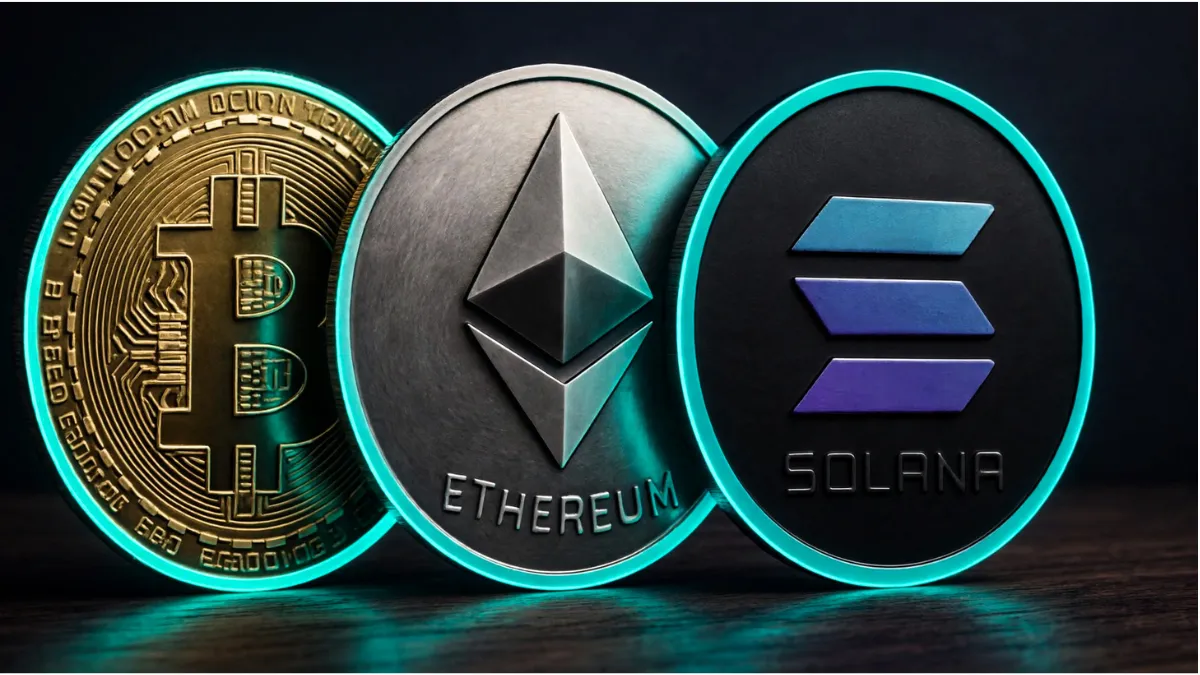
Bitcoin and Ethereum are not the only networks investors compare. Solana (SOL) is another major blockchain ecosystem, particularly known for supporting applications and high-throughput transactions.
The distinction is useful because people sometimes compare cryptocurrencies solely by price or recent performance without understanding their different purposes.
| Feature | Bitcoin | Ethereum | Solana |
| Main focus | Digital money and monetary scarcity | Programmable applications and smart contracts | Programmable applications with an emphasis on transaction throughput |
| Consensus | Proof-of-work | Proof-of-stake | Proof-of-stake with a separate transaction-ordering mechanism |
| Supply design | 21 million BTC maximum under current protocol rules | No fixed maximum supply cap | No fixed maximum supply cap |
| Ecosystem focus | Value transfers and Bitcoin-related infrastructure | DeFi, stablecoins, tokenized assets, and applications | DeFi, consumer applications, payments, and digital assets |
| Main consideration | Demand for Bitcoin as a monetary asset | Network adoption and ETH economics | Network adoption, validator economics, and technical reliability |
Solana’s design differs from Ethereum’s, and each ecosystem has its own technical trade-offs. Faster or cheaper transactions alone do not establish that one network has better long-term prospects.
Investors should compare decentralization, reliability, ecosystem demand, token supply, and risks rather than relying on headline transaction speeds.
Should You Buy Bitcoin or Ethereum?
There is no universally correct answer to whether Bitcoin or Ethereum is the better purchase. The choice depends on what you believe drives each asset’s long-term demand, your tolerance for losses, and your investment time horizon.
Use the PURPOSE framework before making a decision.
- P — Purpose: Decide whether Bitcoin’s monetary focus or Ethereum’s application ecosystem better matches your investment thesis.
- U — Understanding: Make sure you can explain how the asset works and what could cause its value to fall.
- R — Risk capacity: Consider whether you can withstand a substantial decline without affecting essential expenses.
- P — Price and valuation: Research current market capitalization, supply mechanics, and relevant adoption indicators.
- O — Ownership: Decide how you will hold the asset and protect your account or wallet.
- S — Strategy: Set your time horizon and position size before buying.
- E — Exit conditions: Decide what would change your investment thesis and how you would respond.
This framework is designed to improve your decision-making, not predict returns.
If you are exploring other ways people participate in cryptocurrency markets, Weird Wealth also explains crypto income opportunities. Remember that earning yield or participating in crypto-related services can involve risks beyond holding BTC or ETH.
Frequently Asked Questions
Is Bitcoin better than Ethereum?
Neither is universally better. Bitcoin focuses on decentralized digital money and a limited supply, while Ethereum supports smart contracts and decentralized applications. The better fit depends on your objectives and risk tolerance.
Is ETH the same as Ethereum?
No. Ethereum is the blockchain network, while ether (ETH) is its native cryptocurrency. ETH is used to pay transaction fees and plays a role in securing the network through staking.
Can Ethereum’s supply exceed 21 million?
Yes. Ethereum does not have Bitcoin’s fixed 21-million supply cap. ETH issuance and burning affect its net supply over time.
Why is Bitcoin often called digital gold?
Bitcoin’s limited supply and decentralized design lead many people to compare it with gold as a potential store of value. The comparison is not a guarantee of stability or future returns.
Can I buy a fraction of Bitcoin or Ethereum?
Yes. Both BTC and ETH are divisible, so you generally do not need to buy one whole coin. Minimum purchases and transaction fees depend on the platform you use.
Which is safer to hold, BTC or ETH?
Neither is risk-free. Both face substantial price volatility, custody risks, and regulatory uncertainty. Ethereum also has a broader smart-contract ecosystem with additional application-specific risks.
The Bottom Line
Bitcoin and Ethereum solve different problems. Bitcoin’s appeal centers on decentralized digital money and predictable scarcity, while Ethereum’s appeal centers on programmable blockchain infrastructure and the applications built on it.
Rather than asking which coin has the lower price or which performed better last month, ask what creates demand for each asset, how its supply works, and which risks you are prepared to accept.
Maya’s original question did not have a universal answer. Her useful next step was to understand the two assets before deciding whether either belonged in her financial plan. That is a better starting point than chasing whichever chart looks most exciting.
Financial disclaimer:
This article is for educational purposes only and is not individualized financial or investment advice. Bitcoin, ether, and other crypto assets are highly volatile and can lose substantial or all of their value. Research current market conditions and consider your financial circumstances before investing.