
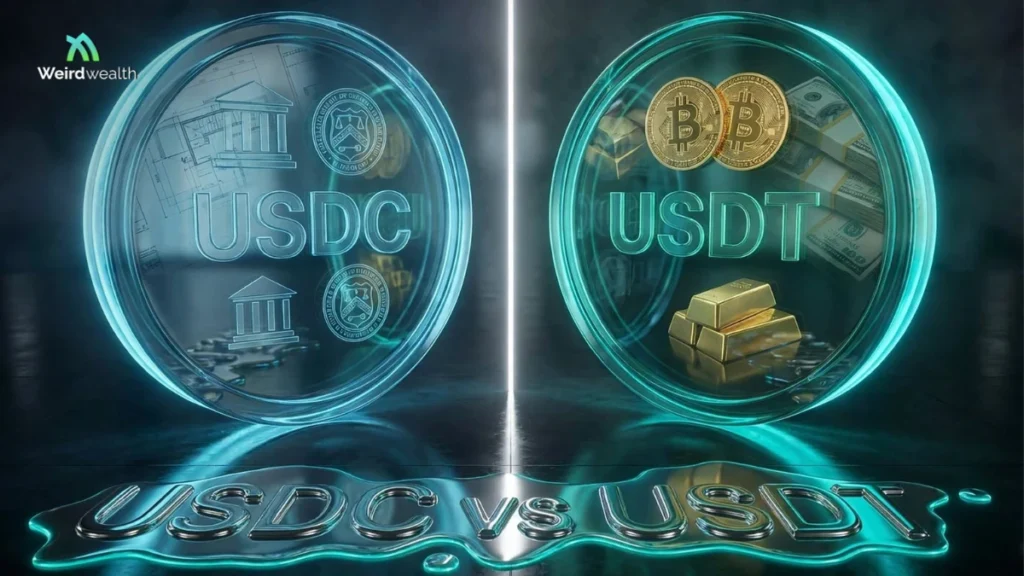
A cryptocurrency can lose 20% of its value in a short period. Stablecoins are designed to reduce that kind of price volatility by tracking an asset such as the US dollar. That makes them useful for moving money across crypto markets, holding funds between trades, and transferring digital dollars without relying on a traditional bank transfer for every transaction.
But “stable” does not mean risk-free. A stablecoin can lose its dollar peg, become difficult to redeem, or expose holders to risks involving reserves, issuers, exchanges, and regulation.
Two of the most widely used dollar-linked stablecoins are USDC and USDT. Understanding how they differ and what could go wrong is essential before treating either one like cash.
Key Takeaways
- Stablecoins aim to maintain a relatively stable value, often by tracking the US dollar.
- USDC is issued by Circle, while USDT is issued by Tether.
- Reserve arrangements, transparency, redemption access, and availability differ between stablecoins.
- A depeg occurs when a stablecoin trades materially above or below its intended value.
- Stablecoins carry issuer, reserve, liquidity, technology, regulatory, and platform risks.
What Are Stablecoins?
Stablecoins are digital tokens designed to maintain a relatively stable value against a reference asset. The most common examples track the US dollar, although some stablecoins reference other currencies or assets.
Unlike Bitcoin, whose market price changes according to supply, demand, and market conditions, a dollar-linked stablecoin aims to trade near $1 per token.
Stablecoins are used for several purposes:
- Moving value between cryptocurrency exchanges.
- Transferring digital dollars across supported blockchain networks.
- Holding funds temporarily without converting back to a bank account.
- Making payments where merchants or payment providers accept them.
- Accessing decentralized finance applications, including lending and trading services.
Their usefulness depends on the specific token, the blockchain it uses, the platforms that support it, and whether holders can reliably sell or redeem it.
A token trading at $1 is not necessarily equivalent to an insured bank deposit or a dollar held in a personal bank account.
USDC vs. USDT: What Is the Difference?
USDC and USDT are both major dollar-linked stablecoins, but they have different issuers, reserve arrangements, and market positions.
The comparison below describes their general characteristics. Reserve disclosures, redemption terms, and regulatory arrangements can change, so check current issuer documentation before making a decision.
| Feature | USDC | USDT |
| Issuer | Circle | Tether |
| Intended value | 1 US dollar | 1 US dollar |
| Reserve model | Backed by reserve assets intended to support redemption at par | Backed by reserve assets intended to support its dollar peg |
| Disclosure approach | Publishes reserve-related disclosures and attestation reports | Publishes reserve reports and related disclosures |
| Market role | Widely used for trading, payments, and decentralized finance | Widely used across cryptocurrency exchanges and global crypto markets |
| Main considerations | Reserve arrangements, issuer and regulatory exposure, supported networks | Reserve composition, issuer and regulatory exposure, supported networks |
| Availability | Supported on multiple blockchain networks and platforms | Supported on multiple blockchain networks and platforms |
What is USDC?
USDC is a dollar-linked stablecoin issued by Circle. It is designed to maintain a value of $1 and is used for trading, payments, transfers, and blockchain-based financial applications.
Circle publishes information about USDC’s reserves and related assurance reports. These disclosures can help users understand the assets supporting the token, but they do not eliminate every risk.
Before holding USDC, check the current reserve information, the terms and availability of redemption, the network you plan to use, and any restrictions that may apply to your account or location.
What is USDT?
USDT is a dollar-linked stablecoin issued by Tether. It is widely used in cryptocurrency trading and is available across multiple blockchain networks.
Its broad use can make it convenient when trading assets or transferring funds between platforms that support it. However, convenience should not replace research into the issuer’s reserve disclosures, redemption arrangements, and applicable restrictions.
As with USDC, the fact that USDT is designed to track the dollar does not mean it is guaranteed to remain at exactly $1 in every market or circumstance.
Which is better: USDC or USDT?
Neither is automatically the better choice for every user. USDC may appeal to users who prioritize its disclosure framework and the regulatory arrangements relevant to their jurisdiction. USDT may be preferable for a particular transaction when the receiving exchange, trading pair, or payment service supports it more conveniently.
The decision should depend on what you need the stablecoin to do, how you can redeem or sell it, and which risks you are prepared to accept.
Weird Wealth rule: Choose the stablecoin that best fits your actual transaction and risk requirements—not the one with the most familiar ticker or the largest number of trading pairs.
How Do Stablecoins Maintain Their Dollar Peg?
A stablecoin’s peg is supported by its design, reserve arrangements, redemption mechanisms, and market activity. Different stablecoins use different methods, so it is important to understand the model behind a specific token.
Reserve-backed stablecoins
Reserve-backed stablecoins are supported by assets held or managed to support the value of the tokens in circulation. Depending on the issuer, reserves may include cash, short-term government securities, and other permitted assets.
The intended mechanism is straightforward: eligible holders or authorized institutions can redeem tokens under the issuer’s terms, while market participants trade the tokens close to their reference value.
However, the system depends on the quality and availability of reserves, operational arrangements, market confidence, and the ability to process redemptions.
Crypto-collateralized stablecoins
Some stablecoins use other cryptocurrencies as collateral. Because that collateral can be volatile, these systems may require excess collateral, automated liquidation mechanisms, and other safeguards. Understanding Bitcoin wallets can also help readers learn how crypto assets are stored and managed.
Their stability depends on the protocol’s design, the value and liquidity of collateral, and how the system responds during market stress.
Algorithmic stablecoins
Algorithmic designs attempt to maintain a target price through mechanisms such as changes in token supply or relationships between multiple tokens. Some designs have failed dramatically when confidence collapsed and the mechanisms intended to restore the peg could not withstand selling pressure. A mechanism that works in normal markets may not survive a severe liquidity crisis.
The label “stablecoin” alone does not tell you which model is being used. Always identify the specific token and understand how its peg is intended to work. Just as you compare high-yield savings accounts to understand different approaches to managing savings, evaluating digital financial products requires looking beyond their labels and understanding how they work.
What Is a Stablecoin Depeg?

A stablecoin depeg occurs when its market price moves away from its intended reference value by a meaningful amount.
For a dollar-linked stablecoin, a price of $0.99 represents trading below the intended peg. A price of $1.02 represents trading above it. Small deviations can occur during ordinary market activity, while more severe or prolonged deviations may signal greater stress.
A temporary price difference is not automatically evidence that the issuer is insolvent. Equally, a token returning to $1 does not prove that every underlying risk has disappeared.
Why do stablecoins depeg?
Several factors can cause a stablecoin to move away from its target. Reserve concerns: Users may question whether the issuer holds sufficient, accessible, and appropriately managed assets. Redemption problems: Delays, restrictions, operational failures, or uncertainty about who can redeem tokens may weaken confidence. Similarly, creating and selling Notion templates online depends on building buyer trust and delivering a product that meets expectations.
Heavy selling: During a market panic, sellers may accept less than $1 to exit quickly, particularly when buyers are scarce.
Exchange or banking disruption: Problems affecting an issuer’s banking partners, exchanges, or payment infrastructure can affect confidence and liquidity.
Smart-contract or blockchain problems: Exploits, network congestion, or technical failures can interfere with transfers and trading.
Weak stabilization mechanisms: A stablecoin that depends on fragile incentives or volatile collateral may struggle to maintain its peg under severe stress.
What should you do if a stablecoin depegs?
Avoid making a rushed decision based on a single price quote. First, confirm that the price deviation is real and check whether it appears across several reputable exchanges or data providers.
Then investigate the cause. Look for official issuer announcements, redemption updates, reserve disclosures, and reports of exchange or network disruptions.
Consider your actual exposure, including whether your tokens are held in a personal wallet, on an exchange, or in a lending protocol. Each arrangement introduces different risks.
Do not assume that a return to $1 is guaranteed, and do not send funds to unfamiliar websites or individuals promising immediate recovery or special redemption access.
The Main Risks of Holding Stablecoins

Stablecoins can reduce one type of risk the day-to-day price volatility associated with many cryptocurrencies but they introduce other risks.
1. Issuer and reserve risk
A stablecoin depends on the arrangements supporting its value. Reserve assets may face liquidity, credit, custody, or operational risks. The issuer may also face legal or regulatory problems that affect redemption or access.
Review the issuer’s latest disclosures rather than relying on old articles or social media claims.
2. Depegging risk
The token may trade below its intended value, temporarily or for a prolonged period. If you must sell during a depeg, you may receive less than the amount you expected.
3. Redemption and liquidity risk
Not every holder has direct access to an issuer’s redemption process. Minimum amounts, eligibility rules, fees, banking access, or other terms may apply.
A token can also be difficult to sell at the expected price if the market becomes illiquid.
4. Exchange and custodian risk
Holding stablecoins on an exchange means you depend on that platform’s security, solvency, withdrawal systems, and account policies.
An exchange may suspend withdrawals or restrict access even when the stablecoin itself continues to trade near $1 elsewhere.
5. Blockchain and smart-contract risk
Sending tokens on the wrong network can result in lost or inaccessible funds. Smart-contract vulnerabilities, bridge exploits, and network failures can also create losses.
Always verify the receiving address and supported network before transferring tokens.
6. Regulatory and access risk
Rules for stablecoins differ across jurisdictions and may change. Issuers, exchanges, and service providers can restrict certain activities or users in response to legal requirements.
Check the rules that apply where you live and where your service provider operates.
7. Opportunity cost and inflation
A dollar-linked stablecoin generally aims to preserve a dollar value, not increase purchasing power. Inflation can reduce what that dollar buys over time.
Some platforms advertise yield on stablecoins, but the return may involve lending, leverage, liquidity restrictions, or additional counterparty risk. A stablecoin itself does not guarantee interest.
How to Evaluate a Stablecoin Before Holding It
Use the PEG Check framework before deciding where to hold funds.
| Check | Question to ask | Why it matters |
| P — Peg mechanism | How is the token designed to maintain its target value? | Different mechanisms have different failure modes. |
| E — Evidence of reserves | What current reserve disclosures or assurance reports are available? | Helps you evaluate the information supporting the peg. |
| G — Getting your money out | Who can redeem the token, under what terms, and where can it be sold? | Access may differ between direct redemption and exchange trading. |
| C — Custody and chain | Which platform or blockchain will hold or transfer the token? | Exchange, network, and smart-contract risks can create losses. |
Apply the same checks to both USDC and USDT. Do not treat a familiar brand, a large market capitalization, or a long history as a substitute for checking current conditions.
Are Stablecoins Safe for Savings?
Stablecoins may be useful for certain digital payments and cryptocurrency transactions, but they should not automatically be treated as a replacement for insured bank savings.
A bank deposit may qualify for deposit protection under applicable rules, subject to eligibility and coverage limits. A stablecoin generally does not provide the same protection simply because it is linked to the dollar.
Before keeping substantial funds in stablecoins, consider your emergency savings, your need for immediate access, your local financial regulations, and the possibility of losing access to the issuer or platform.
If your objective is to earn a return, investigate the source of that yield and the risks involved. A high advertised rate can be compensation for taking risks that are not immediately obvious.
Frequently Asked Questions
Is USDC safer than USDT?
Neither stablecoin is risk-free. Their reserve disclosures, redemption arrangements, issuer structures, market liquidity, and regulatory circumstances differ. Compare current documentation and your intended use instead of assuming one is universally safer.
Can USDC or USDT lose its peg?
Yes. Both are designed to track the US dollar, but market prices can deviate from $1. The duration and severity of a deviation depend on market conditions, liquidity, confidence, and the factors affecting the specific stablecoin.
What happens if a stablecoin collapses?
The outcome depends on the issuer, reserve assets, redemption arrangements, market liquidity, and applicable legal processes. Holders may face delays, restrictions, or losses. Recovery is not guaranteed.
Do stablecoins pay interest?
Holding a stablecoin does not automatically generate interest. Returns offered by exchanges, lending platforms, or decentralized finance protocols come with additional terms and risks.
Are stablecoins the same as dollars in a bank account?
No. A stablecoin is a digital token intended to track a reference asset. It does not automatically have the same legal status, deposit protection, or redemption rights as money held in a bank account.
Can I use stablecoins in Pakistan?
Availability, platform access, banking support, and applicable rules can change. Before buying, selling, or using stablecoins in Pakistan, check current requirements from relevant official authorities and the terms of the platform you intend to use. Do not assume that access to a token on an international exchange establishes its legal status locally.
The Bottom Line
Stablecoins are designed to make cryptocurrency transactions less exposed to everyday price swings, but their stability depends on the systems supporting them. USDC and USDT both aim to maintain a dollar peg, yet they differ in issuer, disclosures, market usage, and other considerations.
Before holding either one, examine its peg mechanism, reserve information, redemption terms, and the platform or blockchain you plan to use. If a stablecoin trades away from $1, verify the information and understand the cause before making a decision.
The goal is not simply to find a token that says “stable” on the label. It is to understand what supports that stability and what might happen when the system is under pressure.
Financial disclaimer:
This article is for educational purposes only and does not constitute individualized financial, legal, tax, or investment advice. Stablecoins can lose their peg, become difficult to redeem, or lose substantial value. Verify current issuer disclosures and applicable local rules before making financial decisions.