A cryptocurrency can look inexpensive at $0.10 and still be dramatically overvalued. Another token trading at $100 might have a much smaller overall market valuation. The difference often comes down to tokenomics: how a token is issued, distributed, used, and brought into circulation.
Tokenomics helps explain why a project’s price can rise while its underlying supply risks grow. It also reveals whether early investors hold a large share of tokens, whether new supply may enter the market, and how a project’s valuation could change over time.
If you want to understand a cryptocurrency beyond its ticker and price chart, start with three numbers: circulating supply, total supply, and fully diluted valuation.
Key Takeaways
- Circulating supply estimates how many tokens are currently available in the market.
- Total supply generally measures tokens already created, minus tokens permanently removed, subject to the data provider’s methodology.
- Fully diluted valuation (FDV) estimates a token’s valuation using its price and maximum or fully diluted supply.
- Token unlocks can make previously restricted tokens transferable, potentially increasing selling pressure.
- A low token price does not automatically mean an asset is cheap; supply and valuation matter just as much.
What Is Tokenomics in Cryptocurrency?
Tokenomics combines the words token and economics. It describes the economic design of a cryptocurrency or blockchain token, including how tokens are created, distributed, used, and removed from circulation.
Tokenomics can influence incentives for users, developers, investors, validators, and other participants. It can also help explain how a token’s supply may evolve over time.
Important elements include:
- Supply: How many tokens exist, circulate, or may eventually be created.
- Distribution: Who holds the tokens and how allocations are divided.
- Issuance: Whether new tokens are created through mining, staking rewards, emissions, or other mechanisms.
- Utility: What the token actually does within its ecosystem.
- Burning: Whether tokens are permanently removed from circulation under defined conditions.
- Vesting and unlocks: When allocated tokens become transferable.
- Incentives: How the system rewards or charges participants.
Good tokenomics does not guarantee that a cryptocurrency will succeed. A token may have a carefully designed supply schedule and still struggle because of weak demand, poor execution, competition, or limited utility.
Circulating Supply vs. Total Supply
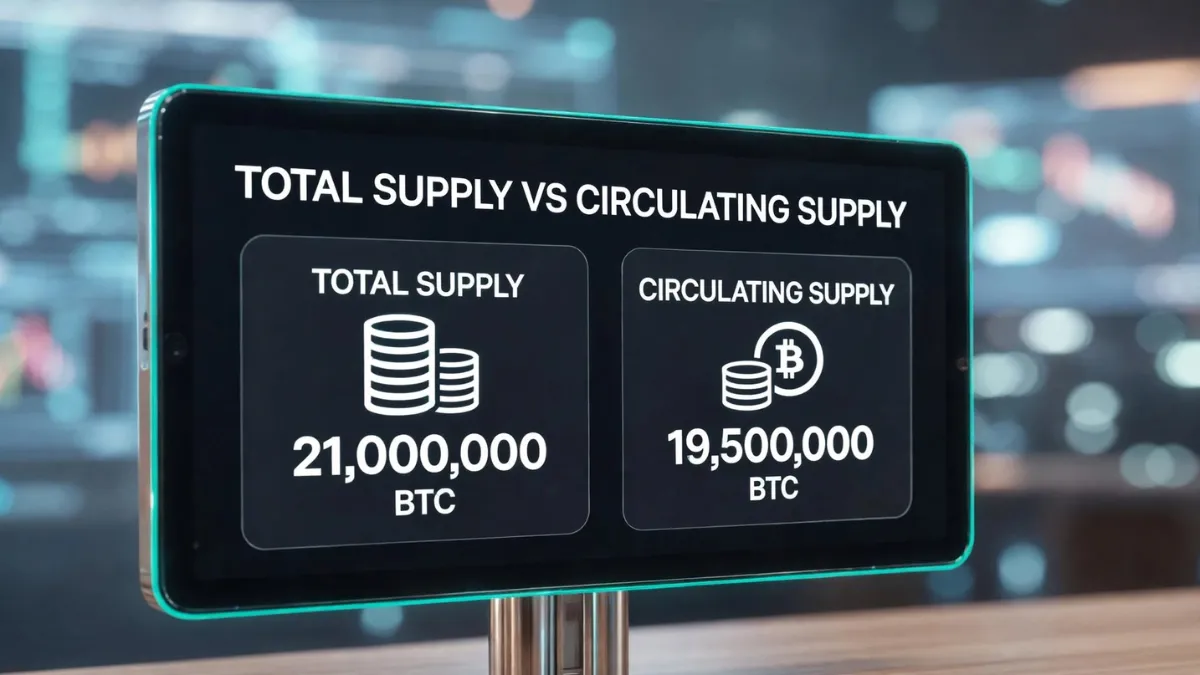
Circulating supply and total supply measure different things. Confusing them can make a cryptocurrency appear smaller or more scarce than it really is.
| Metric | What it means | Why it matters |
| Circulating supply | Tokens estimated to be available in the market | Helps calculate commonly reported market capitalization |
| Total supply | Tokens created, minus tokens burned or otherwise permanently removed, according to the provider’s methodology | Shows how much supply already exists, including some tokens that may not circulate |
| Maximum supply | The maximum number of tokens that can exist, if the protocol or token design defines a cap | Helps assess the potential long-term supply limit |
| Fully diluted supply | The supply assumption used to calculate fully diluted valuation | Helps estimate valuation if the assumed supply becomes available |
These figures are not always reported consistently across projects or data providers. Some tokens have no fixed maximum supply, and certain protocols can change their issuance rules.
Example: Why circulating supply matters
Imagine a cryptocurrency with the following figures:
- Token price: $2
- Circulating supply: 10 million tokens
- Total supply: 40 million tokens
- Maximum supply: 50 million tokens
Its circulating market capitalization would be:
$2 × 10 million = $20 million
But 40 million tokens already exist under the stated total-supply assumption. If the remaining supply becomes available over time, the number of tokens competing for market demand could increase.
That does not mean the price must fall. Demand may grow enough to absorb additional supply. However, the circulating market capitalization alone does not tell the full story.
What Is Fully Diluted Valuation (FDV)?
Fully diluted valuation, commonly abbreviated as FDV, estimates a cryptocurrency’s valuation using its current price and a defined fully diluted or maximum supply figure.
A common calculation is:
FDV = Current token price × Assumed fully diluted supply
Suppose a token trades at $2 and its assumed fully diluted supply is 50 million tokens.
Its FDV would be:
$2 × 50 million = $100 million
If only 10 million tokens circulate, the circulating market capitalization would be $20 million, while FDV would be $100 million.
That difference is important. The project may appear to have a relatively modest market capitalization while its FDV suggests a much larger valuation if the remaining supply enters circulation at the same price.
Is a high FDV bad?
Not automatically. FDV is a valuation reference, not a prediction of what the project will be worth in the future.
A high FDV compared with circulating market capitalization can indicate that a substantial amount of supply remains outside circulation. It can also reflect a market price based on expectations of future adoption.
The key question is whether future demand can justify the valuation as more tokens become available.
FDV also has limitations. Multiplying the current price by all assumed future tokens does not mean those tokens could actually be sold at that price. If a large number of tokens were offered for sale, the market price could change.
Some projects do not have a fixed maximum supply, so the FDV figure may depend on a provider’s chosen supply assumption.
What Are Token Unlocks?
Token unlocks occur when tokens that were previously restricted by vesting schedules or other conditions become transferable.
Projects may allocate tokens to founders, employees, early investors, ecosystem funds, community rewards, or development programs. Those allocations may be released gradually instead of all at once.
Unlocking tokens does not necessarily mean that holders will sell them. The tokens may be retained, staked, transferred, or used for other purposes. Nevertheless, unlocks can increase the amount of supply available to trade.
Why token unlocks matter
Imagine a project has 10 million tokens circulating and a token price of $2. Its circulating market capitalization is $20 million.
If another 2 million tokens unlock, the potential circulating supply could rise to 12 million, assuming all the unlocked tokens qualify as circulating under the relevant methodology.
At an unchanged $2 price, the implied market capitalization would be $24 million.
That is a mathematical illustration, not a forecast. The actual price may rise, fall, or remain stable depending on demand, selling behavior, liquidity, and market conditions.
Which unlocks deserve attention?
Pay particular attention to unlocks that are large relative to circulating supply or typical trading volume.
| Unlock characteristic | What to investigate |
| Large percentage of circulating supply | Whether new tradable supply could materially increase |
| Early investor allocation | Whether recipients may have incentives to realize gains |
| Team or founder allocation | Vesting conditions and remaining restrictions |
| Ecosystem or treasury allocation | How funds will be used and whether spending creates selling pressure |
| Frequent recurring unlocks | Whether supply growth may continue for an extended period |
| Thin trading liquidity | Whether relatively modest selling could move the price significantly |
An unlock calendar is useful, but it should be read alongside the token’s distribution, market depth, and demand. The date alone does not tell you what holders will do.
What Is Token Dilution?

Token dilution occurs when the supply of tokens increases, reducing the percentage of the total supply represented by an unchanged holding.
Suppose you own 1,000 tokens out of a circulating supply of 10,000. You hold 10% of that circulating supply.
If the circulating supply increases to 20,000 tokens and you still own 1,000, your share becomes 5%.
Your token balance has not changed, but your percentage ownership of circulating supply has declined.
This is not the same as stock dilution in every legal or economic sense. Cryptocurrency tokens can have different rights, governance structures, and uses. Still, the example illustrates why supply growth matters.
Dilution does not guarantee a price decline. If a project attracts stronger demand or creates greater utility, its overall market value may grow enough to offset the increase in supply. Investors should also consider secure storage options, such as choosing one of the best Bitcoin wallets, when managing their crypto assets.
How to Analyze Tokenomics Before Buying
Use the SUPPLY Checklist to evaluate a token’s economics before making a decision.
S — Supply today: Check circulating supply, total supply, and the provider’s definitions.
U — Unlock schedule: Identify major upcoming unlocks and recurring issuance.
P — People holding tokens: Review allocations to founders, early investors, the community, and treasury funds.
P — Price versus valuation: Compare circulating market capitalization with FDV, rather than judging a token by its unit price.
L — Long-term demand: Ask what creates a reason to use, hold, or purchase the token.
Y — Yield and new issuance: Determine whether staking rewards or other incentives create additional supply, and whether tokens are burned or permanently removed.
A token with transparent supply rules and broad distribution may still be a poor investment. This checklist is designed to expose questions worth investigating, not to produce a guaranteed buy signal.
Common Tokenomics Mistakes
Assuming a low-priced token is cheap
A token priced at $0.01 is not automatically more affordable in valuation terms than one priced at $100. The supply count makes a major difference.
Compare market capitalization, FDV, supply growth, and demand before concluding.
Ignoring FDV
A low circulating market capitalization may hide a much larger fully diluted valuation. Examine both metrics and understand how much supply remains outside circulation.
Treating every unlock as a sell-off
Unlocked tokens can be held or used instead of sold. The market impact depends on recipient behavior, liquidity, and demand.
Trusting the maximum-supply figure without checking it
Some tokens have a hard supply cap, while others have flexible or uncapped issuance. Protocol changes, burns, and differences in data methodology can also affect reported figures.
Assuming token burns guarantee price increases
Burning tokens can reduce supply, but its economic impact depends on the quantity removed, demand, and the rest of the token’s design. A burn announcement alone does not establish that a token is undervalued. Similarly, earning money through digital side hustles or comparing high-yield savings accounts shows why it is important to evaluate real value and potential returns rather than rely on promises alone.
Frequently Asked Questions
What is the difference between circulating supply and total supply?
Circulating supply estimates the tokens currently available in the market. Total supply generally measures tokens already created minus those permanently removed, according to the reporting methodology. Total supply may include tokens that are locked or otherwise unavailable for trading.
What is a good FDV-to-market-cap ratio?
There is no universally good ratio. A large gap can indicate substantial future supply relative to what currently circulates, but its significance depends on the release schedule, demand, token utility, and project valuation.
Do token unlocks make prices fall?
Not necessarily. Unlocks can increase available supply, but recipients may not sell. Price movements depend on market expectations, demand, liquidity, and how the unlock compares with normal trading activity.
Can a cryptocurrency have no maximum supply?
Yes. Some cryptocurrencies and tokens do not have a fixed maximum supply. Their issuance may instead follow ongoing protocol rules or governance decisions.
Does a token burn increase its price?
A burn reduces the relevant supply if the tokens are genuinely and permanently removed. However, price also depends on demand and market expectations, so a burn does not guarantee appreciation.
Where can I find tokenomics information?
Start with the project’s official documentation, token distribution disclosures, vesting schedule, and protocol rules. Compare those details with reputable market-data providers, and check when each source was last updated.
The Bottom Line
Tokenomics explains the supply mechanics behind a cryptocurrency’s market price. Circulating supply shows how much is available now, total supply helps describe how many tokens already exist, and FDV estimates valuation under a broader supply assumption. Token unlocks help reveal when restricted allocations may become transferable.
Together, these figures provide a more complete view than price alone. Before evaluating a token, calculate its circulating market capitalization, compare it with FDV, review the distribution and unlock schedule, and ask whether future demand can support the potential supply.
A token is not cheap simply because its price has several zeros after the decimal point. Understanding its economics is a better place to start.
Financial disclaimer:
This article is for educational purposes only and does not constitute individualized financial or investment advice. Cryptocurrency tokens can be highly volatile, and supply figures or valuation estimates may differ across data providers. Verify current project documentation and market data before making financial decisions.